The Tidö parties are taking the next step to criminalize participation in criminal gangs. A new offense is proposed carrying up to four years in prison, while those who lead the most serious criminal organizations could, in the most severe cases, be sentenced to life imprisonment. On Wednesday, the four parties also highlighted the sharp decrease in gun violence – and warned that a change in government could halt or roll back parts of the overhaul of criminal policy.
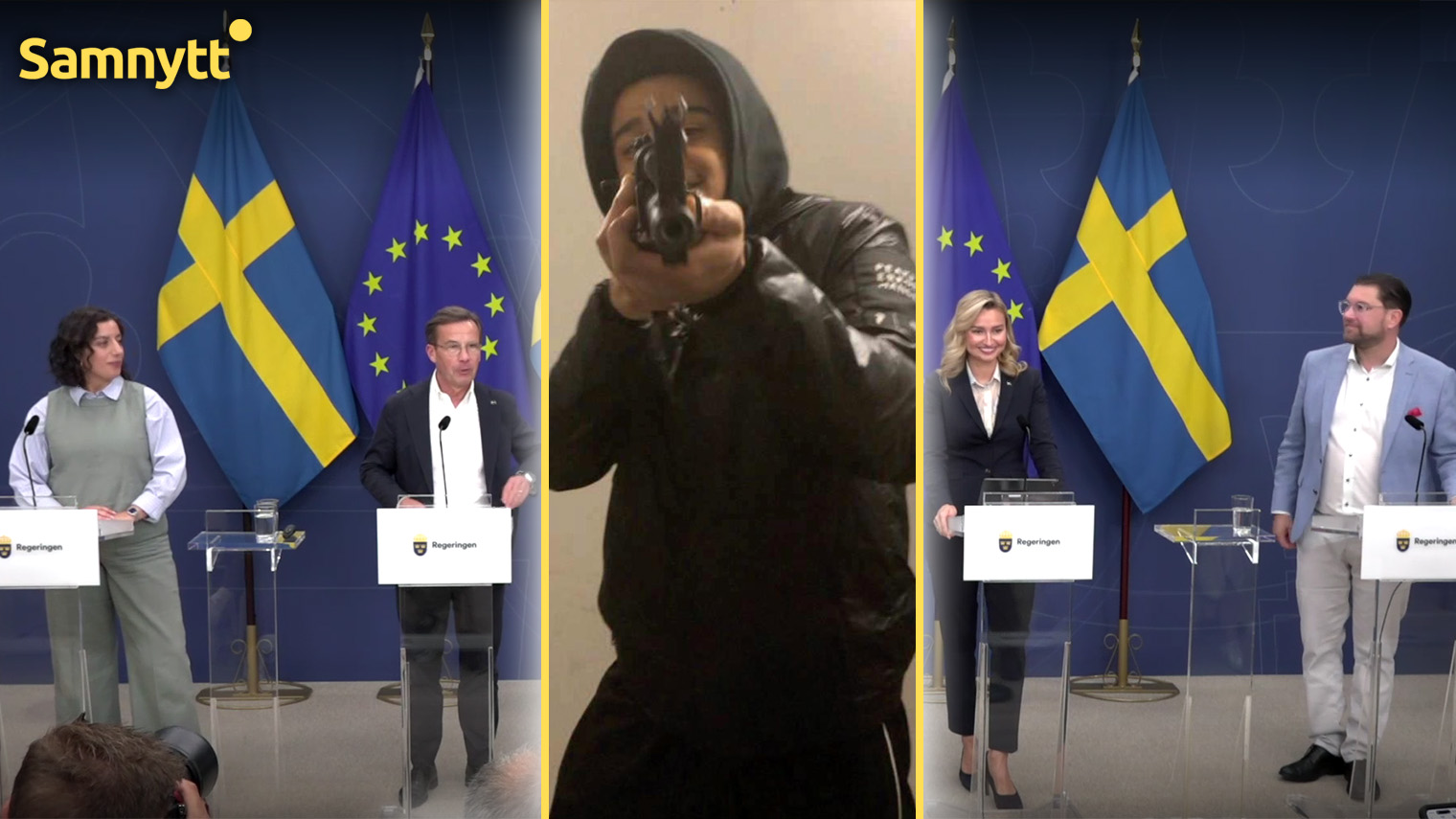
Prime Minister Ulf Kristersson (M), SD leader Jimmie Åkesson, Minister for Energy and Business Ebba Busch (KD), and Minister for Education and Integration Simona Mohamsson (L) gathered on Wednesday for a joint press conference regarding organized crime. The main news was that the government will decide on Thursday on a draft bill proposing that participation in criminal associations become a specific criminal offense.
The legislation requires a constitutional amendment, which has already passed the first of the two parliamentary votes needed. After the election, the newly elected parliament must make a second identical decision. If the Tidö parties remain in power, the plan is for the constitutional change to take effect on January 1, 2027, with the new offense applied from April 1 the same year.

“This is about making it a crime to be part of a criminal gang. Roughly in the same way as it is a crime to belong to a terrorist organization,” Kristersson said.
Kristersson: “Stay the course and persevere”
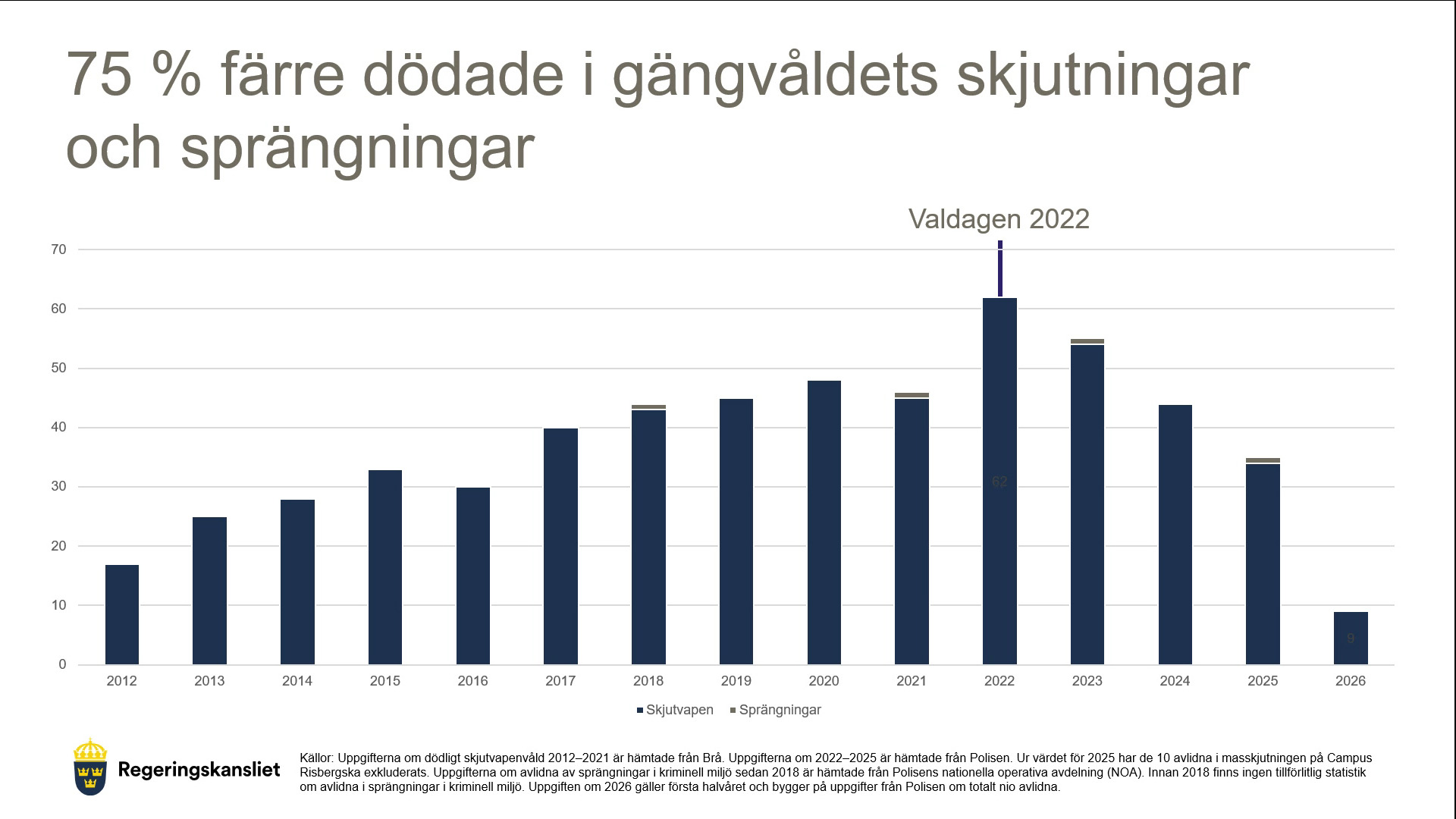
The Prime Minister dedicated much of his address to the developments in deadly gang violence. He described the decrease during the term as dramatic and emphasized that, in his view, no single measure is solely responsible.
Kristersson instead pointed to the combination of new legislation, changed police methods, preventive initiatives, and intensified international efforts to apprehend gang criminals abroad and extradite them to Sweden.
He compared the figures for August 2022 and August 2026. Four years ago, according to the statistics presented, there were 30 shootings registered in the month, with 14 injured and five dead. In August this year, the corresponding figures were two shootings, one injured, and none dead.
At the same time, Kristersson pointed out that the fight against gangs is not over. His previous assessment has been that it will take the entire decade of the 2020s to rectify the problem.
“We have made good progress. Now it’s about staying the course and persevering.”
He also emphasized that the constitutional amendment alone is not sufficient. A government is needed that will follow up with the regular legislation using the new constitutional space to criminalize gang participation.
Åkesson warns that reforms may disappear
Jimmie Åkesson (SD) described the development in a similar way. According to him, the situation is still serious but significantly better than four years ago. He attributed the improvements to a combination of law enforcement work and political policy changes.
Åkesson also devoted much of his speech to pointing towards the election and the opposition’s criminal policy. He noted that while the Social Democrats have supported many of the government’s reforms, they have opposed, among other things, security zones and the change to the so-called volume discount for repeat offenses.
He then listed measures that the Left Party and Green Party have opposed, including preventive stay-away orders, expanded camera surveillance, preventive secret coercive measures, double penalties for gang criminals, and youth prisons. He described the Centre Party’s position as more difficult to interpret.
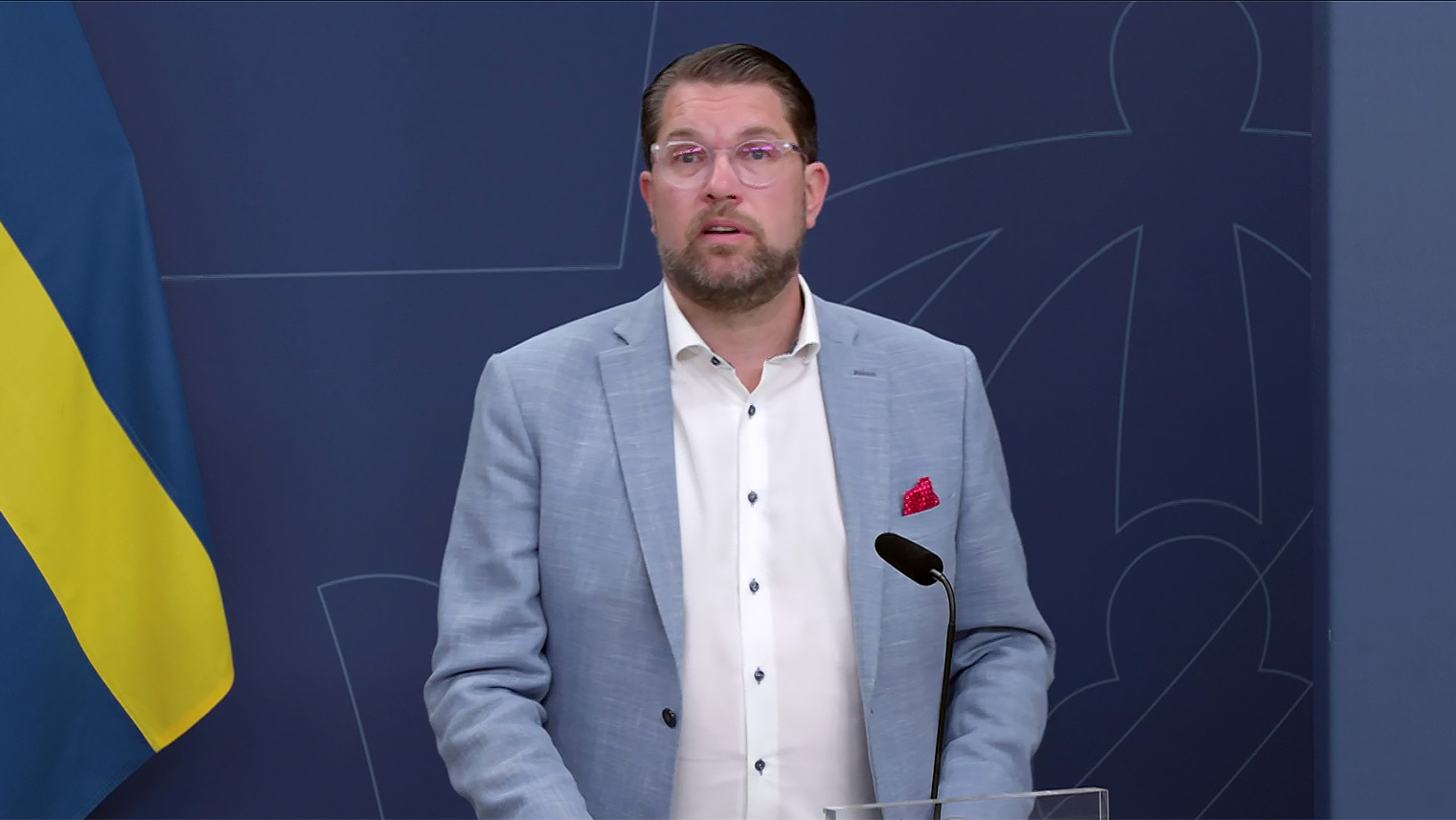
Åkesson especially pointed out that several of the crime-fighting measures introduced during this term are temporary and therefore need to be extended through new political decisions. According to him, a change of government would not only stop new reforms but could also mean that existing tools would cease to apply.
“We need four more years for this to become reality and so that we can also complete all those other important things we have done to address the serious problems we face,” Åkesson said.
Four years in prison for participation
Ebba Busch (KD) presented in more detail how the new criminalization is intended to work. In the bill to the Council on Legislation, a new offense is proposed for the Penal Code called participation in a criminal association.
This could cover, among other things, individuals who manage or control the organization, but also those who in various ways promote, strengthen, or support the organization’s criminal activity. For example, this could mean recruiting new members, handling weapons or money for the organization, or giving advice that significantly strengthens its criminal operations.
READ ALSO: New law aims to stop crimes against the welfare system
The penalty proposed is imprisonment for up to four years. A special offense, aggravated participation in a criminal association, will also be introduced with a sentencing range of two to eight years in prison.
In assessing the crime, factors considered will include whether the perpetrator had a central role in the organization, whether the action significantly strengthened the gang’s ability to commit crimes, or if the act was particularly dangerous in other ways. Busch pointed out that the aim is not only to target people at the bottom of the criminal hierarchy but also those who keep the organizations running and recruit new people – especially children – into crime.
“We are not just going after those lower down the ranks, but those who steer and ensure constant recruitment,” she said.
Life imprisonment for the most serious gang leaders
For people who lead criminal associations, even harsher penalties are proposed. The penalty scale should range from two years up to 18 years or, in particularly serious cases, life imprisonment.
Life imprisonment is contemplated when the organization led commits crimes that, in themselves, can lead to life imprisonment. Busch mentioned murder and kidnapping as examples.

She also emphasized that the outcome of the upcoming election will be decisive for whether the reform can be carried out. The constitutional amendment is pending, awaiting the second parliamentary decision after the election, after which the regular legislation can come into effect.
Busch simultaneously criticized the opposition and warned against what she called a “red-green roulette” on criminal policy. According to her, several crucial tools against gangs risk disappearing or never coming to fruition if the Tidö parties lose power.
Mohamsson: Gangs should be punished for organizing
Simona Mohamsson (L) emphasized that the purpose of the reform is to shift focus from only the individual crimes gang members commit to the very organization of the criminal associations themselves.
“Now we want criminals not only to be punished for the drugs, the weapons, the murders, but for the very basic element of their illegal activity, namely that they organize themselves in gangs.”
The proposal therefore also includes a definition of what is to be considered a criminal association. According to the presentation, it must be a group of at least three people engaged in criminal activity carrying a sentence of four years imprisonment or more, and where the purpose is to make money or attack the rule of law. This could, for example, involve serious violent crimes or attacks against witnesses.

The legislation is intended to target both gang leaders and others who enable the organizations’ activities. At the same time, the proposal contains exceptions for cases where otherwise criminal participation serves a legitimate rule-of-law function. Mohamsson mentioned, for example, police use of informants and lawyers and their assistants, whose work must be able to continue without being criminalized.
Secret coercive measures even against criminals under 15
The proposal also means that secret coercive measures can be used in investigations into the new offenses. A particularly far-reaching part is that such measures, according to the draft bill, could even be used when the suspect is under 15 and therefore not of criminal age.
The reform is part of the Tidö parties’ broader ambition to attack the underlying structure of organized crime, rather than only prosecuting individual gang members for specific drug, weapons, or violent crimes.
At the same time, Wednesday’s press conference was clearly a part of the election campaign. All four representatives highlighted the reduction in shootings as a result of the term’s policy changes and argued that the work requires four more years under the same political majority.
Kristersson summarized the government’s message by stating that the tide has turned, but the gangs are not yet defeated. Åkesson warned that temporary reforms could disappear with a change in government, while Busch and Mohamsson highlighted the new gang criminalization as the next step in their efforts.
If the Tidö parties’ plan is followed after the election, the constitutional amendment would enter into force at the end of the year and the new offense on April 1, 2027.
The full press conference can be viewed below.