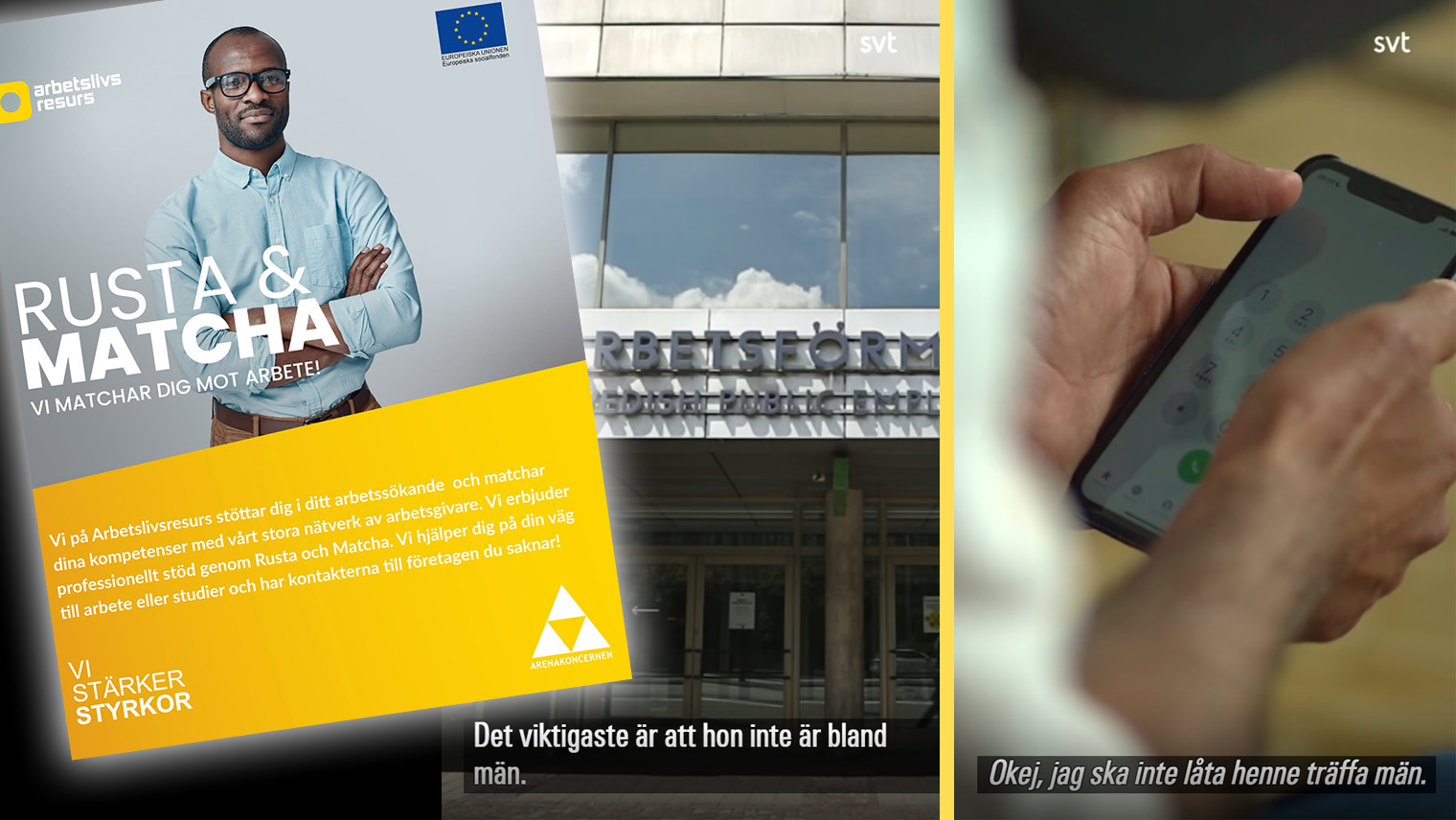
Private job coaches with Arabic immigrant backgrounds working on behalf of the Swedish Public Employment Service (Arbetsförmedlingen) are willing to help men with similar backgrounds who want to prevent their wives from working or meeting other men. In an SVT investigation, 33 out of 72 contacted offices accepted such demands. The Director General of Arbetsförmedlingen calls the findings “completely unacceptable.”
Each year, private companies receive billions of kronor from Arbetsförmedlingen to help the long-term unemployed find work or pursue studies. However, an investigation by SVT Nyheter Skåne and Uppdrag granskning shows that instead, job coaches with immigrant backgrounds may be prepared to participate in keeping women away from the labor market.
In covert recordings, a reporter poses as a newly arrived husband of a job-seeking woman. He explains in Arabic that he does not want his wife to work, partake in activities with men, or in some cases, even attend mandatory meetings.
At a significant proportion of the contacted offices, these demands are not met with objections. Instead, coaches, who share the same values and background, offer to adapt their services to accommodate the man’s wishes.
“You decide as you wish”
SVT conducted the test at 72 offices under the “Rusta och matcha” program, Arbetsförmedlingen’s initiative where private providers are tasked with guiding the unemployed towards jobs or education.
READ ALSO: Arbetsförmedlingen infiltrated by criminal networks
At 33 out of the 72 offices—nearly half—SVT found that staff were prepared to in some way comply with the man’s wish to limit his wife’s ability to work or socialize with men. At an office in Helsingborg, the reporter says he wants his wife to stay at home and avoid job seeking.
– I understand, I will help you. I understand you, brother, responds the job coach.
In another covert recording, the reporter explains that the wife herself wants to work, but he opposes this. The coach replies:
– I understand. I will help you.
Thereafter, the man is encouraged not to reveal the arrangement and hears:
– She is your wife. It is your family. You decide as you wish.
This viewpoint stands in direct conflict with the principle that women and men in Sweden have equal right to work, educate themselves, and make their own life choices.
Value conflicts enter public services
The investigation also raises broader questions about what happens when norms from environments with more patriarchal views on family and gender roles are brought into publicly funded institutions.
Sweden has long debated value differences between the majority population and sections of society with roots in countries where women’s status, the family’s role, and gender relations look very different. These differences, of course, do not apply to everyone with a certain national or cultural background, but they can have real consequences when notions of a man’s right to control women are accepted even by those representing Swedish public systems.
In several of the recorded conversations, coaches not only accept the man’s requirements but also show an understanding of his reasoning. In this way, an organization meant to bring people closer to the labor market risks instead perpetuating women’s economic and social dependence.
For Arbetsförmedlingen, the revelations raise questions not only about oversight of private providers but also about how the agency ensures that those carrying out the assignments actually work according to the fundamental principles of gender equality and individual independence that the activities presuppose.
More than half ready to break the rules
The problem within “Rusta och matcha” also turns out to be broader than just women’s right to work. SVT contacted a total of 100 offices and tested whether staff were prepared to help job seekers circumvent Arbetsförmedlingen’s rules without their compensation being affected.
READ ALSO: Inside accounts: Antisemitism and special treatment for immigrants at Arbetsförmedlingen
The reporters claimed, among other things, that they were working off the books, did not wish to attend mandatory meetings, or planned to travel abroad despite requirements to remain in Sweden. At 43 of the 100 offices, staff were reportedly willing to assist in some form of rule-breaking.
Including the test where the reporter posed as a controlling husband, a total of 54 out of the 100 offices were prepared to help with one or more of the requested actions.
Companies investigate
SVT has contacted the companies involved in the investigation. A majority say they take the revelations in the recordings very seriously, with several launching internal investigations.
At the same time, some companies object to how their actions have been described by SVT. Some claim statements were taken out of context or that the investigation draws unwarranted conclusions from the conversations. Several coaches also claim their real intention was to contact the woman in order to help her.
Arbetsförmedlingen reacted strongly to the material. Director General Maria Hemström Hemmingsson described what she saw as “horrible.”
– This is completely unacceptable. Completely unacceptable. In Sweden, women and men have the same rights and obligations, and no one has the right to limit women’s opportunities to participate in working life and support themselves.
The fact that this also occurs within an operation financed by taxpayer money makes it even more serious, according to the Director General.
Arbetsförmedlingen promises oversight
Arbetsförmedlingen states that the revelations will be followed up but does not want to elaborate on what checks may be implemented. According to Hemström Hemmingsson, control measures can lose their effectiveness if providers know in advance how they will be carried out. She also describes what has emerged as a challenge for the Swedish system’s high level of trust.
– We absolutely cannot accept things being this way. We need to work on this issue in many different ways. But this is a societal challenge and a challenge for the trust-based system we have in Sweden, where we rely on people and providers.
The investigation thus reveals a dual problem for Arbetsförmedlingen—on the one hand, providers willing to help job seekers bypass rules, and on the other hand, coaches willing to accept demands that women be restricted because their husbands do not want them to work or have contact with other men.
In both cases, the result is the opposite of what Rusta och matcha is intended to achieve—to bring people closer to the labor market and self-sufficiency.
Read all articles at Samnytt and Arbetsförmedlingen HERE.