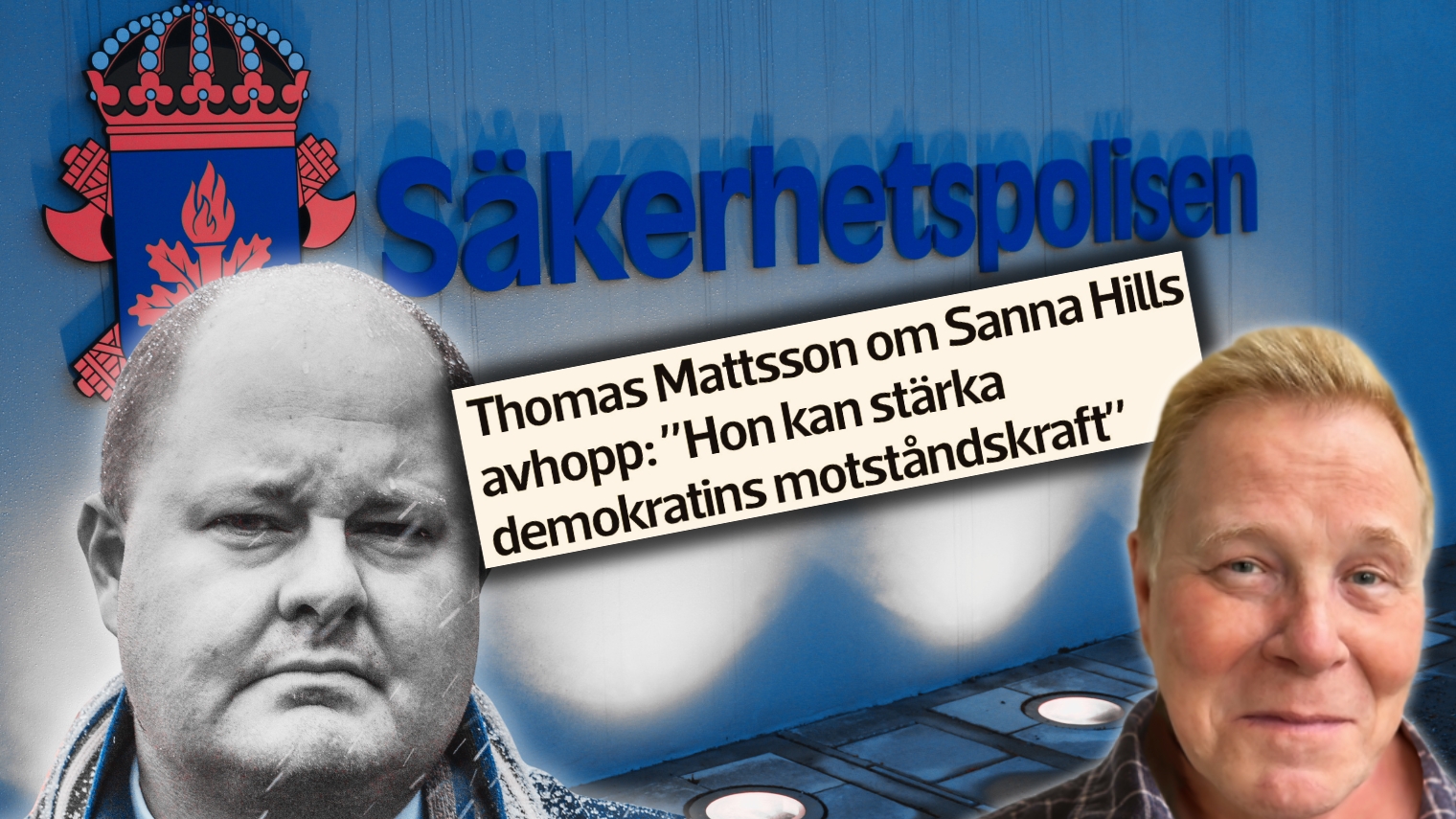
EDITORIAL • Expressen’s former editor-in-chief Thomas Mattsson wants to strengthen “democracy’s resilience” by having a former alternative media figure tell the Swedish Security Service (Säpo) which politicians have provided tips and content to the outlets he refers to as far-right and hate sites. This is a remarkable argument from a publisher who has himself often defended source protection. The constitutional protection also applies to people and media whom Thomas Mattsson dislikes.
There are principles that are easy to defend when they protect your own side. The real test comes when they protect your opponent. Thomas Mattsson, former editor-in-chief of Expressen and now a senior advisor at Bonnier News, seems to need reminding of this difference.
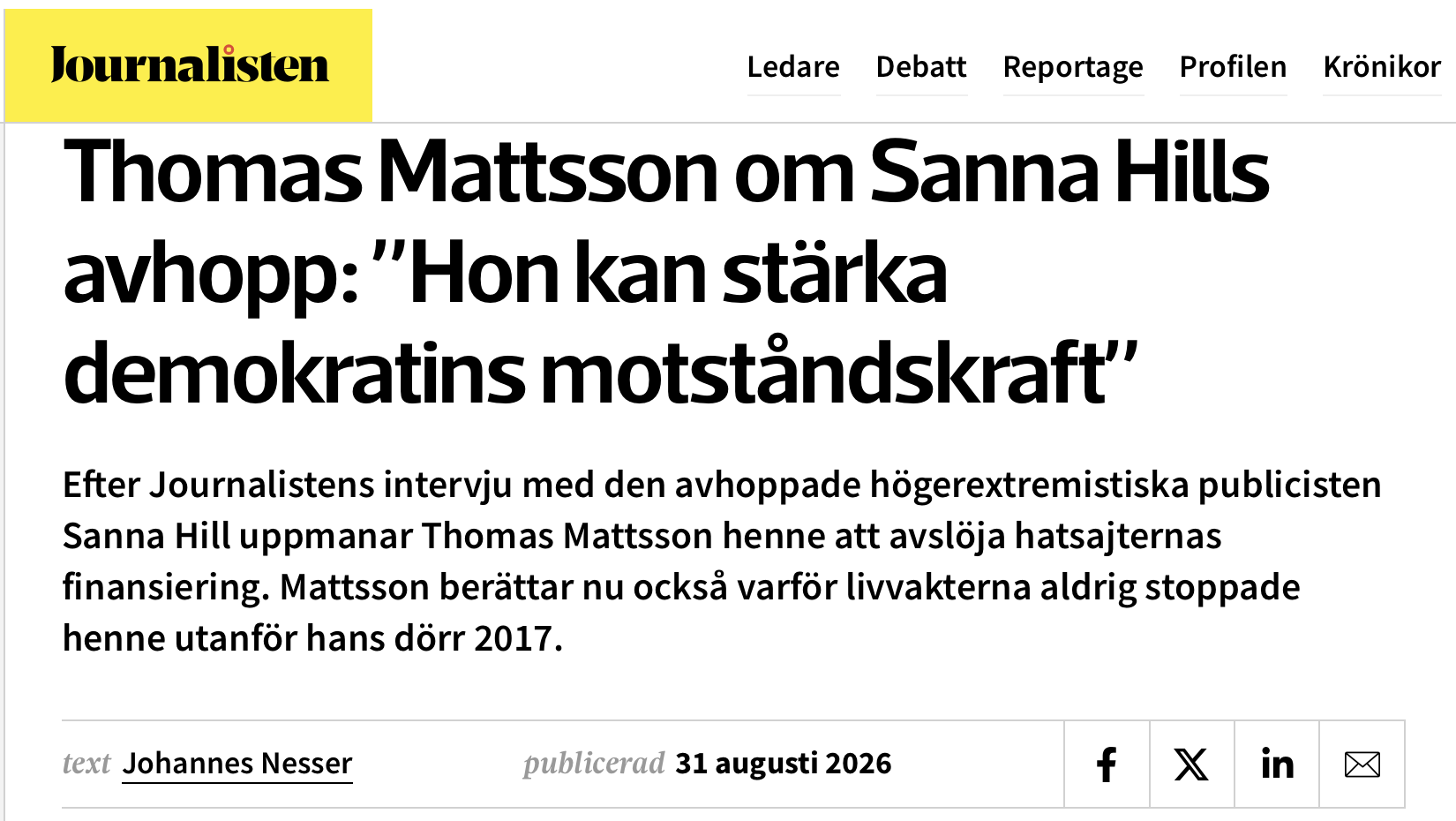
In an interview with the Journalist Union’s magazine Journalisten, he comments on how the former alternative media profile Sanna Hill has distanced herself from the environment she was involved in. According to Mattsson, Hill should share more information about what he describes as “the ecosystem that enabled the network of far-right sites.”
Then come the questions: “What did the financing look like? Who donated money to the sites they ran? Which elected politicians contributed tips or even content?” Here something remarkable happens. One of Sweden’s most experienced publishers suddenly seems to forget one of the fundamental principles of Swedish press freedom.
“That’s Not How It’s Done”
Which elected politicians have provided “tips or even content” to a newsroom is not necessarily information a former editor-in-chief is free to disclose. Freedom of expression expert Nils Funcke reacts strongly to Mattsson’s phrasing. Source protection gives informants the right to anonymity, he points out in an interview with Riks. That right can only be waived by the person who provided the information.
That Hill no longer works for Nya Tider changes nothing. “Source protection applies there as well,” Funcke notes. “She is not freed from the obligation just because she left.”
Actually revealing a protected source can be criminal. Funcke will not go so far as to say Mattsson is encouraging a crime. However, he repeatedly calls it “remarkable” that an experienced publisher would express himself in such a way. To sum up: “That’s not how it’s done.”
Nor does Journalisten, in the published interview, seem to have reacted to the issue, despite it being the Journalist Union’s paper from which high standards should be expected in this regard. No follow-up question on source protection is presented. Funcke also finds this noteworthy.
Two institutions at the heart of the Swedish media establishment thus pass over a question about revealing informants without the most obvious press-ethical warning light seeming to go off. These are not oversights or mistakes. It’s about a deliberate double standard—slipping principles for one’s own interests.
Source Protection Was “Still in Force”—Until Recently
When Riks later asks Mattsson about the matter, he “clarifies” himself. He of course has not encouraged breaking the constitution, he says. “Of course, source protection should be respected.” Hill should be able to provide relevant information “beyond source protection.”
But the question remains—why, then, did he ask which politicians “contributed tips or even content”? Tips to a newsroom are the very essence of what source protection is designed to safeguard.
ALSO READ: Thomas Mattsson Attacks Samnytt: “Undignified”
And Mattsson can hardly plead ignorance. In 2021, he wrote together with legal expert Per Hultengård: “We have exceptionally strong protection for press and freedom of expression, especially for informants and tipsters. And we should uphold that.” And: “Source protection still applies.”
The question is whether this “still” needs an asterisk. Does it apply also when the informant’s tips go to a paper Thomas Mattsson dislikes and calls far-right? The answer can only be yes.
Who Gets to Belong to Democracy?
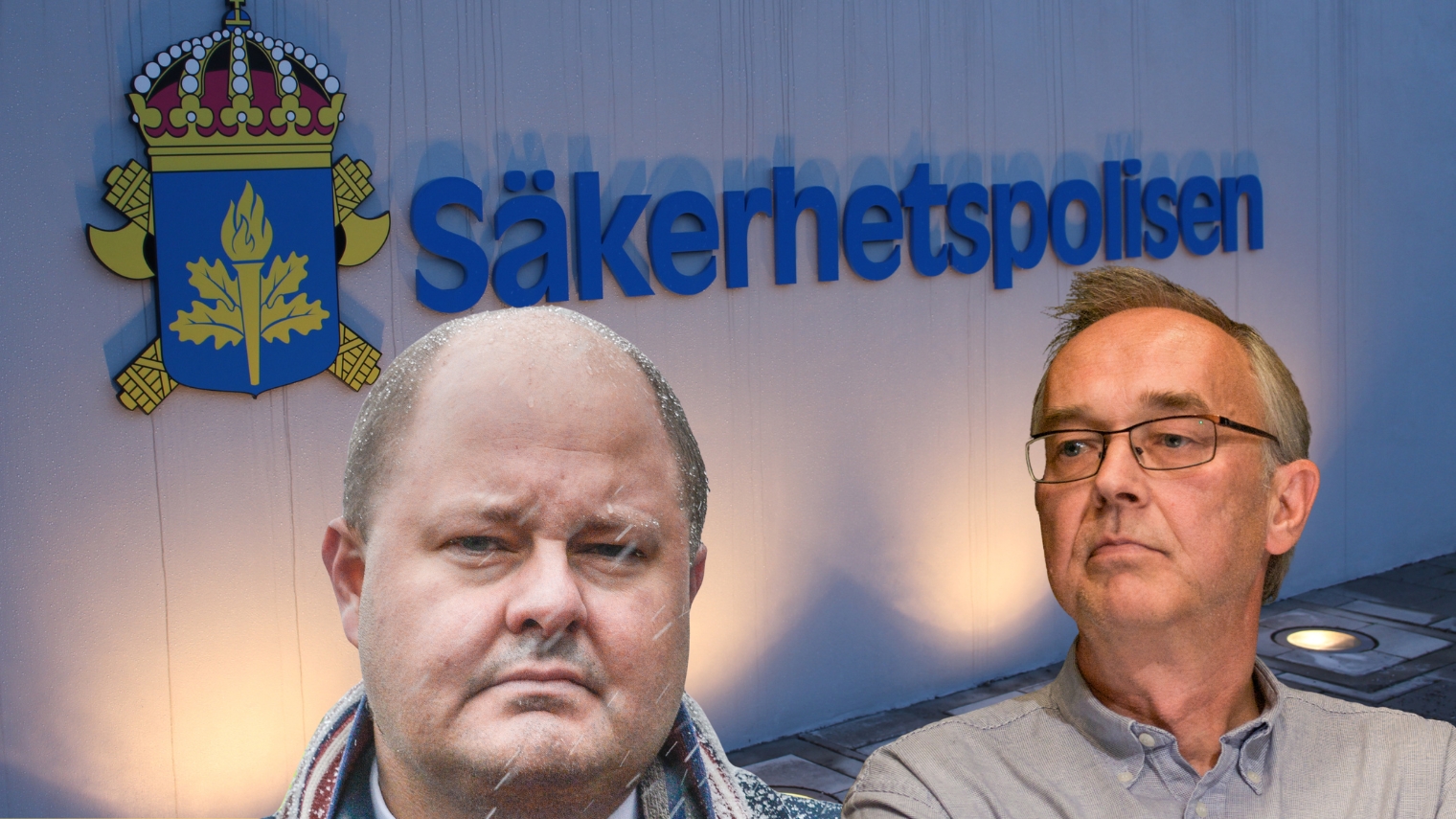
Mattsson says that by telling more, Hill can help strengthen “the resilience of Swedish democratic society.” He wants to know which people and organizations have been behind the relevant media and notes that even the Security Service might be interested.
This is an odd way to reason about legal Swedish media. One doesn’t have to like Nya Tider. The paper can be as unsympathetic, tendentious, or politically extreme as Thomas Mattsson wants to consider it. That does not change source protection in the slightest.
Nya Tider has for many years openly operated as a newspaper, had an editor-in-chief and received state press and media subsidies. Its editorial work has been carried out within the broad boundaries set by Swedish freedom of the press and expression.
That’s why it is unsettling when a prominent publisher begins talking about mapping financiers, political contacts, and informants as a way to strengthen “democracy’s resilience.” That resilience does not consist in the right people having the right opinions. It consists, among other things, in people being allowed to have ‘wrong’ opinions—and in the same constitution protecting them.
The “Hate Sites” That Filled a Void
There is also a significant historical irony in Mattsson’s description of these outlets as “hate sites.” For he admits himself why they could grow. “The legacy media did not write enough about immigration earlier,” Mattsson says. According to him, this contributed to the growth of alternative media.
For many years, there was a gap between voters’ concern over migration policy and the traditional media’s reporting on its consequences. Alternative outlets filled that gap by writing about costs, segregation, crime, Islamism, unemployment, and welfare dependency—questions many readers felt the big newsrooms treated cautiously, late, or not at all.
They did so from a clearly migration-critical perspective. Sometimes well, sometimes poorly, sometimes highly slanted. But the perspective did not make the work non-journalistic. Investigative journalism has an edge. Opinion journalism has a viewpoint.
The odd thing is the notion that a migration-critical approach would disqualify journalism, while left-liberal perspectives can pass as the professional norm. In Mattsson’s world, you are a ‘real’ journalist only if you have the “right” views, the “right” political motivation for your writing.
Silence Us.
– and reports straight, without political correctness filter.
Support Samnytt – Become a Subscriber
123 083 33 50
When Agenda-Driven Journalism Is Praised
Traditional media have hardly been bastions of value-neutral news delivery. Selection, headlines, which questions are asked, and how much space events are given massively affect the public’s sense of reality long before any leader writer expresses an opinion.
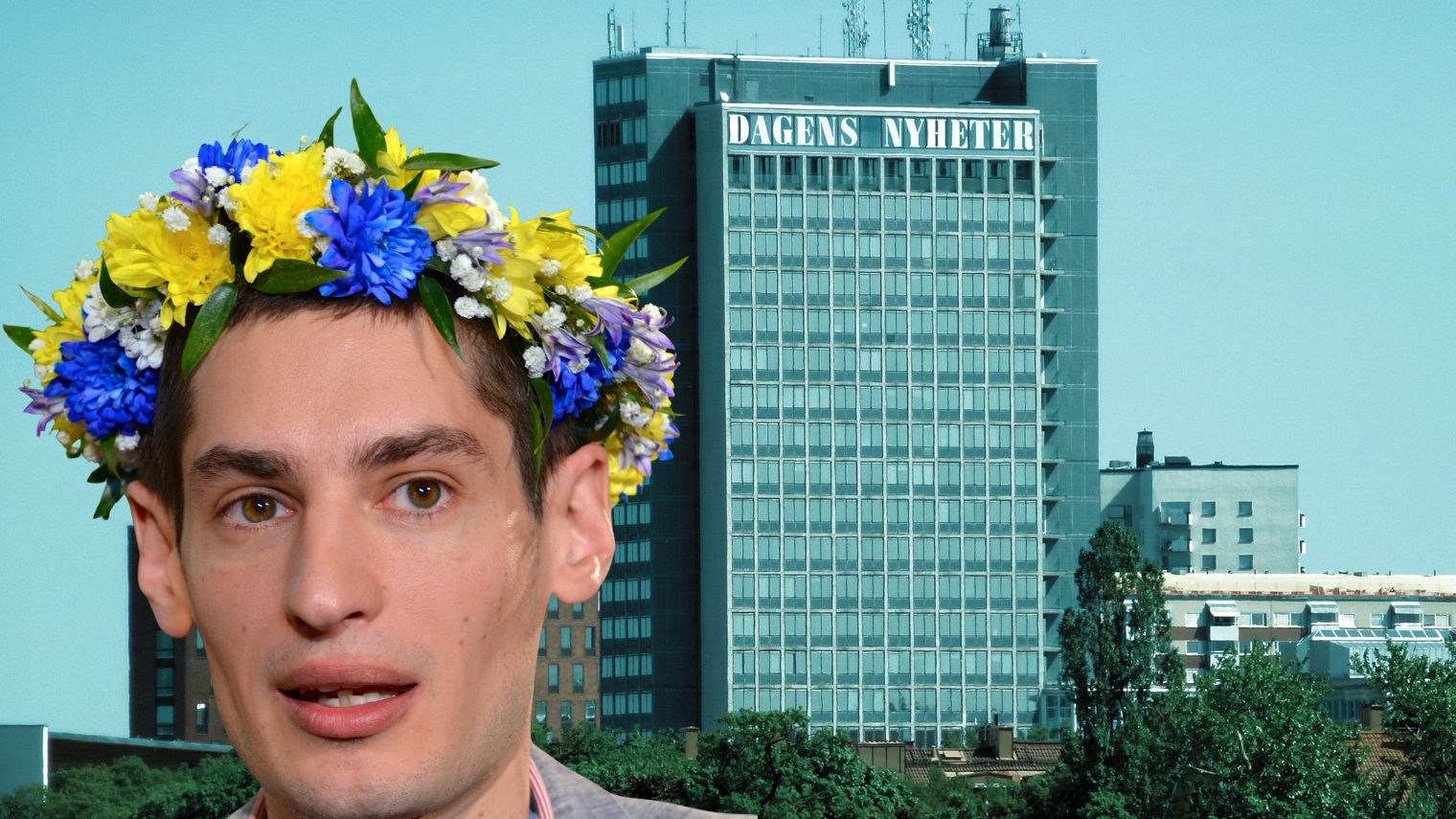
Dagens Nyheter’s editor-in-chief Peter Wolodarski has even made a point out of “agenda-setting” journalism. Apparently, having an agenda is not a problem. The problem seems to be having the ‘wrong’ agenda.
When journalism is conducted from a left-liberal viewpoint, it is described as agenda-setting, investigative, and civically engaged. When from a social-conservative or migration-critical viewpoint, comparable work is readily called “propaganda,” “activism,” and “hate.” It is a convenient division. On principled journalistic grounds, it is harder to justify.
When the “Wrong” Journalist Knocks
The double standard becomes particularly clear when Journalisten brings up how Hill and the now-deceased media figure Bechir Rabani in 2017 visited Mattsson’s residence. Mattsson did not open. Hill has now apologized and the home visit is portrayed as an example of alternative media harassing journalists.
One may find it inappropriate. The problem is that home visits were hardly invented by alternative media. Swedish journalists have long sought people at home, waited outside residences, and sought confrontations with people reluctant to speak to them.
When journalists once visited then Minister of Justice Laila Freivalds at home, she was livid: “You are intruding in my home, standing outside my door, violating my family. This is degrading. Especially for you, and you, and you. You should be ashamed.” Yet, the method was considered journalism.
When “shotgun” reporters like Christian Peterson and Nick Alinia today use confrontational methods, however, the method itself is used as an argument that their work isn’t journalism. The difference appears to lie less in what the reporter does than in who the reporter is, and what he or she wants to scrutinize or expose.
Orrenius Himself Stood Outside Julia Caesar’s Door
There is an almost unbelievable irony in the home visit story. The DN journalist whom Hill first chose to tell about her “defection” was Niklas Orrenius. It was the same Orrenius who in 2015 called on the then-anonymous migration-critical writer Julia Caesar at her home.
Caesar, already an elderly and ill woman with a long background in journalism, including at Dagens Nyheter, had become a thorn in the side of the media establishment through books and articles sharply critical of migration policy and media’s coverage of it.
Caesar herself, as well as then Gothenburg-Posten editorial writer Marika Formgren, described how Orrenius stood outside Caesar’s home calling for her while an accompanying photographer looked in through the window. Caesar found the visit deeply uncomfortable. Formgren considered the incident so serious that she called for a boycott of DN.
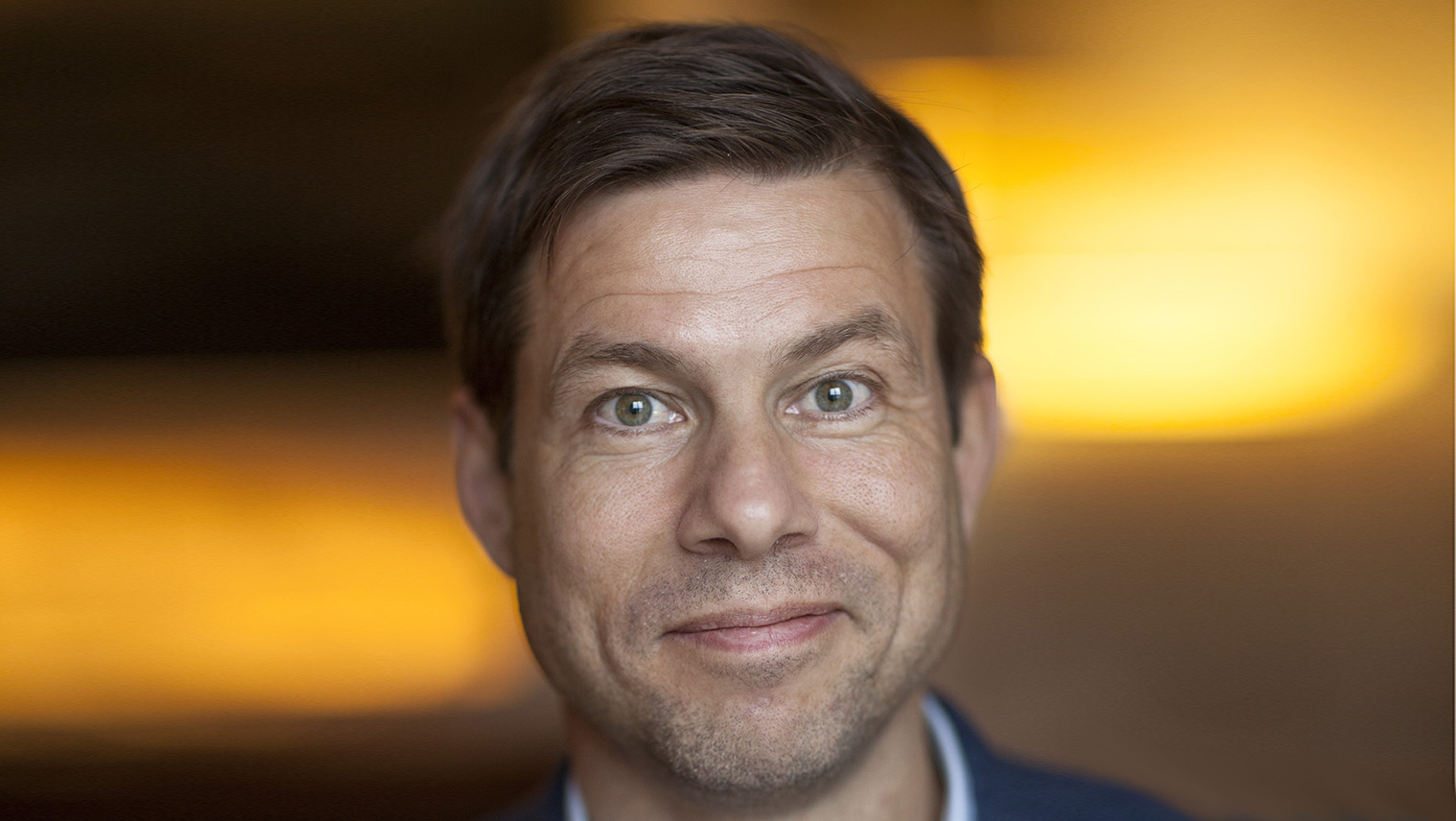
Orrenius did not believe he had crossed a journalistic line. When his actions attracted hard criticism, the story soon shifted to focus on threats he claimed to have received afterwards.
Threats against journalists are of course never acceptable. But that does not change the question—why is an intrusive home visit considered legitimate scrutiny when DN does it—but a democratic problem when a journalist from alternative media does something similar?
Expressen’s Own Pillory
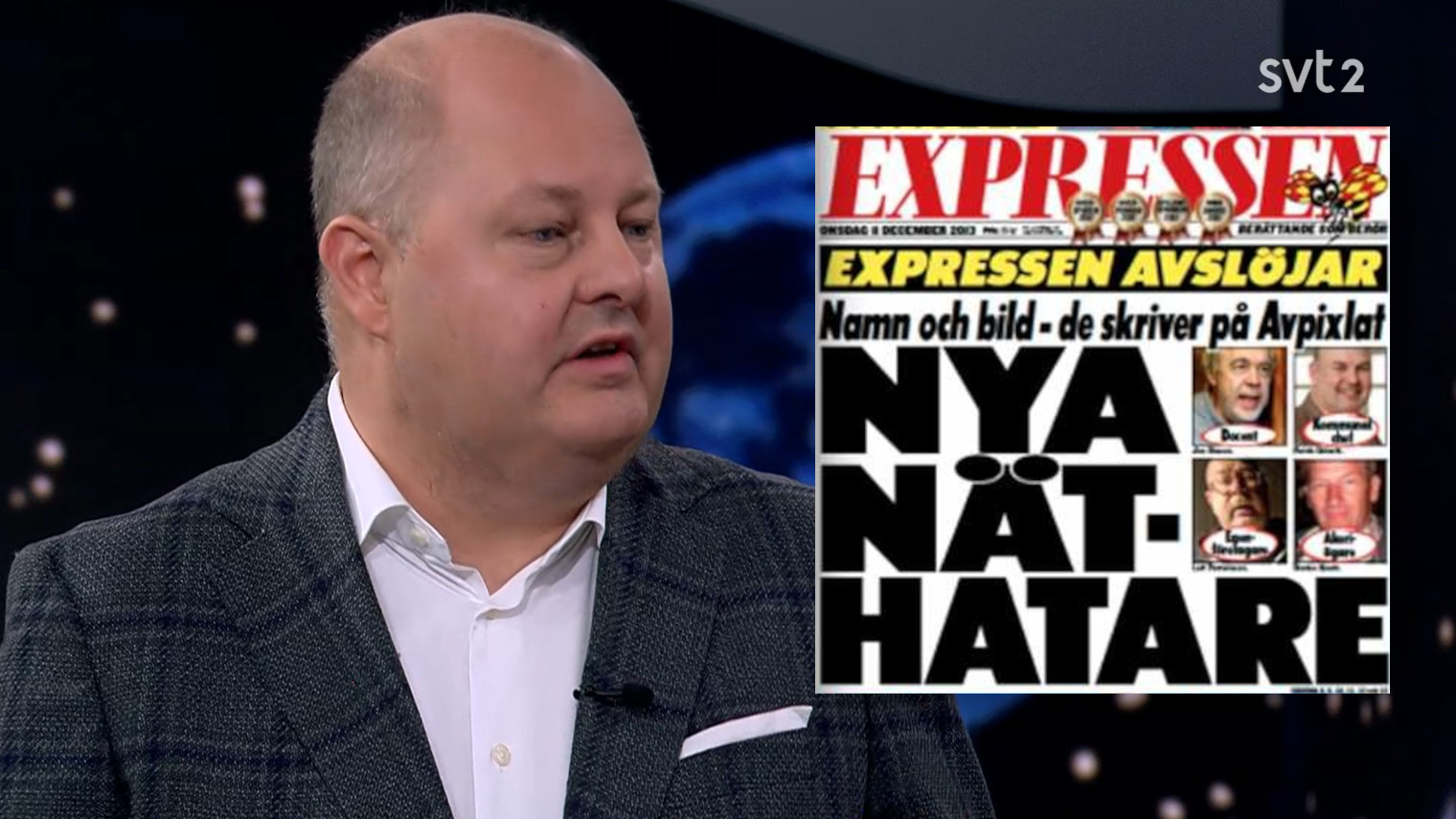
Thomas Mattsson need not just look to Dagens Nyheter for examples. During his time as editor-in-chief, Expressen—together with Researchgruppen—conducted a widely discussed hunt for people who had written anonymous comments online.
One of them was private individual Jim Olsson. Expressen visited him, filmed him at home, and published his name and photograph. His “offense” was to have posted migration-critical comments anonymously online.
Things were even worse when statements he had not made were attributed to him. Olsson later tried to attain legal redress but failed. The power imbalance could hardly be clearer—a private individual versus one of Sweden’s largest media groups.
Thomas Mattsson at the time called this investigative journalism. Today, the same Mattsson refers to alternative media reporters’ confrontational methods as a democratic problem. Where lies the principled distinction?
When Journalism Crosses the Law
Mattsson’s Expressen even literally crossed the line of the law in pursuit of a report. The newspaper bought a gun from the criminal gang milieu to demonstrate how easy it was to acquire illegal weapons. The intention was journalistic.
The firearms law made no such exception. Mattsson was convicted for firearms offenses. The episode illustrates a self-image often cultivated within major media—that their own mission is so important that far-reaching methods can be justified when used in journalism’s service. That’s a difficult attitude to reconcile with today’s outrage over other journalists’ confrontational methods—even when those are not criminal, but entirely legal.
Journalism Has No “License” on Opinions
There is no need to romanticize alternative media. A fair amount of poor journalism, slanted articles and exaggerations have been published there—just as in traditional media. But in general, they have been necessary and filled a void in the media landscape that should not exist in a democratic society.
The traditional media—or the hegemonically left-liberal media establishment, as they more properly should be called—long had a monopoly on determining what counted as respectable journalism. The internet broke that monopoly.
ALSO READ: The World Is Upside Down When a Former Expressen Chief Pretends to Defend Freedom of Expression
Smaller newsrooms could suddenly report on things the major newspapers ignored, choose different angles, and challenge the political and media consensus that had long surrounded, above all, migration policy. That did not automatically make them better than the old media. But more perspectives are not a democratic problem. They are the very point of a free press.
That is why it is so problematic when a former editor-in-chief of one of Sweden’s largest newspapers divides the media world into journalistic outlets on one side and “hate sites” on the other—then argues that the financing, political contacts, and tipsters of that latter group should be exposed to strengthen democracy. That’s exactly backwards.
Democracy Is Tested by Those We Dislike
Sweden is rightly proud of its press freedom tradition. But it is worthless as a ceremonial platitude if it is not applied when it’s difficult. Freedom of expression is not primarily for what everyone finds agreeable. Press freedom is not just for Bonnier.
And source protection is not just for the whistleblower who calls Dagens Nyheter, Expressen, or SVT. It also applies to those who contact a small migration-critical newspaper. It also applies to politicians who tip off a newsroom that Thomas Mattsson loathes.
This is what constitutes democracy’s resilience. Not sorting news outlets and journalists into “approved” and “unapproved” based on political stance. Not viewing left-liberal, agenda-driven journalism as beneficial to society while portraying social-conservative, agenda-driven journalism as a threat.
And certainly not beginning to erode source protection just because one wants to know who has spoken to the “wrong” newsroom. Press freedom that only applies to the ideologically approved is no press freedom at all. Source protection that is only sacred when the informant tips the “right” paper is no source protection.
And a democracy in which Thomas Mattsson gets to decide which legal media count as part of democracy needs far greater resilience than could ever be found in Sanna Hill’s address book.
Silence Us.
– and reports straight, without political correctness filter.
Support Samnytt – Become a Subscriber
123 083 33 50