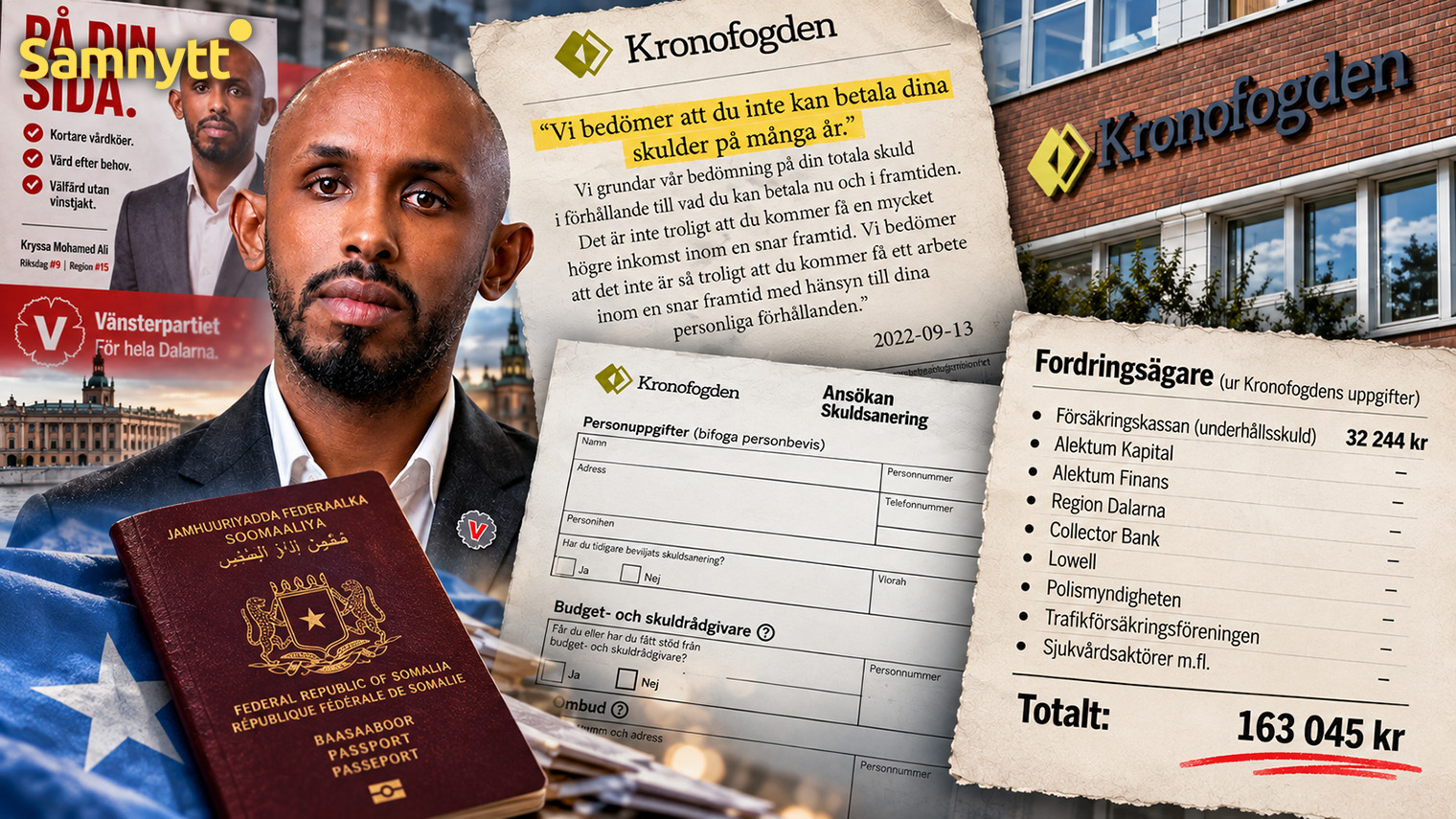
When Mohamed Abdukardir Ali was granted debt restructuring, the Swedish Enforcement Authority (Kronofogden) assessed that he could not pay anything on his debts and that the prospects for work and significantly higher income were small. Four years later, he has been elected to the Riksdag for the Left Party, where the base salary is 81,400 kronor a month. He is now under investigation for election fraud, but in parallel, the question arises as to what happens to his debt restructuring if his financial situation changes.
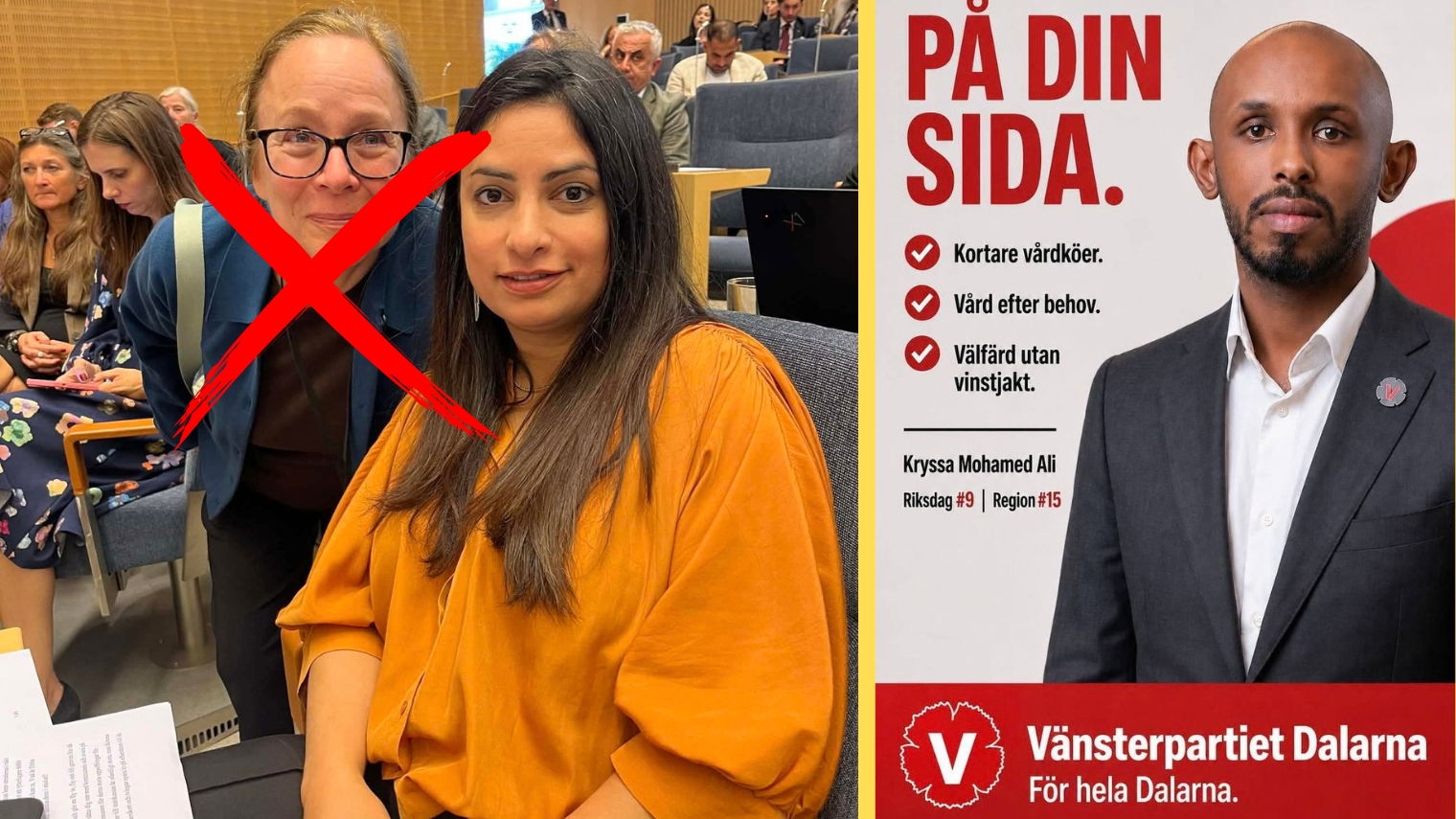
Mohamed Abdukardir Ali has in a short time gone from being virtually unknown even within his own party to one of the most talked-about names after the parliamentary election. The Left Party candidate leapfrogged the party’s top name in Dalarna, climate policy spokesperson Kajsa Fredholm, and took a parliamentary seat after receiving 648 personal votes.
The circumstances surrounding the personal votes are now being investigated as suspected undue influence in voting. No individual has so far been officially notified of suspicion of a crime, and Ali himself has denied any involvement.
The Left Party has since announced that Ali is taking a ‘time out’ and, for the time being, will not serve in the Riksdag while the investigation is ongoing. However, as of Wednesday, no request to leave the parliamentary position had been submitted. According to reports, Ali does not wish to relinquish his seat either.
Assessed as Having No Payment Capacity
In parallel with the events surrounding the parliamentary seat, another issue arises—the ongoing debt restructuring for Ali. On September 13, 2022, the Enforcement Authority granted him debt restructuring. At the time, Ali had debts totaling 163,045 kronor to about 40 creditors and was assessed as having zero payment capacity.
The payment plan was therefore set at zero kronor—he would not have to pay anything to the creditors during the debt restructuring. In the Enforcement Authority’s justification, it states among other things:
“We assess that you will not be able to pay your debts for many years. We base our assessment on your total debt relative to what you can pay now and in the future. We have taken into account all known circumstances that affect your ability to pay.”
READ ALSO: SVT intervenes in election fraud scandal: Concerned about the image of Somalis
The authority, among other things, considered Ali’s education and work experience. The projection for his future earnings was low:
“It is not likely that you will have a much higher income in the near future. We assess that it is not very likely you will get a job in the near future, considering your personal circumstances.”
Four years later, however, the economic conditions may look completely different. A regular member of parliament receives a base salary of 81,400 kronor a month. Exactly what Ali’s “time out” will mean financially is still unclear. He has not resigned from his parliamentary seat and, as of Wednesday, also had not formally applied for leave.
Moreover, Borlänge Tidning has reported that Ali has been offered a position at the Left Party’s parliamentary office with the same monthly salary, 81,400 kronor, should he give up his seat in parliament. The Left Party has neither confirmed nor denied these reports.
Regardless of which of these options becomes relevant, the question arises as to what happens to a debt restructuring based on non-existent payment capacity if the debtor’s income suddenly increases significantly.
Enforcement Authority on Changed Financial Situation
Samnytt contacted the Enforcement Authority and asked how the authority handles such a change.
If a person has debt restructuring and gains a significantly greater capacity to pay – does the Enforcement Authority then reconsider the decision?
– Of course, that’s not something we reconsider unless the creditors file for reconsideration for some reason or the applicant himself wants a reconsideration. And even then, it’s not really about whether one is granted debt restructuring or not, but rather about the payment plan—whether, at that time, one had the ability to pay anything on their debts.
The case officer explains that it is normally the creditors who monitor if the debtor’s financial situation changes.
When Ali received debt restructuring, his payment plan was set to zero because he lacked ability to pay. Is that correct?
– Yes, exactly. That is how it was in the payment plan.
If he now were to have an income of over 81,000 kronor per month, could that lead to a new assessment of his capacity to pay?
– If you have debt restructuring and changes occur, then you yourself above all should submit a reconsideration application if you have a higher payment capacity than stated in the previous decision.
The case officer adds that creditors can also request a reconsideration, and that the consequences may be more severe if the initiative comes from them.
– If the creditors submit a reconsideration application when you yourself do not, then the risk is greater that you simply lose your debt restructuring.
The Enforcement Authority’s information on its website also shows that payment capacity is central to debt restructuring. In the assessment, among other things, current and future income, age, education, and unemployment are considered.
No Automatic Check
There is, according to the case officer Samnytt spoke to, no automatic reconsideration of Ali’s payment plan as a result of him being elected to parliament.
Does the indebted person have an obligation to notify the Enforcement Authority when their income changes, like those who receive certain benefits must notify of changed economic circumstances?
– No, there hasn’t been such an obligation, as we do not make any deductions; usually, it’s the creditors who submit a reconsideration application.
The case officer, however, notes that it can be risky for the debtor not to act on their own.
– If he has not already done so, then there is a risk that he could lose it.
When asked if the Enforcement Authority itself can act when it becomes aware of significantly changed financial circumstances, the case officer cannot provide a definite answer and refers the conversation to the debt restructuring department.
Promised to Get Back – Did Not Get Back
Another officer at the Enforcement Authority’s debt restructuring department was then asked questions about what obligations apply when the ability to pay changes and whether the Authority itself can act.
If the payment plan is based on the person completely lacking payment capacity and the income thereafter increases sharply—must the person themselves report the change, or does the initiative lie with the creditors?
– I’ll note down your questions, and I think we will get back to you with answers.
At the same time, Samnytt requested Ali’s debt restructuring application and the Enforcement Authority’s full decision from 2022.
– I’ve noted it down, and we’ll get back to you with answers, said the case officer.
At the time of writing, the authority has not responded either by phone with the promised answers or by email with the requested documents.
40 Debt Items
Another officer at the Enforcement Authority has stated that Ali’s debts at the time of the debt restructuring totaled 163,045 kronor. The information is also supported by documents from the Enforcement Authority that later became public and show around 40 debt items totaling the same amount.
Among the creditors listed by the officer are the Swedish Social Insurance Agency, CSN (student loans), Alektum Kapital, Alektum Finans, Region Dalarna, Collector Bank, Lowell, the Police Authority, the Swedish Motor Insurers, and several healthcare providers. The largest single item noted by the officer was a debt to the Social Insurance Agency.
– Social Insurance Agency, maintenance debt 32,244, said the officer.
And the total debt?
– In total, we have 163,045.
Debt restructuring normally runs for five years. The Enforcement Authority generally states that a person can get a payment plan where they pay nothing at all if there is no capacity to pay. How much the creditors eventually get is governed by the debtor’s ability to pay.
For Mohamed Abdukardir Ali, this means that the debt restructuring is still ongoing while his financial circumstances may be about to change radically compared to those that formed the basis for the Enforcement Authority’s decision in 2022.
If he takes office and receives the parliamentary salary—or obtains any other income at a corresponding level—the question is raised, which the Enforcement Authority has not yet fully answered for Samnytt: how and on whose initiative his zero payment plan would then be reconsidered.
investigations?
Do you appreciate Samnytt? Show it through a subscription or donation.
DONATE VIA SWISH
123 083 33 50