On average, Sweden has historically granted 3,000–5,000 new citizenships to immigrants every month for decades. But after pressure from the Sweden Democrats (SD) within the Tidö cooperation, the rules were tightened this summer, and now this has had a major effect for the second month in a row.
Historically, the figure has been around 5,000 per month, but it plummeted in April this year, then rose again, and after that has fallen to record lows.
Granted Swedish citizenships per month
November 2022 – July 2026
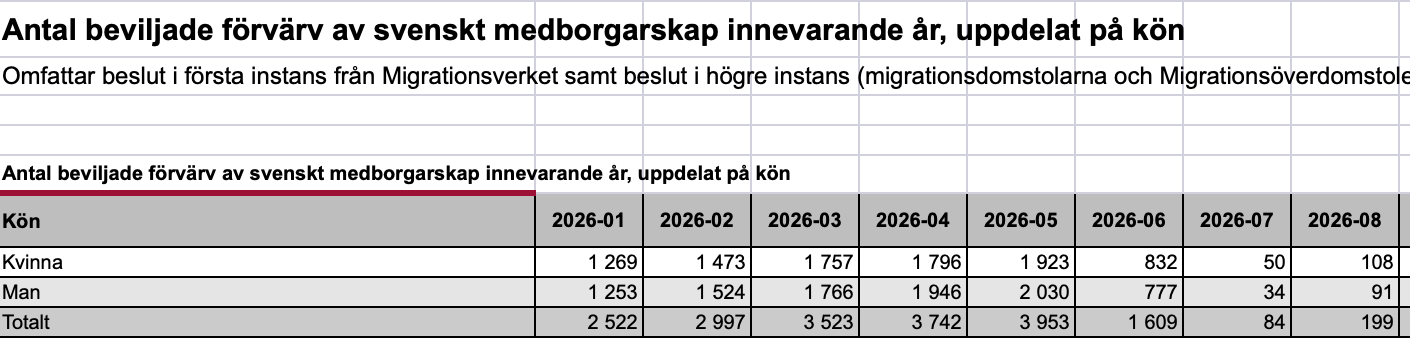
Now the statistics for the month of August have been released and the trend seems to continue. In July, only 98 citizenships were granted. However, this figure appears even lower in August’s statistics – 84 people. It is unclear why the two figures differ.
In August, it was still close to that number; only 199 citizenships were granted: 108 women and 91 men.
The statistics show that out of the total 18,629 citizenships distributed so far this year, 9,977 went to the Middle East, Africa, Central and South Asia. Europe, North America, East/Southeast Asia and Oceania received 7,650, and Latin America/Caribbean: 347. Stateless/unknown/under investigation amount to 562 and the remaining balance.
READ ALSO: Large majority of Swedes want to revoke immigrants' citizenship
During the parliamentary term, Jimmie Åkesson also demanded a total stop for Swedish citizenships. He claimed that Sweden had pursued a "completely crazy policy" conducted by previous governments with their naive migration and integration policies over the years, the consequences of which Sweden is still forced to bear.
In his op-ed, Åkesson argued that the granting of Swedish citizenships largely goes to “individuals from deeply dysfunctional countries where entirely different values usually prevail, compared to those that characterize our Swedish culture.” He stated that, “A year ago [in 2023], the issue of a moratorium was one of our proposals in the annual renegotiation of the Tidö Agreement. At that time, it received absolutely no support from any of the government parties.”
After the expected shift of power in parliament, with the left-wing parties promising a more liberal immigration policy, there is now a risk that the positive trend will be broken.