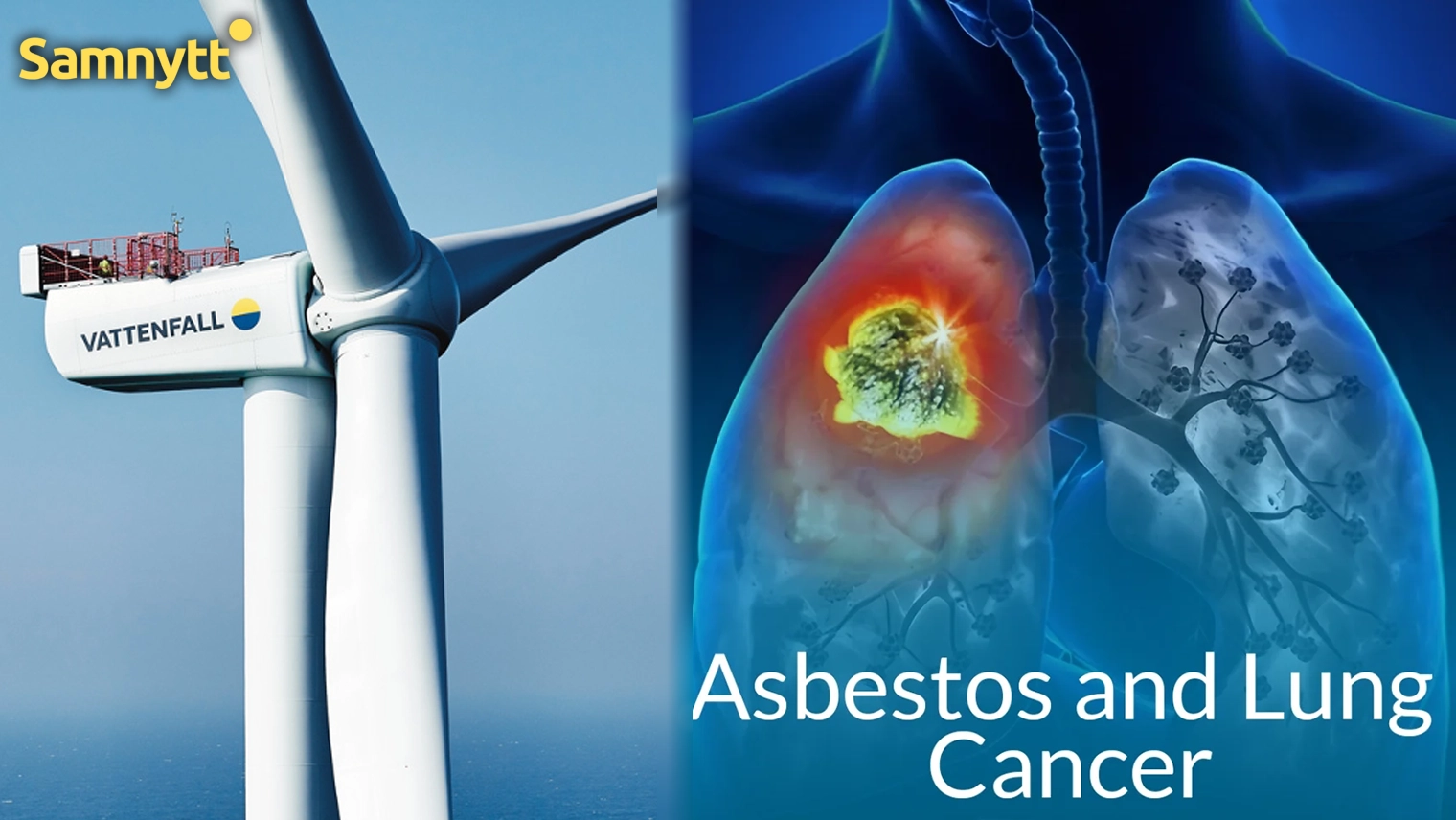
Findings of asbestos in wind turbines continue to increase. Following earlier revelations in Sweden and high-profile cases at one of state-owned Vattenfall’s facilities in Scotland, a British investigation now shows that at least 1,000 wind turbines in the UK contain components made with the banned and carcinogenic substance. This development raises questions about how thoroughly supplier chains have been scrutinized during the rapid expansion of wind power—and whether the true number of affected facilities could be much larger than what has so far been revealed.
The problems with asbestos in the wind power industry appear to be far more extensive than previously known. A review published by The Times in the UK shows that asbestos has been identified in at least 1,000 wind turbines across Britain.
Just like in the Swedish cases reported earlier, the issue concerns brake components in the internal elevator and lifting systems used for servicing and maintenance inside the turbine towers.
The information comes only days after it became known that asbestos was discovered in components in the emergency brake systems for service lifts at South Kyle Wind Farm in Scotland, a wind farm developed by Sweden’s Vattenfall.
READ MORE: Asbestos discovered in Vattenfall’s wind turbines
Vattenfall defends itself by asserting that the components concerned are fully encapsulated and therefore pose no risk during normal operation. At the same time, the company has initiated a program to replace the affected parts with the help of specialized contractors.
The state energy giant does not explain how the substance could have ended up in its products. There is a total ban on asbestos in Sweden and the entire EU, and Sweden is also prohibited from exporting products containing asbestos to any country.
Blaming Chinese Subcontractors
According to the British reports, the asbestos-containing components originate from Chinese third-party suppliers. The parts are said to have been used in lift systems from several well-known suppliers to the wind power industry.
The findings have put the spotlight on the :censored:6:cdd6bbaa89: supply chains that have emerged around the large-scale expansion of wind power worldwide. Critics, including Swedish researcher and green transition expert Christian Sandström, argue that oversight of subcontractors has not always kept pace with rapid growth.
Scottish union leader Louise Gilmour put it concisely when she commented on the development:
– Our country banned asbestos decades ago because it killed workers and their families. Now we are paying for it to be shipped here from across the world and then paying again to remove it.
Significant Dark Numbers Feared
Industry representatives emphasize that the components in question are sealed units and are therefore not considered to pose an acute risk to employees or the public as long as they are not opened or damaged. Nevertheless, extensive inspections and replacements are already underway. Hundreds of lifts are said to have already been dealt with in the UK.
ALSO READ: Annual reports show: Big losses for Vattenfall’s wind power five years in a row
At the same time, the ongoing findings raise the question of the true scale of the problem. Asbestos has not only been discovered in Sweden and the UK but also in Australia. This suggests it is not about isolated incidents, but a more systematic issue linked to certain supply chains.
Christian Sandström states in an article in Affärsvärlden that the developments highlight the question of how well the industry has vetted its suppliers. With wind power expanding at a very high pace for many years, there is reason to ask whether control functions have always been adequate.
If the same component types have been installed in thousands of facilities worldwide, there is an obvious risk that the dark numbers remain substantial.
Earlier Swedish Cases
Several Swedish cases have already come to light this year. The Swedish Chemicals Agency has investigated reports of asbestos in brake pads used in Swedish wind turbines, while the Swedish Work Environment Authority has been involved in cases concerning workplace risks when handling these components.
This is particularly sensitive since asbestos has long been banned in Sweden. The substance was banned in new buildings and products already in 1982 and is well known for its severe health risks. Inhaling asbestos fibers can cause asbestosis, lung cancer, and mesothelioma, often with several decades’ delay.
That deadly asbestos is now being found in modern wind turbines therefore risks becoming a troubling issue for an industry often presented as central to the green transition.
Could Become Costly
In addition to work environment issues, significant costs for inspections, decontamination, and replacement of components are likely to follow. The more facilities affected, the greater the economic impact. Ultimately, the bill ends up with electricity consumers.
ALSO READ: Vattenfall’s wind power lost 28 million – but still paid out 20 million to owners
What first appeared to be isolated findings in individual wind turbines has in a short time developed into an international scandal. With new discoveries in several countries and thousands of potentially affected facilities, concern is growing that the current problems could be only the beginning of a much larger asbestos scandal within the wind power industry.