
Abolished quantity discount, longer sentences, and lower age of criminal responsibility for serious crimes. Henrik Vinge of the Sweden Democrats describes Thursday’s expected parliamentary decision as one of the major legal reforms of the term. But in an interview with Samnytt, he warns that the reforms could end up “in a desk drawer” in the event of a change of power. Ahead of this autumn’s election, Vinge paints a stark contrast between two completely different directions for Sweden — and warns that a left-wing government could open the gates to a new wave of mass migration similar to 2015. At the same time, he highlights SD’s next major project: a much tougher repatriation policy, harsher measures against radical Islamism, and continued tougher sentences.
On Thursday, the Riksdag is expected to make decisions on comprehensive changes to Swedish criminal law. One of the most important is the change to the so-called quantity discount — the principle that a person convicted of multiple crimes does not receive full sentences for all crimes added together.
When Samnytt interviews Henrik Vinge, parliamentary group leader and deputy party leader for the Sweden Democrats, he describes the current system as one in which repeated criminality can, in practice, pay off.
– Right now, if you commit several crimes, you get a lower sentence per crime the more crimes you commit. For the first crime, you get the full sentence. For the second crime, you get about a third. For the third crime, even less.
According to the SD leader, this system means that additional crimes after a certain number of convictions make very little difference to the overall sentence.
– Once you reach four, five, six crimes, they are practically without punishment.
He argues that the consequence is especially clear for people who systematically commit crimes.
When someone shows they are prepared to repeatedly commit serious violent crimes, for example, it shows a special degree of ruthlessness. Now, we’re simply removing the quantity discount. Sentences will no longer be calculated this way. There will be much longer sentences for repeat offenders.
Henrik Vinge (SD)
If someone has already committed 4-5 crimes, can they currently continue without any punishment at all?
– Yes, if a criminal has already committed four serious crimes, they can just keep going until they get caught.
READ ALSO: Tidö government scraps the quantity discount for criminals
Vinge also brings up repeated sexual offenses and abuse within families as examples where, in his view, today’s practice of additive sentences produces unreasonable results.
– It should really be the other way around. When someone shows they’re prepared to repeatedly commit serious violent crimes, for example, that shows a special kind of ruthlessness.
Under the new rules, repeated serious crime will be able to result in significantly longer prison sentences.
– Now, we’re simply removing the quantity discount. Sentences will no longer be calculated that way. There will be much longer sentences for repeat offenses.
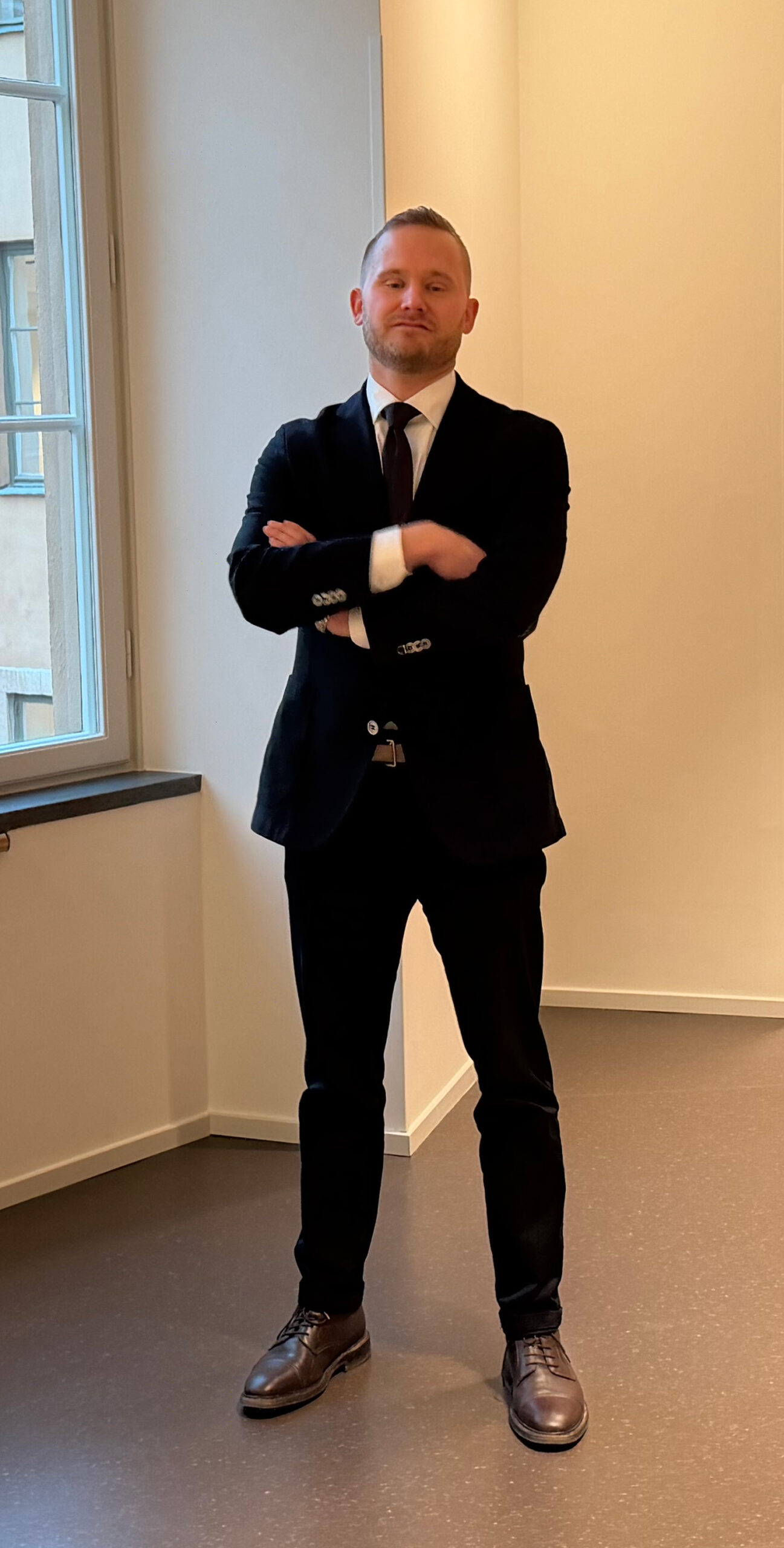
The Social Democrats say they are in favor of abolishing the quantity discount, but they aren’t voting for it. How do you comment on that?
– No, they voted against the proposal last Thursday. If the left-wing parties win the election, this will not be implemented. He continues:
– But they know they can’t say that before an election, so they invent that they have their own variant. But there’s no such variant — it’s just a talking point to avoid admitting they will not implement this.
READ ALSO: Ekeroth: “Tidö’s policies are pushing the gangs back — Sweden must not change course now”
Vinge goes on and gives grocery stores as a concrete example of how the system is exploited. He describes how three people enter a store together, partly because it takes two staff members to apprehend one suspect and there are rarely six staff members present to go after all three.
Each steals goods worth about 1,450 kronor, making each individual theft a minor offense, but together they can leave with goods worth nearly 5,000 kronor.
If the suspects are already under investigation for a long list of other crimes, further thefts may also become pointless to investigate, as they hardly affect final sentences.
The result, says Vinge, is that the perpetrators effectively become “immune from punishment” for further crimes.

Vinge also points to serious sexual crimes and long-term abuse within families as cases where today’s system can produce unreasonable consequences. A person who repeatedly abuses a relative over several years does not face full sentencing consequences for each individual crime.
The SD leader believes that the principle should work the opposite way — those who repeatedly commit serious violent or sexual crimes display a “special ruthlessness” and are a greater threat to others — and should therefore be punished more severely, not get an increasingly large discount for further crimes.
Henrik Vinge also raises the so-called extenuating circumstances, which in some cases lead to reduced sentences.
He cites as an example an offender who is injured in the commission of a crime, or a convicted pedophile who loses his job as a result of the verdict. According to Vinge, such circumstances should no longer mean reduced sentences.
– We’re removing that as well now.
SD wanted to lower age of criminal responsibility to 13
Another controversial change is the reduction in the age of criminal responsibility for serious crimes from 15 to 14 years. The background is the gangs’ systematic recruitment of minors as perpetrators of, among other things, shootings and bombings.
The gangs have deliberately used very young perpetrators because they know the legal system treats them more leniently. Do you really think the 14-year limit will reduce recruitment — or will gangs simply turn to 13-year-olds instead?
– Yes, there is a risk that gangs will increasingly use 13-year-olds — which is precisely why SD actually wanted to lower the age to 13.
I’d like to say that the paradigm shift has occurred both in criminal policy and migration policy. In terms of criminal policy — when we took office Sweden was one of Europe’s most dangerous countries, with shootings and bombings nearly every day. Now, three years later, lethal violence in Sweden is down 80 percent. It’s the lowest level of lethal violence in over a decade.
Henrik Vinge (SD)
Vinge says the gangs willingly use people under 15 because they are not criminally liable, but children under 13 are less often used for complex tasks like shootings and bombings.
They’re simply too young and more likely to fail, he claims. In practice, it is mainly 13- and 14-year-olds who are used.
READ ALSO: 14-year-olds shot dead a bank manager in Skurup — cannot be punished
By making 14-year-olds legally responsible, the gangs’ recruitment pool is thus reduced, but Vinge admits that 13-year-olds risk being even more targeted. That’s why SD wanted to lower the limit to 13, something Vinge says was blocked by the Social Democrats.
He also points out that 14-year-olds committing the most serious crimes will now fall under the responsibility of the Prison and Probation Service instead of being handled by the municipal social services, which he sees as an improvement.
– The 14-year-olds will have it much better now. They will be taken care of by the Prison and Probation Service, which is a much better arrangement than being taken care of by local social services.

“Paradigm shift has been implemented”
When Samnytt asks Vinge for the Sweden Democrats’ summary of the parliamentary term, he rejects criticism from voters who claim the party has not delivered enough.
How much of what you promised voters in 2022 has actually been delivered?
– I’d like to say that the paradigm shift has occurred both in criminal and migration policy. When we took office, Sweden was one of Europe’s most dangerous countries, with shootings and bombings nearly every day. He continues:
– Now, three years later, lethal violence in Sweden has gone down by 80 percent. It’s the lowest rate of lethal violence in more than a decade. The SD leader continues:
– In their chats, the criminal gangs write: don’t go to Sweden. It’s pointless to commit crimes here — the police are too effective, and you’ll get caught.

He also claims Sweden has gone from being one of Europe’s biggest recipient countries to a country with very low asylum and family immigration.
– We have the lowest asylum and family immigration in over 40 years.
READ ALSO: Sweden faces its fate — and Tidö risks wasting its chance
Vinge especially highlights Somalia, Iraq, and Afghanistan, saying that more people are now moving from Sweden to these countries than the other way around.
– These are significant changes compared to just a few years ago.
Yes, I think it is absolutely necessary. Those who have come here and who do not adapt to Sweden or Europe, who do not want to become part of society and who commit crimes, they must return. This is the next big migration policy project. But first, you have to stop the inflow.
Henrik Vinge (SD), on repatriation.
But he also emphasizes that SD does not consider the work finished.
– We shouldn’t say we are satisfied. There is still a lot left to do.
READ ALSO: INTERVIEW: SD wants life sentences for rape of the elderly
And he uses the past parliamentary term as an argument for another four years of Tidö rule.
– If so much can be done in one term, imagine what could be done in two.
Wants to ramp up repatriation
One area where Vinge wants to see much more in the next term is repatriation.
The repatriation benefit is, according to Vinge, part of the solution, but he still sees practical obstacles. He criticizes, among other things, Social Democrat-led municipalities for not providing sufficient information about the possibility.
– If they don’t, then the word doesn’t get out. If more publicity were given, then more people would choose it.
Samnytt has interviewed Eva Vlaardingerbroek and Philipp Huemer, who work with the Save Europe Act and the Institute for Remigration. They advocate for a much tougher repatriation policy. How do you comment?
– Yes, I think it’s absolutely necessary. Those who have come here and do not adapt to Sweden or Europe, who do not want to be part of society and who commit crimes, they must return. He continues:
– This is the next big migration policy project. But first, you need to stop the inflow.
READ ALSO: Eva Vlaardingerbroek to Samnytt: “Repatriation is Europe’s last peaceful option”
Vinge also highlights that support for a tougher repatriation policy isn’t limited to native Swedes.
He says that even those who have themselves immigrated to Sweden and who follow the rules, work for their children’s future, have an interest in criminals and troublemakers leaving the country.
Such people, according to Vinge, “give all immigrants a bad reputation” and at the same time destroy the country for other immigrants and their children. Therefore, he argues, there is also strong support among law-abiding immigrants for a tougher stance.
READ ALSO: Head of the Repatriation Institute warns Sweden: “You have a time window of five to ten years”
Richard Jomshof (SD) has long argued that mosques should be closed and radical imams expelled as a way to increase the incentive to leave Sweden. Do you agree?
– I think that’s exactly the kind of thinking needed. On one hand, you create an exit via economic incentives, but when it comes to radical Muslims you can also demolish mosques, punish imams who spread extremism and revoke various types of association grants. He sums up:
– Then it becomes less attractive to live in Sweden.

“Most far-left government alternative ever”
Ahead of the election, Vinge draws a stark dividing line between the Tidö parties and the opposition. He warns that a change of government could once again make Sweden attractive for asylum migration, repeatedly referencing the refugee crisis of 2015.
– Do we want 2015 back? Do we want hundreds of thousands of people coming to Sweden again? Or not?
It could mean a catastrophe for Sweden. This is a fateful election, for real.
Henrik Vinge (SD), if the Social Democrats win the election this autumn
Vinge claims that a red-green takeover could lead to people on their way to Europe once again turning to Sweden.
– If we get Social Democrats and the Greens in government, then smugglers around the world will know that the benefit taps will be open again.
He also has a warning for right-wing voters considering voting for parties outside the Riksdag.
– A vote for any other party, if it’s outside the Riksdag, is a wasted vote.
READ ALSO: Poll: Tidö parties catching up — the red-green lead halved
Vinge is moreover convinced that the Left Party would be part of the government if Magdalena Andersson is able to put together a parliamentary majority after the election.

– What we are up against now is the most far-left government alternative that has ever stood in a Swedish election.
Nor does he believe that the Center Party will block such a government alternative.
– After the election, they’ll choose power.
For Vinge, the autumn election is therefore not just about which reforms are to be implemented over the next four years, but also whether the changes initiated during the Tidö mandate will continue at all.
– It could mean a catastrophe for Sweden. This is a fateful election, for real.