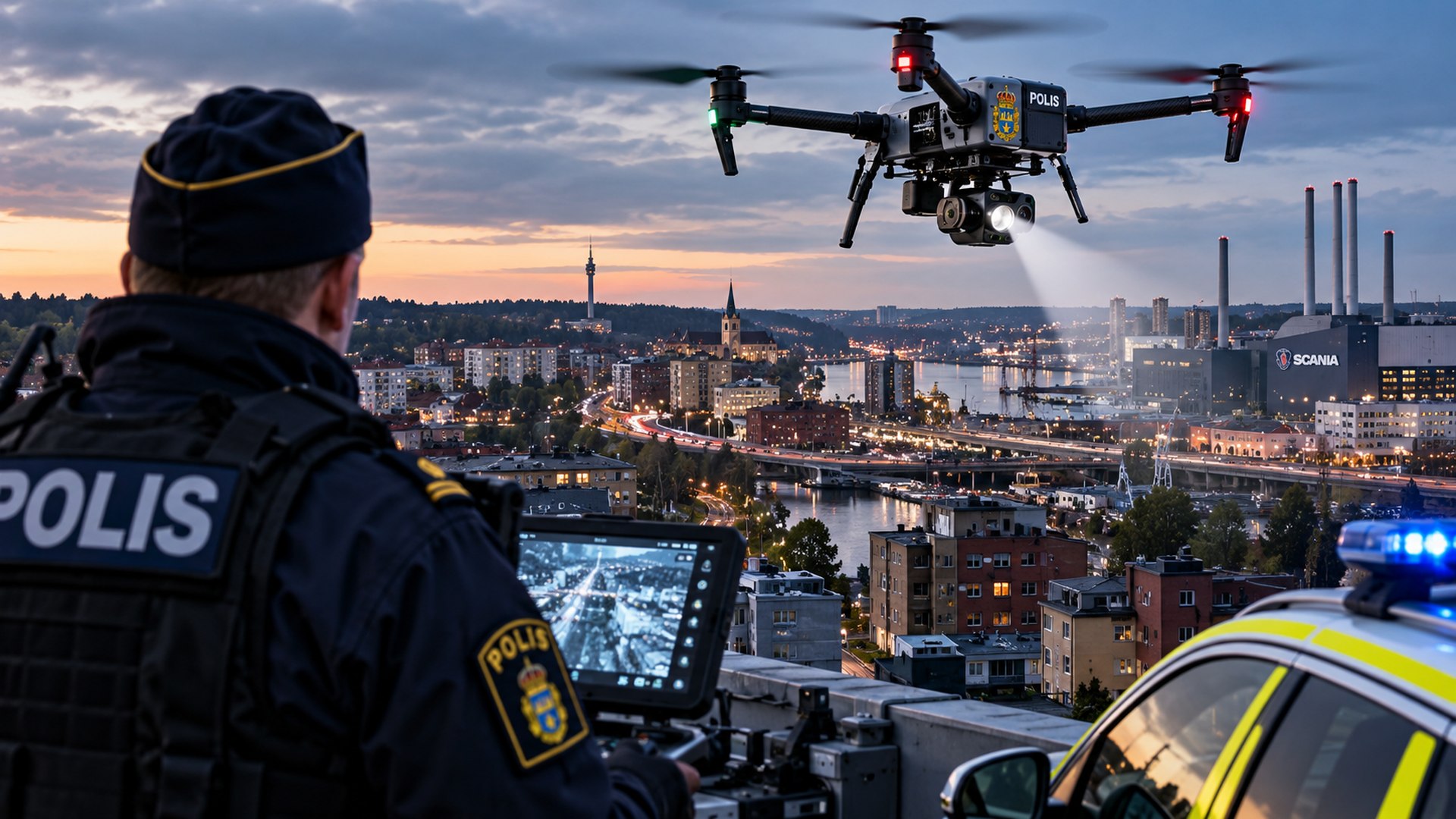
The police are expanding their surveillance of Södertälje with drones placed on rooftops that can be sent directly to suspected crime scenes. The vehicles are remotely controlled from Stockholm and may be used around the clock in large parts of the municipality until the end of May next year.
Since Monday, October 19, the police have had access to a new system with pre-positioned drones in Södertälje. The purpose is to be able to follow suspected crimes more quickly and gain an overview of situations where police patrols have not yet arrived.
According to the Swedish Police Authority, Södertälje is the first in Stockholm County to have this new expansion. Similar systems have previously been tested in Malmö and Norrköping, but now the technology will be implemented on a larger scale in the Stockholm region.
Unlike the police’s regular drone operations, where an operator needs to bring equipment to the site, these new vehicles are already deployed at strategic locations. This means that in many cases a drone can reach a suspected crime scene before a patrol car gets there.
“In most cases, a drone can get there faster than a police patrol in a car,” says Emil Lidén, who is responsible for the implementation of the new drone capability at the police in the Stockholm region.
Controlled from the Police Headquarters
The drones are not remotely controlled by police officers on the streets of Södertälje, but by special pilots in the police’s camera surveillance center on Kungsholmen in Stockholm.
The center is located near the regional command center, from where police resources are allocated when, for example, an alarm about a suspected crime comes in via 112.
When an alarm comes in, a drone can be sent to the scene and transmit camera images to the police. The images can provide an early impression of what has happened, how many people are at the scene, and what resources need to be deployed.
“With drones, we are able to understand more quickly what is happening, assess the scope of the situation, and identify which police capabilities are required,” says Emil Lidén.
According to police, the technology can also improve safety for patrols that are about to intervene, since they receive better information about the situation before they arrive.
At the same time, the police emphasize that the drones are not meant to replace regular police patrols, but to serve as a complement to ground operations.
Allowed to Fly Around the Clock
The new surveillance permit is valid from October 19, 2026, through May 31, 2027, and covers large parts of Södertälje municipality.
During the period, the police may use camera-equipped drones at all hours within the permitted area. However, this does not mean that drones will continuously fly or film over the municipality.
The geographically extensive surveillance also raises questions concerning privacy. Aerial camera surveillance allows police to quickly gain an overview of locations and movements that may otherwise be difficult to follow from the ground.
The police also have the possibility to use relevant recorded material in criminal investigations, according to the regulations governing police camera surveillance.
Drone surveillance in Södertälje is not in itself new. As early as last December, SVT reported on a decision that allowed drone surveillance around the clock in Södertälje, Salem, and Nykvarn during a three-month period.
The main new feature is that the vehicles are now positioned in advance and can be remotely controlled from the police’s central command environment, which is expected to reduce the time between an alert and when the police receive camera images from the scene.
Aiming for Faster Response
Tommy Dimitrios Dimitrakis from the Södertälje local police area describes the initiative as part of the police’s ongoing work to increase safety in the municipality.
He emphasizes that drones are just one of several resources used and that the police are continuing to develop their working methods.
Emil Lidén stresses that the new technology is mainly intended to improve the basis for decisions when the police need to act quickly.
“The capability complements the traditional police response. It does not replace the police presence on the ground, but provides the police with additional information that can contribute to safer and more accurate decisions,” he says.
The police have not yet reported any results from the new operation in Södertälje. There are therefore no publicly verified figures on how much response times have actually been reduced or how many crimes have been solved with the help of the new system.