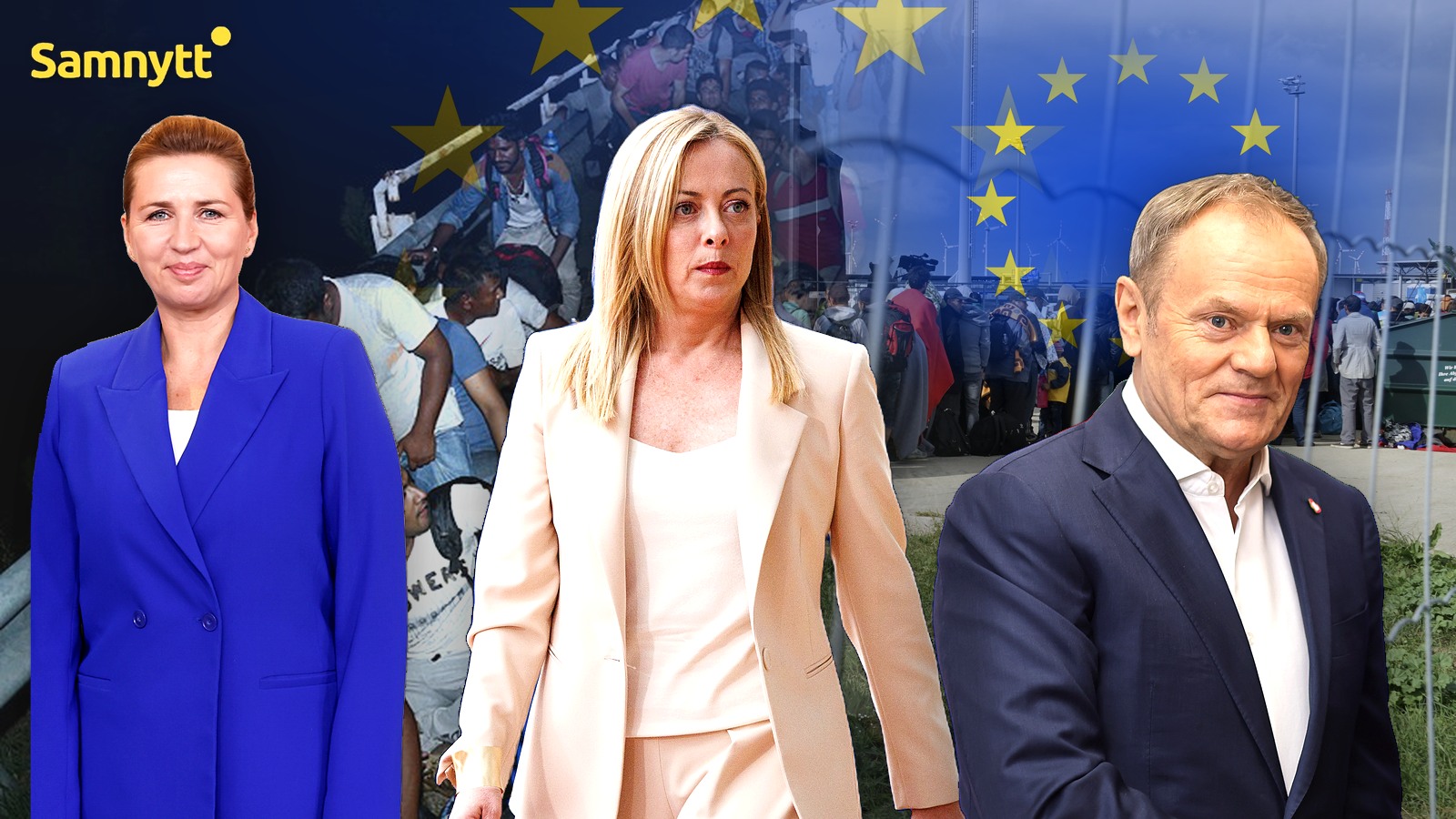
A joint statement from Denmark, Italy and Poland calling for a tougher EU stance on irregular migration was removed from the conclusions of the EU summit in Brussels, which ended late on Friday, October 16. The proposal, which according to diplomatic sources was supported by about ten countries, would have stated that migration challenges social cohesion and negatively affects crime rates. What remained was a brief mention of a future emergency framework and a show of solidarity with Spain following the migrant crisis in Ceuta.
It was Denmark’s Prime Minister Mette Frederiksen, Italy’s Prime Minister Giorgia Meloni, and Poland’s Prime Minister Donald Tusk who pushed for stronger language in the summit’s conclusions.
According to a draft seen by Politico, the heads of state and government would have explicitly linked irregular migration to crime and to the threat against social cohesion. The European Commission would also have been tasked with investigating a consultation mechanism for when national measures risk impacting other member states.
The proposal was backed by around ten countries, including Hungary, according to two EU diplomats. That was not sufficient. The wording was removed from the final conclusions after a divided and, according to the French president, highly politicized debate.
The background includes both this summer’s crisis in the Spanish exclave of Ceuta, which tens of thousands of migrants reached in a short time—something Samnytt previously reported—and Spain’s decision earlier this year to grant temporary residence permits to about one million irregular migrants. This has triggered open quarrels between Madrid on one side and Rome and Copenhagen on the other.
Macron: A bad and politicized debate
French President Emmanuel Macron criticized the way the discussion was conducted around the table.
– We had a bad debate about good results. A bad debate because it became very politicized and a major source of division around the table, said Macron.
He pointed out that France did not sign the open letter criticizing Spain after Ceuta. According to Macron, more than 140 people died during the influx, and Spain was subjected to an information attack where smugglers spread false information about opportunities to enter.
– It was not Spain that said people should come. They were targeted by this attack, said Macron.
Von der Leyen: National decisions can have cross-border effects
EU Commission President Ursula von der Leyen, when asked about Denmark’s criticism of Spain, responded that decisions to legalize irregular migrants are a national prerogative, but such decisions—as with other national measures—can have cross-border effects.
She pointed out that there is already a mechanism for information exchange in place, and that it can be strengthened. Von der Leyen also confirmed that before the end of the year, the Commission will present a framework for crisis response to sudden mass movements, like those that created chaos in Ceuta this summer.
At the same time, Frontex is to be proposed for reinforcement. Denmark’s Prime Minister Mette Frederiksen has recently, in an interview reported by Samnytt here, warned that Sweden has been destroyed by immigration—the same Frederiksen who now saw her and Meloni’s proposal dropped in Brussels.
– We will always uphold our values and fundamental rights, but we will never compromise on protecting our borders, said von der Leyen.
What remains: emergency framework and solidarity with Spain
In the final conclusions, the summit welcomes the Commission’s intention to closely cooperate with member states in drafting a framework for emergencies and instrumentalization.
READ ALSO: Denmark’s Social Democratic Prime Minister: Sweden destroyed by immigration
In a separate point, the Council expresses its solidarity with and support for Spain following the sudden massive influx into Ceuta at the end of July. The European Council will return to the migration issue at a future meeting.
Meloni and Frederiksen have previously made joint statements that Europe must defend its values, something Samnytt has reported. At the summit, this was not enough to get the tougher line into the text.
Ukraine and the budget postponed
Migration was not the only contentious issue. Ukraine’s President Volodymyr Zelensky requested a further 70 billion euros for 2027, but leaders only decided to task the Commission with coming back with a concrete proposal.
The issue of using frozen Russian assets remained unresolved. The EU’s long-term budget, almost 2 trillion euros, was also postponed to later meetings in November and December.
READ ALSO: Ceuta on the brink – rapes and fear among the local population