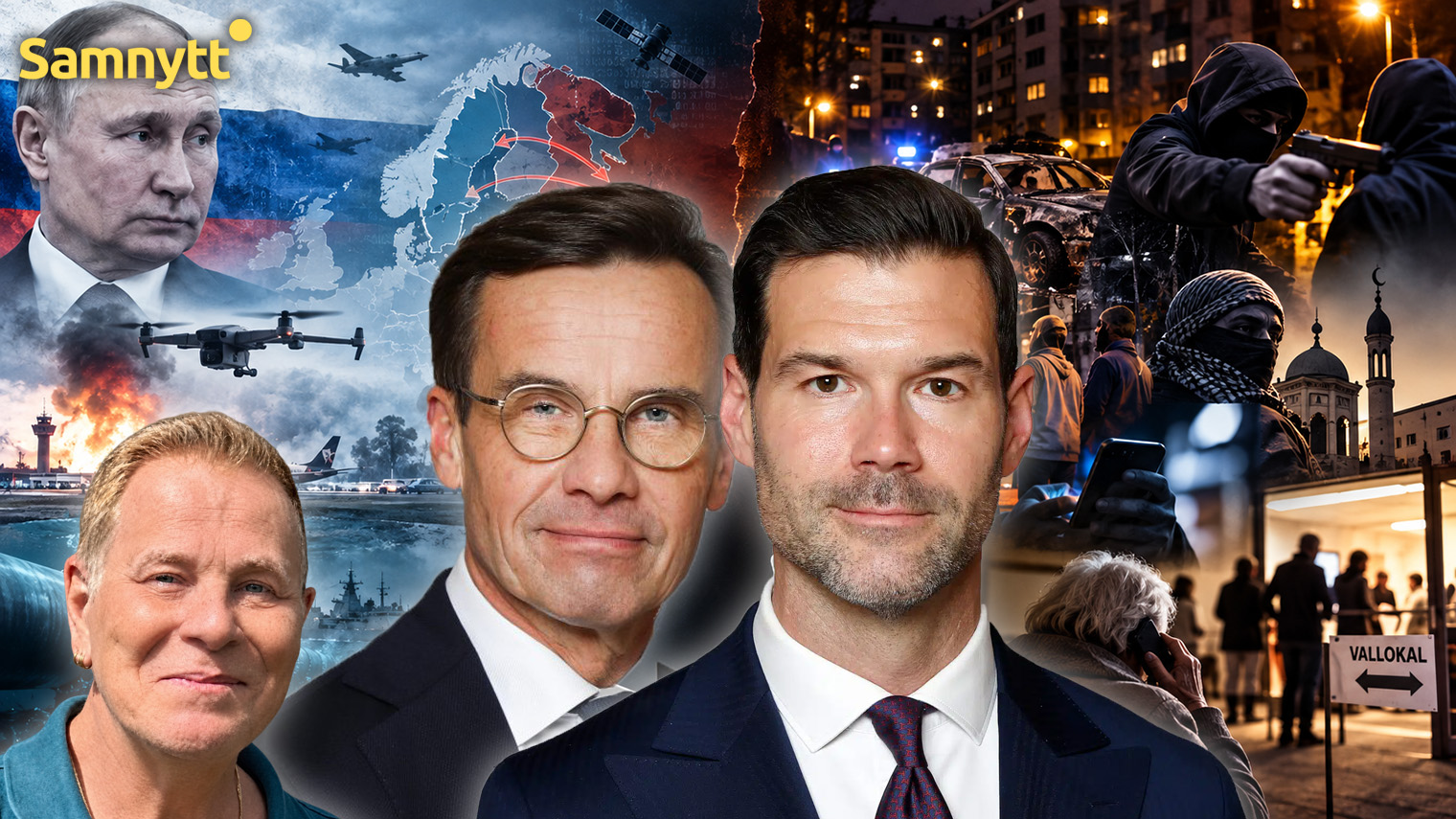
EDITORIAL • Russia is guilty of much, but not everything. Yet, suspicions of Russian involvement increasingly seem sufficient for far-reaching political conclusions. Now, Prime Minister Ulf Kristersson (M) and Migration Minister Johan Forssell (M) want to make it possible to deny people entry to the EU solely because they are Russian citizens. At the same time, other, much more tangible security threats continue to wear down Swedish society. It’s time to discuss both the burden of proof and proportionality in our security policy.
It’s hard to imagine a more effective way of making an entire population suspect than letting their nationality alone become sufficient reason to close Europe’s doors. But also, a more unpleasant one. Yet this is exactly what Prime Minister Ulf Kristersson and Migration Minister Johan Forssell are advocating in an opinion article in Aftonbladet.
Under the headline”Make it impossible for Russians to travel in the EU,” they argue that Russian citizens should be denied visas solely on the basis of their citizenship. The motivation is the security policy threat that Russia is seen to pose to Europe. The ministers refer to sabotage, espionage, cyberattacks, and other forms of so-called hybrid warfare.
A party colleague in Parliament, Jan Ericson, now blames the street riots in France on Putin. It’s convenient when you’ve let immigration run wild and handled left-wing extremism with kid gloves. And Ericson’s statement is just the latest in an endless series.
Kristersson and Forssell assure that their proposal should not be interpreted as holding all Russians responsible for the actions of the Russian regime. But what else does it mean when people who haven’t done anything wrong are hit with restrictions solely because of their citizenship? Calling it a security policy stance instead of collective punishment does not change the reality.
From Suspected Perpetrators to Suspected Millions
As a particularly clear example of the Russian danger, Kristersson and Forssell highlight the failed drone attack on Leipzig/Halle airport in Germany last summer. German authorities have identified Russia as responsible. Two suspects have been identified. One was born in Russia but holds a Latvian passport. He is suspected of having played a coordinating role and reportedly has links to Russian intelligence.
The other is a man from Belarus with a Russian passport. According to investigations by Süddeutsche Zeitung, NDR, and WDR, he entered Germany with an Italian tourist visa. Investigators have secured DNA traces and other findings that, according to media reports, connect the suspects to the attempted attack.
These are details that need considering. But there is a crucial difference between identifying suspected perpetrators with suspected ties and proving that a foreign state planned or ordered their actions. There are also reasons to consider why this difference is so seldom acknowledged nowadays.
SEE ALSO: Dagerlind: From Electoral Fraud to Putin and Hitler – How the Real Issue Disappears
The German government has not publicly presented the intelligence that underpins the attribution to Russia. There may be good reasons to protect sensitive information, but the public is simultaneously deprived of the chance to independently scrutinize the conclusions. The fact that nothing has been presented could also be due to there simply not being anything substantial to present, and that what does exist might even weaken the overall argument in the public’s eyes.
The EU’s High Representative Kaja Kallas has claimed that the attempted attack bore “all the hallmarks of state-sponsored terrorism.” What these hallmarks are we do not know. And how does one so confidently distinguish an attack commissioned by a state from one carried out by other actors with similar methods and motives? How does one tell one state’s terrorism from another’s? As a politician, Kallas may have reasons other than factual ones for pointing to a specific geographic direction.
Still, Sweden’s Prime Minister and Migration Minister use the attempted attack as a main argument for limiting Russian citizens’ ability to travel to Europe. Perhaps because they are the same type of politicians as Kallas — voluntarily or forced by membership in the EU and NATO to make certain priorities.
SEE ALSO: AFD Leader Promises to Stop Support for Ukraine: “They Can’t Win – It’s Impossible”
But even if we accept that the Russian state was behind the attempted attack, it does not follow that millions of ordinary Russian citizens deserve to be treated as potential security threats. The ministers have not shown why a general citizenship-based barrier would be more effective than targeted controls of individuals who actually pose a security risk.
When Suspicions Take on a Life of Their Own
The Nord Stream affair should have taught us something about the danger of deciding too quickly who is guilty. After the explosions of the gas pipelines in the autumn of 2022, suspicions were quickly cast at Russia. That was the main line, and those who raised objections to the logic of Russia blowing up its own pipeline were met more with accusations of serving Putin’s interests than factual counterarguments.
Now, the concrete German criminal investigation – that is, beyond speculation and hypothesis – instead concerns Ukrainian suspects, and prosecutors have presented information that also strongly indicates connections to Ukrainian state actors. Not all questions are answered, but the development illustrates why security policy hypotheses should not be turned into established truths before evidence is on the table.
Playing the “Russia card” has become a reflex, while those who criticize the phenomenon are themselves cast under suspicion. Some should have learned something, but instead just move on to point the finger at Russia for the next event, and the next. Perhaps they should consider the boy who cried wolf.
Even more telling are the recent weeks’ much-discussed suspicions of break-ins at Finnish politicians’ homes. A light left on. An unflushed toilet. An inner door left open. A power outlet fallen to the floor.
Everyday occurrences that would normally be explained by forgetfulness, faulty memories, or poor installation have, in the heightened security climate, given rise to far-reaching speculation about foreign intelligence services, specifically Russian. If there is an underlying agenda, is it actually served by incidents like this? Or does it simply cast a counterproductive air of ridicule over the security policy debate?
SEE ALSO: Russophobia in the Forest: The Tourist with a Map Could Be a Spy
It’s possible, even if it’s a far-fetched hypothesis, that Russian incursions of the prank type ordered by Putin have really occurred. But before starting to hunt for Russian agents, one should at least be able to show that someone unauthorized has actually been inside the home. Occam’s razor seems at times to have disappeared from the security policy toolbox.
Putin Is Not the Russian People
Russia’s invasion of Ukraine is a serious violation of international law. The Russian regime bears primary responsibility for the war and the human suffering it causes. But Russia is not synonymous with Vladimir Putin. Even less so with the Russian people.
There are millions of Russians who never asked for the war, who out of necessity quietly oppose the regime, or who just try to live their lives under circumstances they have little capacity to affect. Others have left the country precisely because they don’t want to live under Putin’s rule. Should these people too be considered a security threat simply because they are Russian citizens?
Russia has given the world some of its finest authors, composers, and artists. Tolstoy, Dostoevsky, Tchaikovsky, and the Bolshoi Ballet belong to all of humanity’s cultural treasure. Their works do not become less valuable because today’s Russian government wages a war of aggression. But merely stating this obvious fact can now also lead to suspicions of serving Kremlin’s interests. The tone is that feverish.
It should be above any reasonable suspicion to be able to appreciate Russian culture. It should also be reasonable to defend ordinary Russians’ right not to be collectively suspected and punished, without being accused yourself of having sympathies for Putin.
Kristersson and Forssell append a small caveat to their article by saying they don’t believe all Russians bear responsibility for the regime’s actions. Yet in the rest of the article, both ministers do exactly that when they want citizenship alone to be sufficient grounds for denying entry. It’s hard to see how those two positions fit together.
The Threats Already Among Us
While the political debate is increasingly about Russian hybrid attacks, suspected sabotage, and future military threats, there are already other serious externally derived attacks on Swedish society that needn’t be speculated about. They are ongoing. In full swing. Every day. All year round.
Organized, entirely immigrant-dominated gang crime has for a long time shaken Sweden with shootings, bombings, murders, and extortion. Criminal immigrant networks infiltrate authorities and companies, exploit welfare systems, and try to influence public decision-makers. Islamic extremism has caused bloody terrorist attacks around Europe and, according to the Swedish Security Service (Säpo), also constitutes a permanent, heightened security threat in Sweden.
SEE ALSO: Events That Threatened Our Democracy and Security
Elderly people are systematically subjected to fraud, theft, and abuse in their care. Children and young people are robbed and humiliated. Criminal circles recruit minors to carry out serious violent crimes.
A significant portion of these problems are linked to failed migration and integration policy. Immigrants in general should not be labeled criminals – any more than Russian citizens in general should be portrayed as agents of Putin. But we must at least be able to ask the possibly uncomfortable question of which of these groups Sweden has had the most problems with.
Speculation about Russian agents cannot be allowed to obscure facts about the links between migration, segregation, crime, and extremism. Or the latest suspicions of organized electoral interference through undue pressure, vote directing, and other irregularities especially in immigrant communities.
Not all these claims are fully proven. But the documented cases are serious enough to warrant attention and to recognize that there is a real problem here. If people cannot vote freely and without pressure, democracy is attacked at its most fundamental level.
These are threats that require no future invasion to have consequences. They already affect people’s safety, freedom, and confidence in the institutions of society. Here and now.
Where Is the Proportion?
It’s not as if this government has completely ignored these problems. On the contrary, the Tidö government has implemented significant changes to migration and crime policy, and in several areas gone considerably further than previous governments, characterized by lots of talk and little action.
That should be acknowledged. But it doesn’t invalidate the question of proportionality in the security policy mobilization. When it comes to Russia and Ukraine, there seems to be an almost unlimited willingness to discuss new financial commitments, military investments, and far-reaching political restrictions.
When it comes to the threats already hollowing out Swedish society, the discussion of resources and priorities is often much more restrained. By contrast, Sweden has set aside record large amounts in military and economic support to Ukraine.
There are security policy arguments for the latter. But that’s not the same as every additional billion for the war in Ukraine being automatically the best possible use of Swedish taxpayers’ money from a security perspective. Resources are limited. Money used for one purpose cannot at the same time be used for another.
Therefore, it must be legitimate to discuss whether parts of the extensive resources mobilized for Ukraine and Europe’s external security would be of greater benefit if used to strengthen the justice system, fight organized crime, protect welfare systems, and restore security in Swedish neighborhoods.
Such a discussion should not be seen as a lack of solidarity with Ukraine. We must be able to have a debate about political priorities, about Swedish security interests and which threats to our country, our safety, and our democracy are really the most serious and urgent.
Kristersson’s Double Message on the EU
The same question arises in the discussion on the EU’s upcoming long-term budget. The EU Commission wants to sharply increase the union’s joint spending, referring among other things to the deteriorating security situation, defense investments, and continued support for Ukraine.
For Sweden, the talk has been of a very significant increase in the EU fee. Kristersson has stated that Sweden cannot accept the Commission’s budget proposal.
This is a position that deserves support if Swedish taxpayers are going to be burdened with ever-increasing costs for the wrong types of priorities. But it also raises questions about double messages from the government.
If the Russian threat really is as extensive and acute as the Prime Minister describes, and if you truly believe that Trump has abandoned NATO Article 5, how then do you argue against financing European security ambitions with a bigger EU budget?
And why isn’t the need for joint European initiatives against organized crime, Islamic extremism, and societal infiltration that are already major problems in several member states discussed as strongly at the EU level? Sweden is not the only or even the worst-hit country by the consequences of mass immigration.
The European Parliament has recently dealt with a resolution on Islamic infiltration and the Muslim Brotherhood’s networks. The Swedish red-green parliamentarians who voted against it were severely criticized by the right. This shows that there is at least some awareness of the threat picture.
But that should lead to a broader and deeper discussion on how Europe’s joint security resources are distributed. The mentioned resolution is only an essentially non-binding declaration of intent. It comes with no earmarked multi-billion increases to the EU budget.
Security is not just about protecting the borders against a foreign army. It’s also about preventing societies from being broken down from within by crime, extremism, and corruption that we naively let cross our borders without any security considerations. But as a European politician, it naturally hurts less to point the finger at Putin than to examine one’s own role in creating migration-related societal threats.
Security Policy Must Withstand Critical Questions
It is a tiresome trend in the security policy debate to treat questioning of allegations against Russia as something suspicious, almost subversive. Those who demand evidence instead of speculation for an alleged Russian act of sabotage risk being dismissed as Putin-friendly.
Those who question the extent of support for Ukraine can be accused of serving Kremlin’s interests. Can the narrative not be disturbed by any information that doesn’t fit, even if it’s true and relevant?
SEE ALSO: Dagerlind: The Room for Reform Didn’t Disappear on Its Own – Follow the Money to Ukraine
Those who defend ordinary Russian citizens’ right not to be collectively suspected can be met with the suspicion of not taking the Russian threat seriously. This is paradoxical, given that the same voices just as reflexively accuse critics of mass immigration of collectively blaming immigrants, Muslims, and so on.
Those who question whether there ought to be some kind of election in Ukraine while Zelensky has long exceeded his mandate and corruption scandals swirl around him, are also accused of serving Kremlin’s interests. When did democratic elections become a threat to the democracy in Ukraine we claim to be fighting for?
SEE ALSO: Dagerlind: Is Democracy Really a Threat to Ukraine?
It’s a dangerous development. A democracy must be able to hold several thoughts in its head at once – and discuss, without suspicion, which thoughts deserve the most attention.
Russia can constitute a serious security threat without every suspected sabotage automatically being Russian. Ukraine can have the right to defend itself against the invasion without every economic or military support measure being immune to criticism, especially when reports hold that as much as a third of the aid ends up in the pockets of corrupt Ukrainian actors instead of supporting the Ukrainian soldiers risking their lives at the front.
Ordinary Russians can deserve to be treated as individuals without that constituting any defense of Putin. Above all, it must be possible to discuss which threats in reality do the most damage to Swedish society and how our limited resources can best be used to address them.
When the Prime Minister and Migration Minister want to use Russian citizenship as grounds to close Europe’s doors, they should be able to explain why this measure is proportionate, how effective it is expected to be, and what other security measures would be deprioritized as a result. Above all, a Migration Minister should be required to make such assessments more rigorously.
Forssell should be able to explain why a similar logic to entirely close the door to people with other, more problematic nationalities hasn’t been considered in the same way. On the contrary, we have let in probably hundreds of thousands who could not even prove their identity. One of these won a seat in Parliament in this year’s election.
A security policy that allows suspicion to replace evidence and nationality to replace individual assessment risks undermining exactly the values it claims to defend. Russia is guilty of much. But not everything. And Europe’s future is not only threatened from the east.