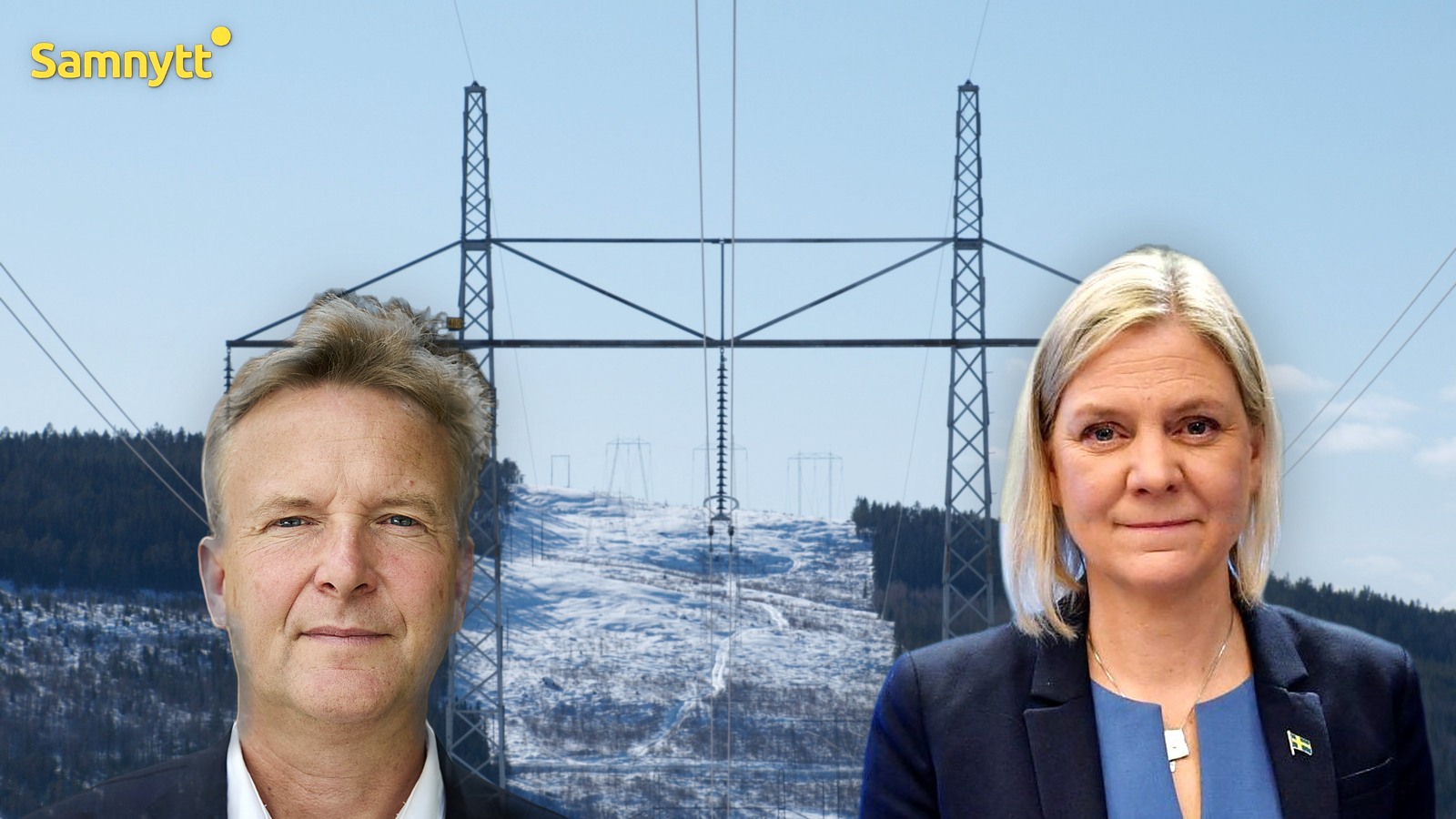
Swedish companies are losing faith in Sweden as an energy nation. This is the warning from Fortum Sweden’s CEO Peter Strannegård, whose first demand for the next government is a real reduction in electricity tax. The question is who will do it. The Social Democrats and the Left Party have said no to further reductions, and the Center Party leader, who is currently exploring the possibility of a centrist government, points to Magdalena Andersson as her most likely prime minister.
Strannegård presents seven proposals in an op-ed on Di Debatt today. He writes that high electricity taxes, complicated permitting processes, and a system that is based on the electricity grid rather than on customers threaten stable electricity prices.
– When fossil-free electricity is taxed too heavily, diesel becomes the competitive alternative for trucking companies, he writes.
He also points out that electricity use in Sweden has hardly moved since the 1980s, despite the fact that 99 percent of electricity is fossil-free. Fossil fuels still account for about a third of energy use, 140 terawatt hours per year.
Denmark removed almost the entire tax
As a role model, the Fortum CEO highlights Denmark, where the electricity tax has been reduced to the EU’s minimum level. This is correct, but the reduction is temporary. According to the Danish Ministry of Taxation, the tax is 0.8 Danish öre per kilowatt hour in 2026 and 2027. Without the reduction, it would have been 72.7 Danish öre.
In Sweden, the energy tax on electricity was reduced at the turn of the year to 36 öre per kilowatt hour, according to Energiföretagen, or 45 öre with VAT. Previously, automatic indexation had raised the tax three years in a row, from 36 öre in 2022 to 43.9 öre in 2025. The reduction therefore practically returned the tax to the level it was when the Tidö government took office.
Strannegård argues that this is not enough. He writes that Finland exempts electric boilers in district heating from tax, while electric boilers in Sweden, which have a combined capacity of several gigawatts, stand still due to tax reasons.
Seven demands for the next government
Aside from lowering the electricity tax, Fortum wants the state, regions, and municipalities to require fossil-free alternatives when procuring goods and services for 800 billion kronor a year. The company also wants government-backed credit guarantees for industry’s long-term fixed price contracts, shorter queues and permitting processes for grid connections, and fewer and larger electricity market zones, ideally just one.
The last two proposals are that municipalities producing electricity should receive a share of the revenues, and that flexibility and storage should be promoted, including pumped storage, batteries, and managing electric boilers. Strannegård also wants existing hydropower to remain unrestricted.
Fortum is one of Sweden’s largest electricity producers and thus has a vested interest in increasing electricity consumption.
S and V say no
Among the parliamentary parties, S and V stand alone on the issue. In a survey by the Swedish Homeowners’ Association in August, six out of eight parties said they want to lower the energy tax further. The Social Democrats and the Left Party were the only ones who replied no.
When the industry association Green Power Sweden asked this spring whether the tax should be reduced to Finland’s level of 24 öre, S replied “don’t know”. The party justified itself as follows in the survey:
– It is low system costs for electricity that should drive electrification and Sweden’s competitiveness. Not the distribution of tax, which is needed to finance welfare and joint costs.
The Left Party also replied “don’t know” and gave no justification. In its tax policy in parliament, V has instead called for a “new major tax reform that increases tax revenues,” and a special tax on grid companies’ excess profits, according to the tax committee’s opinion on the 2026 budget.
During the parliamentary term, the red-green parties have not proposed any broad reductions of the electricity tax, according to a review by Energimarknaden. S has pushed for lower taxes on electricity for large heat pumps in district heating, and V has focused on price regulation and price caps. However, neither S nor V opposed the government’s reduction to 36 öre in the tax committee.
The Green Party answered yes in the Homeowners’ survey, but would prefer targeted reductions, such as lower tax on electricity for vehicle charging and zero tax on electricity for district heating. Party spokesperson Daniel Helldén has told Energimarknaden that the party wants to investigate a “dynamic electricity tax that follows the price of electricity down.”
The government issue is decisive
The future of the electricity tax now depends on the government question. Last Thursday, the Riksdag voted no to Magdalena Andersson as prime minister in a purely S government. On Monday, Speaker Andreas Norlén instead tasked Center Party leader Elisabeth Thand Ringqvist with exploring the possibilities for a centrist government. She is to report to the Speaker by October 26.
The Center Party wants to reduce the electricity tax. But the centrist government Thand Ringqvist wants to see would, according to her, consist of the Green Party, S, C, Christian Democrats, and the Liberals, and she tells DN that Andersson is still her most likely candidate for prime minister. Andersson leads a party whose position is that the electricity tax is needed to finance welfare.
Strannegård writes that his hope is that the new government will dare to pick up the pace, “regardless of its composition.”