The debate about who works at the Migration Agency has picked up again after Delmi published a report on the agency’s case officers and decision-makers. The report concludes that only 18 percent are foreign-born and that background or gender does not appear to affect the likelihood of granting asylum. However, within the Migration Agency, the report has been met with skepticism. One of Samnytt’s sources, who has long experience with the authority, argues that reality looks different. After personally reviewing staff lists, the source estimates that the proportion of employees with foreign backgrounds is significantly higher than what the report suggests. At the same time, the source directs broader criticism at what he describes as Swedish authorities’ lack of understanding of clan structures, cultural identity, and the conflicts that, according to him, have accompanied migration to Sweden.
A new report from Delmi has reignited the debate about the composition of Migration Agency staff and the importance an employee’s background can have for the agency’s operations.
Delmi (The Delegation for Migration Studies) is a government-funded committee appointed by the government to produce and disseminate research-based knowledge about migration and integration.
The organization brings together researchers from various universities and publishes reports, policy briefs, and analyses that are intended to contribute to public debate and provide decision-makers with a knowledge base on migration issues.
Delmi describes itself as politically independent, but its reports are often used as a basis in the migration policy debate.
The report claims that only 18 percent of the agency’s employees are foreign-born. Among other things, it states:
“There are no statistically significant differences in approval rates linked to the gender or background of case officers or decision-makers.”
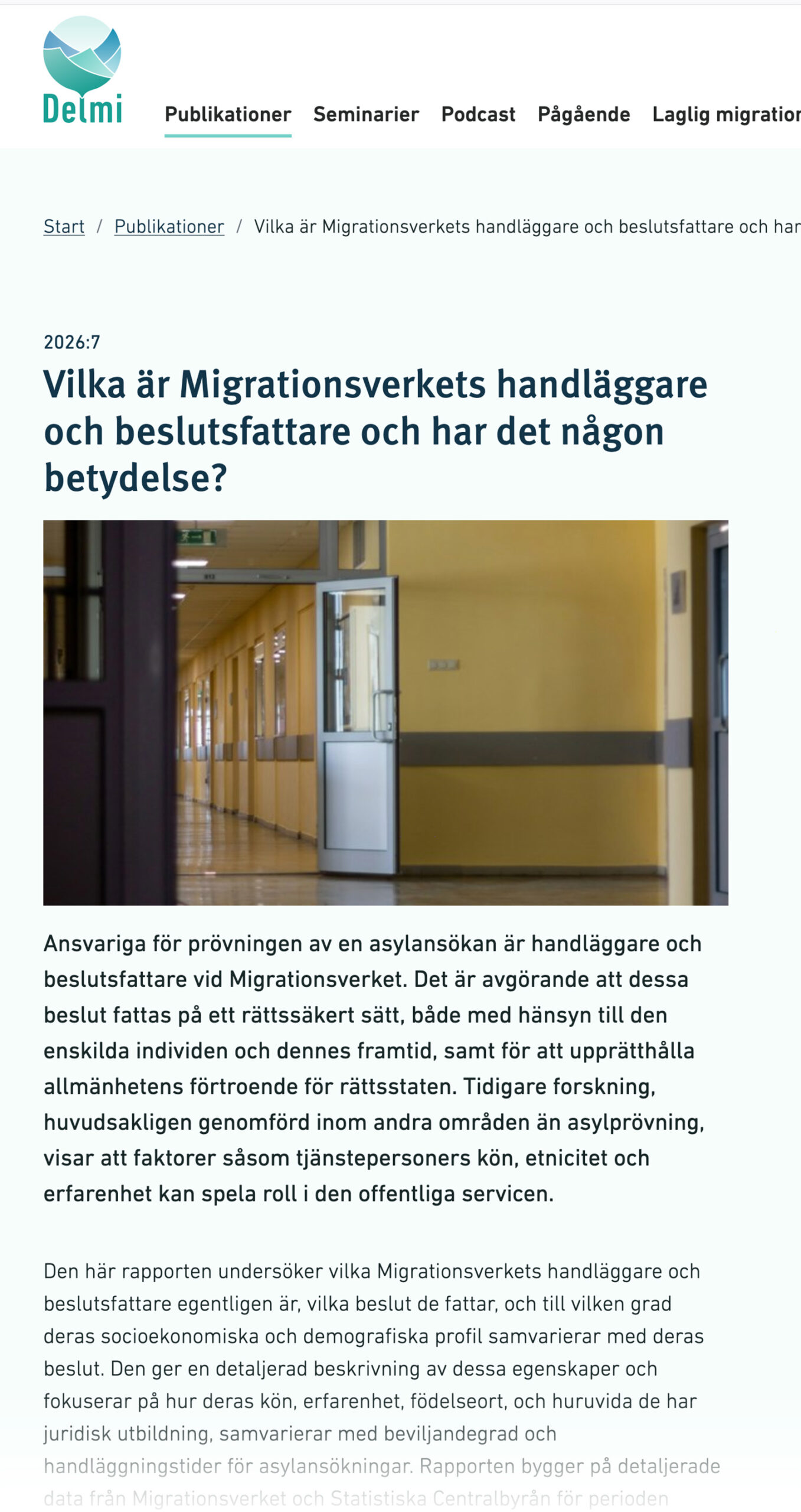
The report is based on information about 814 case officers and decision-makers as well as 55,312 first-time applications during the period 2020–2023.
The authors’ conclusion is that the results do not support theories that certain groups within the Migration Agency are more generous or restrictive than others when making decisions in asylum cases.
READ ALSO: Testimonies from inside the Migration Agency: “The Tidö government is the enemy”
But one of Samnytt’s sources inside the Migration Agency, with long experience at the authority, believes the figure is highly misleading.
After personally reviewing staff lists, the source estimates the share of employees with foreign names is significantly higher. In a previous interview, the source said that only about a third of the staff are Swedes.
Why look at foreign-born? Loyalty to the home country still remains. Especially in these cultures.
One of Samnytt’s sources at the Migration Agency
At the same time, the source sharply criticizes what he describes as Sweden’s inability to understand clan societies, cultural identity, and the conflicts that have accompanied migration to Europe.
READ ALSO: Inside the Migration Agency: Clans, Swedes in the minority, and culture of silence
The source says further that they have only managed a preliminary review so far, but the results have already made them question the much-debated figure of 18 percent.
– I spent about fifteen minutes today going through the lists. In the asylum units in Stockholm alone, I counted about 40 percent with foreign names, says the source.
According to the source, this is far from a scientific survey, but at the same time says that the 18 percent figure seems very unlikely. The source states they now plan to also review staff in work permits, family reunification, student cases and asylum review units to get a broader picture of the authority.
“Looking at the wrong thing”
The source believes the whole debate is based on false premises. According to the source, it is misleading to just focus on whether people are born in Sweden or abroad. They argue that cultural identity, religion, and kinship often play a much larger role than country of birth.
In what way, do you mean?
– Why should you look at foreign-born? Loyalty to the home country still exists. Especially in these cultures, the source says.
The source describes how, in their opinion, people often continue to live within the same cultural and social communities even after several generations in Sweden.
In Sweden, geography is everything. In clan systems, blood ties are all that counts. It doesn’t matter in which country you live.
One of Samnytt’s sources at the Migration Agency
READ ALSO: Migration Agency source about overtime: “They don’t say it’s about more citizenships – but it is”
– People talk about foreign-born. But it’s an entire culture, an entire clan that has come here. Then people are born within that clan and still belong to it.

“The conflicts from the Middle East follow here”
During the interview, the source also talks about conversations they have had with Syrian Christian colleagues at the authority.
According to the source, several of them describe how their children encounter tensions in Swedish schools which, they claim, have their roots in conflicts from the Middle East.
The colleagues supposedly do not live in vulnerable areas but in established middle-class neighborhoods with condominiums and terraced houses. Despite this, the children end up in conflicts with Muslim students.
– They told me about their children, who are seven or eight years old. And they already have problems with this at that age. The conflict from the Middle East then spreads into Sweden, the source says.
The source believes this shows that integration problems are not only about economics or residential segregation.
“In Sweden you think geography – they think kinship”
A large part of the anonymous source’s professional life has, according to them, been devoted to training about clan societies, not least with a focus on Somalia.
The source believes that Swedish authorities still analyze society based on nation-states and geographical borders, while people from clan-based societies tend to organize around family ties and kinship.
READ ALSO: Samnytt’s revelations about the Migration Agency put pressure on the government
Does this affect the credibility of the Delmi report?
– Absolutely. In Sweden, geography is everything. In clan systems, blood ties are all that matters. It doesn’t matter in which country you live, the source says.
The source describes the lack of understanding of these structures as a recurring problem in the public sector and believes Swedish decision-makers have long underestimated the significance of clan identity.
Despite the criticism, the source emphasizes that their review of the Migration Agency’s staff is still at an early stage.
READ ALSO: Ekeroth: “The scandal at the Migration Agency must have consequences”
The source plans to continue the mapping over the coming weeks and believes that the issue of the authority’s staff composition will receive greater attention in the future.
– This is something I think will come up more in the future as well, the source concludes.
At the same time, the report raises questions that are likely to continue being discussed. Delmi describes itself as politically independent, but the organization is government-funded and appointed by the government.
Furthermore, the report is based on the definition of foreign-born, while critics—including Samnytt’s source—believe that issues of cultural identity, family background, and social networks may be just as relevant when discussing the composition of government agencies.
The question, therefore, is not just what the report shows, but also which questions it chooses to ask—and which perspectives are left out of the analysis.
123 083 33 50