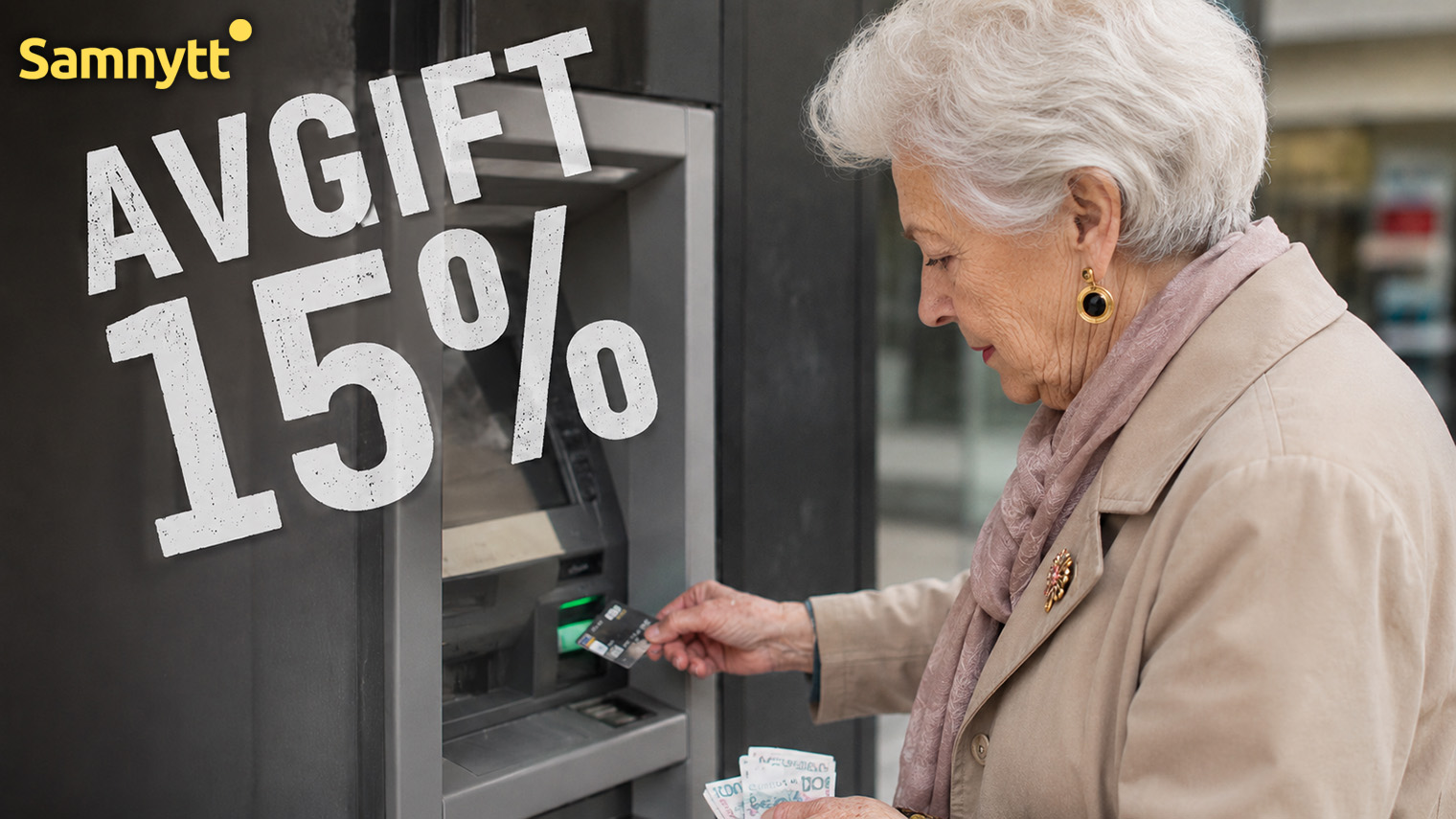
Accessing your own cash is no longer a given without an extra fee. In hundreds of ATMs across Sweden, charges have been introduced for cash withdrawals—fees that in some cases can amount to up to 15 percent of the withdrawn sum. At the same time, authorities are urging households to keep cash at home as part of crisis preparedness.
Anyone wishing to withdraw cash from one of Kontanten’s approximately 450 ATMs has, since May 29, had to pay a special withdrawal fee. For smaller sums, the cost can be remarkably high compared to the withdrawn amount.
The fees are 15 kronor for withdrawals of 100–200 kronor, 20 kronor for 300–1,000 kronor, and 25 kronor for 1,100–2,000 kronor. For those withdrawing 200 kronor, that’s an extra cost of 7.5 percent. For 100 kronor, the fee equals a full 15 percent of the withdrawn sum.
On its website, Kontanten describes its role as follows: “Since we are not affiliated with any bank, our ATMs often exist where there are no others and offer cash withdrawals close to you, wherever you live.”
Fees Entering the Swedish Cash System
Fees for cash withdrawals are common in many other countries, but have so far been rare in Sweden. The competitor Bankomat, which is owned by the major banks and operates around 1,200 machines, still does not charge users any fee.
READ ALSO: Thousands of ATMs Stand Empty in the Country
The change has sparked reactions among customers. Marcus Liljeblad is Sweden Director for Kontanten and says in a comment to DN that he knows customers are generally critical, but the company has chosen not to listen to that criticism. Instead, they hope customers will get used to it and show understanding.
Fewer Withdrawals—Higher Costs
According to Kontanten, the reason is that the economy behind the business has become increasingly difficult to manage. The compensation per withdrawal has, according to the company, remained unchanged for about two decades, while both costs and digital competition have increased.
The trend is clear in the statistics. The number of withdrawals from the company’s ATMs has dropped from around 15.5 million in 2017 to just under seven million in 2025—a drop of more than half in less than ten years.
“The equation just doesn’t add up anymore. We’ve reached a point where costs exceed revenue,” explains Marcus Liljeblad.
READ ALSO: Too Many Robberies and Violence—Now Police Want to Remove ATMs
At the same time, the decrease in cash usage is mainly because fewer businesses accept physical money as payment, and because banks have introduced rules that mean anyone using cash risks being suspected of money laundering for organized crime or terrorism.

Kontanten states that it has held discussions with, among others, the Riksbank, the County Administrative Board, the Swedish Post and Telecom Authority, Visa, Mastercard, and the major banks on how the costs for cash infrastructure should be distributed.
Marcus Liljeblad believes that several actors need to take financial responsibility if the country’s politicians want cash to be part of national preparedness. Until that happens, his company will charge a fee for every cash withdrawal.
Concerns that the Cash Chain Is Weakening
The trend worries Björn Eriksson, chairman of Kontantupproret. He believes that the fees are a symptom of a larger problem: that responsibility for Sweden’s cash supply is still unclear.
“If 450 ATMs disappear, that’s not a good sign,” he says to DN.
READ ALSO: Cash as a Means of Payment May Disappear
The issue has become especially relevant since both the Riksbank and the Swedish Parliament emphasized the importance of cash for societal preparedness.
Earlier this year, the Riksbank recommended that households should keep 1,000 kronor in cash per adult at home to be able to handle a week’s necessary purchases in the event of disruptions in digital payment systems.
At the same time, the Parliament has passed a new law strengthening the position of cash by requiring that staffed grocery stores and pharmacies must accept cash payments. The aim is both to help people who find it difficult to use digital payment methods and to strengthen society’s resilience in a crisis.
Laws Aren’t Enough If Cash Isn’t Accessible
Kontantupproret welcomes the new law but believes it should include more essential services, such as patient fees, passports, and vehicle inspections.
Björn Eriksson also points out that legislation risks having limited effect if people can’t easily access cash.
“It’s not enough that politicians pass a new cash law; they also have to ensure the cash chain works,” says Björn Eriksson.
The growing contradiction is clear: while the government urges citizens to keep cash at home as part of crisis preparedness, withdrawing it is now becoming more expensive. For many Swedes, this means that access to their own money is no longer free of charge.
Documentary: The War on Cash
This documentary was released in 2016 by Samhällsmagasinet, which is no longer active. With their permission, we at Samnytt have taken over the rights and are relaunching this important and timely documentary about the war on cash. Don’t miss it: