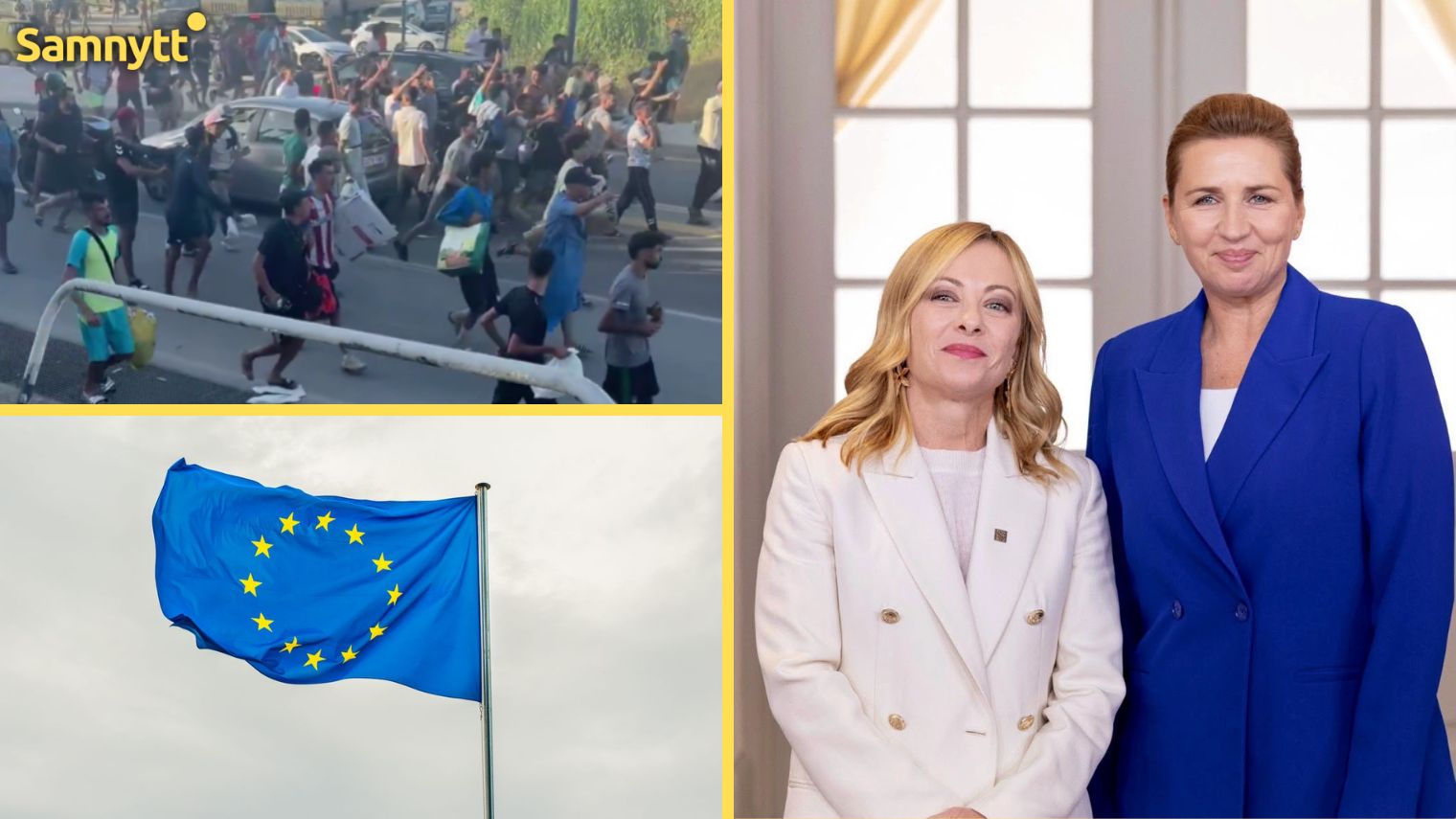
Italy’s Prime Minister Giorgia Meloni and Denmark’s Prime Minister Mette Frederiksen released a new joint message on Monday regarding Europe’s future, security, and values. The statements come as the conflict surrounding the Spanish exclave of Ceuta continues to create tensions among EU member states.
On Monday morning, Meloni published a joint message with Frederiksen. “A joint message for Europe,” Meloni writes, and continues: “Together with Mette Frederiksen, the Prime Minister of Denmark, we share some reflections on Europe’s future, the security of its citizens, and the need to defend our values and our way of life.”
The duo notes that respect for the laws of EU countries must go hand in hand with respect for European values and that both are proud of Europe’s Christian cultural heritage, which they want to protect.
This new initiative comes just days after Meloni and Frederiksen gathered support for a significantly broader European stance on the migration issue. On August 1, 22 EU countries signed a joint letter demanding swift and coordinated action following the dramatic events in Ceuta.
The countries called for, among other things, stronger external borders, more efficient returns, and measures against human smuggling. They also opened up to the possibility of temporarily reintroducing border controls when deemed necessary.
The letter was also a direct challenge to Spain’s Prime Minister Pedro Sánchez. In the letter, the 22 countries pointed out that national decisions on amnesty for people residing illegally in Europe could serve as a pull factor for further illegal migration.
Ceuta Was the Spark
The background is the dramatic migrant crisis in Ceuta at the end of July. Tens of thousands of people crossed from Morocco into the Spanish exclave in North Africa in a very short time. Spanish authorities reported about 50,000 arrivals, while local authorities had earlier spoken of around 60,000.
A large number subsequently returned to Morocco, but the events led to extensive political and diplomatic turbulence. The Sánchez government has claimed that, among other things, the crisis was exploited by human smugglers and criminal networks.
Brussels meanwhile emphasized that no continued migration flow from Ceuta to the Spanish mainland or onwards to other EU countries has been detected, and that special checks apply to people leaving the Spanish exclaves Ceuta and Melilla.
SEE ALSO: Migrant Surge Could Halt EU Freedom of Movement: “Invasion”
For Meloni and her European allies, however, the crisis has become an example of what they consider to be a weakness in Europe’s shared border protection. Italy therefore reintroduced controls for travelers from Spain, citing security risks after the Ceuta crisis.
Spain responded by imposing corresponding checks on travelers from Italy. According to Madrid, the Spanish controls will apply until September 7, while Italy’s measures were initially set to last until at least August 15.
Sánchez at the Center of Criticism
Another central part of the conflict is the amnesty implemented by the Sánchez government. Earlier this year, Spain opened up the possibility for about half a million so-called undocumented migrants to obtain legal status. According to the Spanish government, when the application period ended, more than a million people had applied to be included in the system.
Sánchez has defended the policy by arguing that Spain needs labor and that migration must be managed in an orderly way. The Italian government, on the other hand, has argued that such a policy could encourage increased illegal migration.
Foreign Minister Antonio Tajani, already during the Ceuta crisis, criticized Spanish policy, saying it risks creating incentives for human smuggling and further migration.
Sánchez hit back at the criticism, referring among other things to Frontex statistics. He pointed out that between 2021 and 2026, Italy had registered around 478,600 irregular entries compared to around 234,760 via Spain. The Spanish Prime Minister therefore argued that other EU countries should not use the Ceuta crisis to attack his country.
???????? A crowd of exclusively male African migrants runs down a street in Ceuta, chanting "Allahu Akbar."
The Spanish authorities continue to report that most of the migrants who illegally entered the city have returned home. pic.twitter.com/qQnrnttWBy
— Remix News & Views (@RMXnews) August 2, 2026
Several Countries Backed Meloni
Meloni and Frederiksen received support from several European governments. Sweden’s Prime Minister Ulf Kristersson (Moderates) urged Spain to quickly regain control of the situation and fulfill its obligations within the Schengen cooperation.
Finland’s Interior Minister Mari Rantanen went further, arguing that EU countries should support Italy’s stance that Spain could be excluded from Schengen if border protection failed.
Poland’s Donald Tusk also demanded that Spain act for Schengen to function. Germany, France, Austria, and Portugal took or considered various forms of strengthened border controls or other measures in response to developments. French President Emmanuel Macron expressed solidarity with Spain but simultaneously strengthened France’s border preparedness.
The EU Commission, however, has tried to keep member states together and highlighted that Spain and Morocco have cooperated to return migrants across the border. The Commission has also underscored that Morocco is on the EU’s list of safe countries of origin, which facilitates returns.
The conflict has thus evolved from a regional border crisis into a larger European dispute over migration policy. On one side stands the Sánchez government, defending its regularization policy and emphasizing Spain’s cooperation with Morocco. On the other are Meloni, Frederiksen, and a growing group of European governments seeking tougher external border controls, more efficient returns, and fewer national measures they believe could encourage illegal migration.
Today’s joint statement by Meloni and Frederiksen shows that cooperation between the two prime ministers now extends beyond the acute Ceuta crisis—to a broader discussion about the direction Europe should take on security, migration, and European values.
SEE ALSO: Green Party Leader on Criticism of Adult Arab Men Storming the EU: “Nonexistent Empathy”