
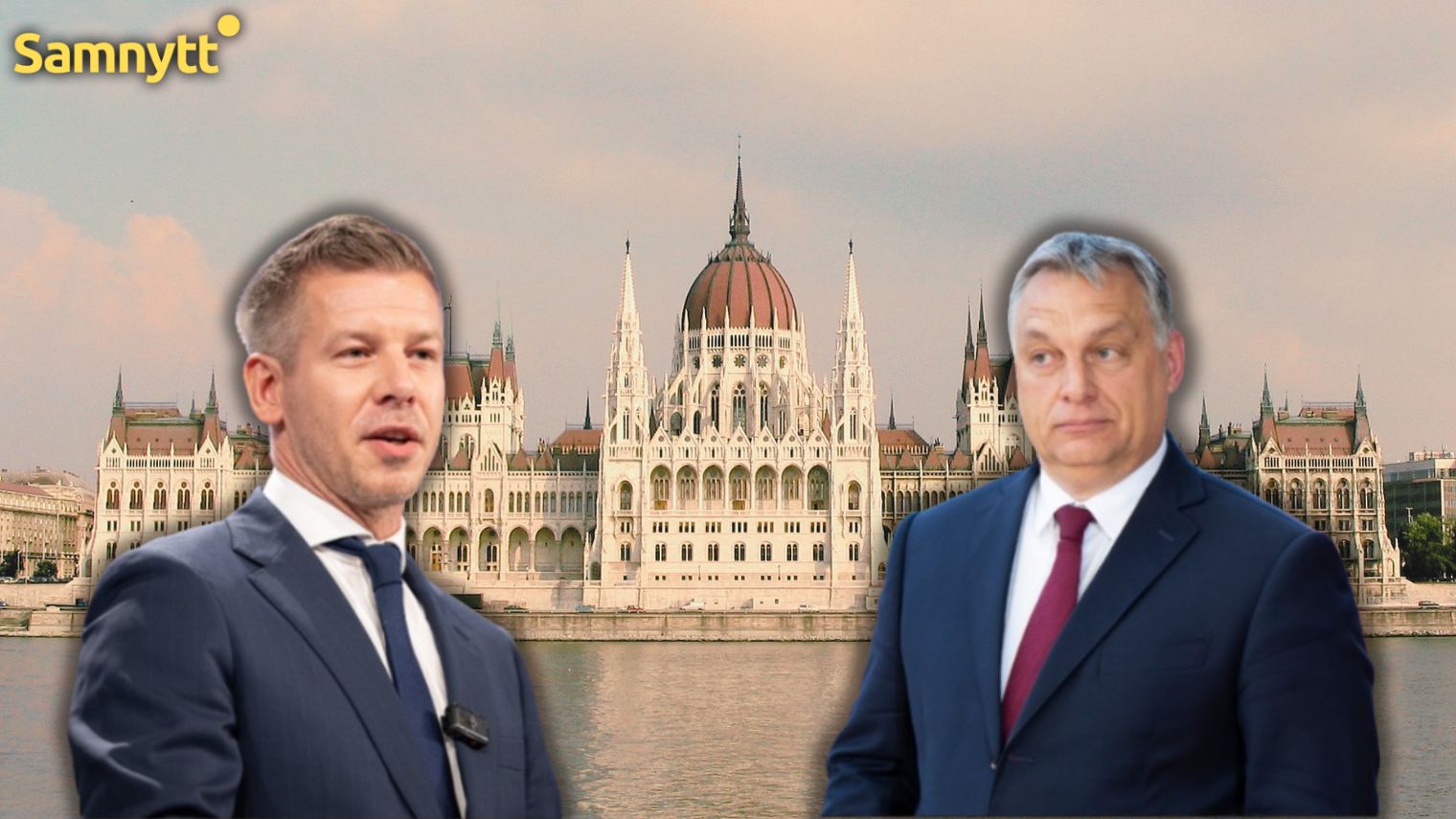
After Viktor Orbán’s fall, the new Hungarian government has launched a wide-ranging purge of the old power system. Constitutional amendments prevent Orbán from returning, experienced Fidesz politicians may be banned from remaining in parliament, and the country’s president has been dismissed prematurely. Meanwhile, Hungary has rapidly changed its policies in several areas where Orbán previously challenged Brussels. The British newspaper UnHerd describes the development as Europe having “conquered Hungary” — and accuses the EU of double standards as the new, Brussels-friendly government dismantles the power of its opponents.
The British writer and UnHerd columnist Thomas Fazi, in a lengthy analysis, describes what has happened in Hungary since Péter Magyar and his party Tisza took power from Viktor Orbán.
The article was published on August 6 under the headline “How Europe conquered Hungary,” with the subheading “Liberal authoritarianism is on the move.” Fazi’s thesis is that the new government is not content with changing Orbán’s policies but is trying to reshape the political system in a way that makes it very difficult for Fidesz and Orbán to ever return to power.
The new government’s offensive goes by the name “Operation Purgatory” and, according to UnHerd, consists of both administrative measures and far-reaching changes to the Hungarian constitution.
Constitutional amendment bars Orbán for life
One of the most far‑reaching changes is the 16th amendment to the constitution. This introduces a maximum total term of eight years, equivalent to two terms, for the Hungarian prime minister.
The rule applies retroactively. Since Viktor Orbán has already served a total of about 20 years as prime minister, the change means he is personally barred from ever holding the office again.
UnHerd describes the provision as so directly targeted at the former prime minister that critics have begun referring to it as “Lex Orbán.”
SEE ALSO: Ekeroth: “Hungary shows the left’s anti-democratic values”
Fazi also questions the very principle behind this limitation. Term limits for presidents exist in many countries, but they are much less common in parliamentary democracies where the head of government depends on support from a majority in parliament.
The practical consequence is that Hungarian voters can no longer return Orbán to the post of prime minister, regardless of the support he or Fidesz might receive in the future.
Veteran politicians banned from remaining
But the changes do not stop with Orbán. The 17th amendment to the constitution also introduces a twelve-year cap for how long a person can be a member of the Hungarian parliament. This provision also mainly targets the old political opposition.
Fidesz and its ally KDNP have been central players in Hungarian politics for several decades, and according to UnHerd, risk losing much of their most experienced politicians. None of the current members from the ruling Tisza party are affected by the limitation.
Fazi notes, however, that the change does not only hit the right. Several veterans of the Hungarian left also risk being disqualified from future parliamentary work. The result, he says, is that a large part of the old political class disappears at once.
The president dismissed by constitutional amendment
Even more remarkable is the treatment of Hungary’s former president Tamás Sulyok. Sulyok was elected by parliament in February 2024, and his term was supposed to run until 2029. After Tisza’s election victory, Magyar accused him of being a political extension of Orbán and demanded his resignation. When Sulyok refused, the government, under the existing constitution, could have tried to remove him through a special impeachment-like procedure.
Instead, the issue was resolved by the government majority changing the constitution itself. One of the amendments simply stated that the sitting president’s term would end on the same day.
SEE ALSO: Ekeroth: “When EU friends dismantle the rule of law, Swedish media suddenly fall silent”
UnHerd describes the procedure as “Lex Sulyok” and notes that no previous Hungarian government has gone so far as to remove a sitting president in this way. Even Amnesty International in Hungary, according to UnHerd, criticized the process. Sulyok also turned to the Council of Europe’s Venice Commission, which reviews constitutional issues and rule of law principles.
No verdict came, however, before the dismissal. According to the article, the commission’s review is expected later in the year.
Changes also to the Constitutional Court
The new government has also targeted judicial institutions.
An obligatory retirement age of 70 has been reintroduced for judges on the Constitutional Court. According to UnHerd, this means that the court’s president and three other judges will be forced to leave. Magyar’s government, therefore, has the opportunity to significantly alter the court’s composition during its very first term.
Simultaneously, a new authority has been created with the task of tracking and reclaiming public assets allegedly handled or used illegally under the previous government.
The problem, according to Fazi, is not that suspected corruption is being investigated, but that the new authority’s mandate is specifically aimed at the former Fidesz government, despite Hungary already having other institutions that can investigate crimes and corruption.
Former Green Party leader András Schiffer, quoted by UnHerd, claims that the purpose is to make it politically impossible for Fidesz to compete for power through legal processes and public inquiries.
Public service halted – raids against Fidesz
The constitutional changes are, at the same time, just one part of what UnHerd describes as a major offensive against Orbán’s old power apparatus.
The new government has, among other things, halted the news division within the country’s national public service media. Institutions with links to the previous government, including Mathias Corvinus Collegium and Danube Institute, have also been affected.
Authorities have also conducted a raid on premises where Fidesz servers were located. Databases were seized and the party’s website, according to UnHerd, was taken offline.
SEE ALSO: Liberal dictatorship is also dictatorship
Fidesz and Orbán have therefore accused the Magyar government of dismantling the separation of powers, attacking independent institutions, and using the state apparatus to persecute the opposition.
The irony, Fazi notes, is that many of the accusations are the same as those the EU and Orbán’s critics directed at Fidesz during its time in power.
The difference, according to Fazi, is that the new government has gone further in certain areas than Orbán did. In particular, he notes the removal of the president and rules that directly prevent named or clearly identifiable political opponents from returning to power.
Hungary’s foreign policy is being reshaped
At the same time as the old political structure is dismantled, Hungary’s previous lines of conflict with the EU have quickly started to disappear.
During his time in office, Orbán made Hungary one of the EU countries most clearly opposed to parts of the union’s policies towards Russia and Ukraine. The new government has moved in the opposite direction.
According to UnHerd, Magyar has lifted Hungary’s veto of the European Peace Facility, through which EU countries are compensated for, among other things, weapons sent to Ukraine. Hungary no longer opposes opening accession negotiations between Ukraine and the EU. Magyar has also signaled that Hungary will no longer use its veto to block further sanctions against Russia.
Meanwhile, the government is expected to gradually reduce dependence on Russian oil and gas and dismantle elements of Orbán’s economic policies, including price controls and energy subsidies.
EU released ten billion euros
It is above all the EU’s actions after the change of government that underpin UnHerd’s harsh conclusion. During Orbán’s government, Brussels withheld large sums of EU funds, citing problems with the rule of law and democratic institutions. Following the change of government, about ten billion euros of previously blocked funds have been released, according to UnHerd.
For Fazi, the contrast becomes especially stark because the new government is, at the same time, taking measures that he considers at least as problematic with regard to the rule of law principles that the EU previously invoked against Orbán.
He also points to how parts of the liberal Hungarian legal establishment have changed their attitude after the new government took office.
For example, in an article in the legal journal Verfassungsblog, the dismissal of the president has been defended as an exceptional but acceptable step, since the new majority is considered to be trying to build a new state structure that supports the EU’s core values.
For Fazi, this illustrates a fundamental contradiction: interventions in the normal rules of the rule of law can be accepted when carried out in defense of what is simultaneously described as the rule of law and EU values.

Comparison to Poland
UnHerd also draws parallels to Poland after Donald Tusk’s EU-friendly coalition took power in 2023.
There too, the new government ended up in strong conflict over, among other things, public service and the judiciary when institutions established under the previous PiS government were to be taken over or changed.
SEE ALSO: The silence about the Polish left government’s abuses against the media is telling
Despite the controversies, the EU’s relationship with Warsaw quickly changed, and previously blocked EU funds were released.
Fazi argues that the same pattern can now be seen in Hungary: when a government is in conflict with Brussels, institutional violations are judged harshly, while much greater tolerance is shown when an EU-friendly government uses extraordinary means to dismantle the previous government’s system.
SEE ALSO: Feature: Poland’s new prime minister strives for absolute power
“Europe conquered Hungary”
It is in this context that UnHerd arrives at the article’s provocative conclusion.
According to Fazi, the development is not just about Viktor Orbán losing an election and being replaced by a government with different policies.
The new political order is, he claims, being built so that Orbán’s earlier EU-critical line becomes difficult to reestablish, even if public opinion were to shift again.
Orbán himself is barred from returning as prime minister. Many of his most experienced parliamentarians are likely to disappear. The Constitutional Court is being changed. Institutions linked to the old government are being dismantled or placed under investigation. Meanwhile, economic policy, policy toward Russia, and policy toward Ukraine are all being aligned with the line long driven from Brussels.
This is why Fazi describes it as the EU not only having managed to defeat perhaps its most troublesome member state politically, but also having ensured that the same resistance cannot easily arise again.
UnHerd sums up the development with the phrase that the EU seems to want to “punish the rebellious colony” by making sure it can never revolt again.
It’s a strong conclusion, but the changes underlying it — Orbán’s lifelong ban from the premiership, the time limit for parliamentarians, the early dismissal of the president, changes to the Constitutional Court, and the rapid shifting of Hungary’s EU and Ukraine policies — are also at the core of the development now being highlighted by the British newspaper.