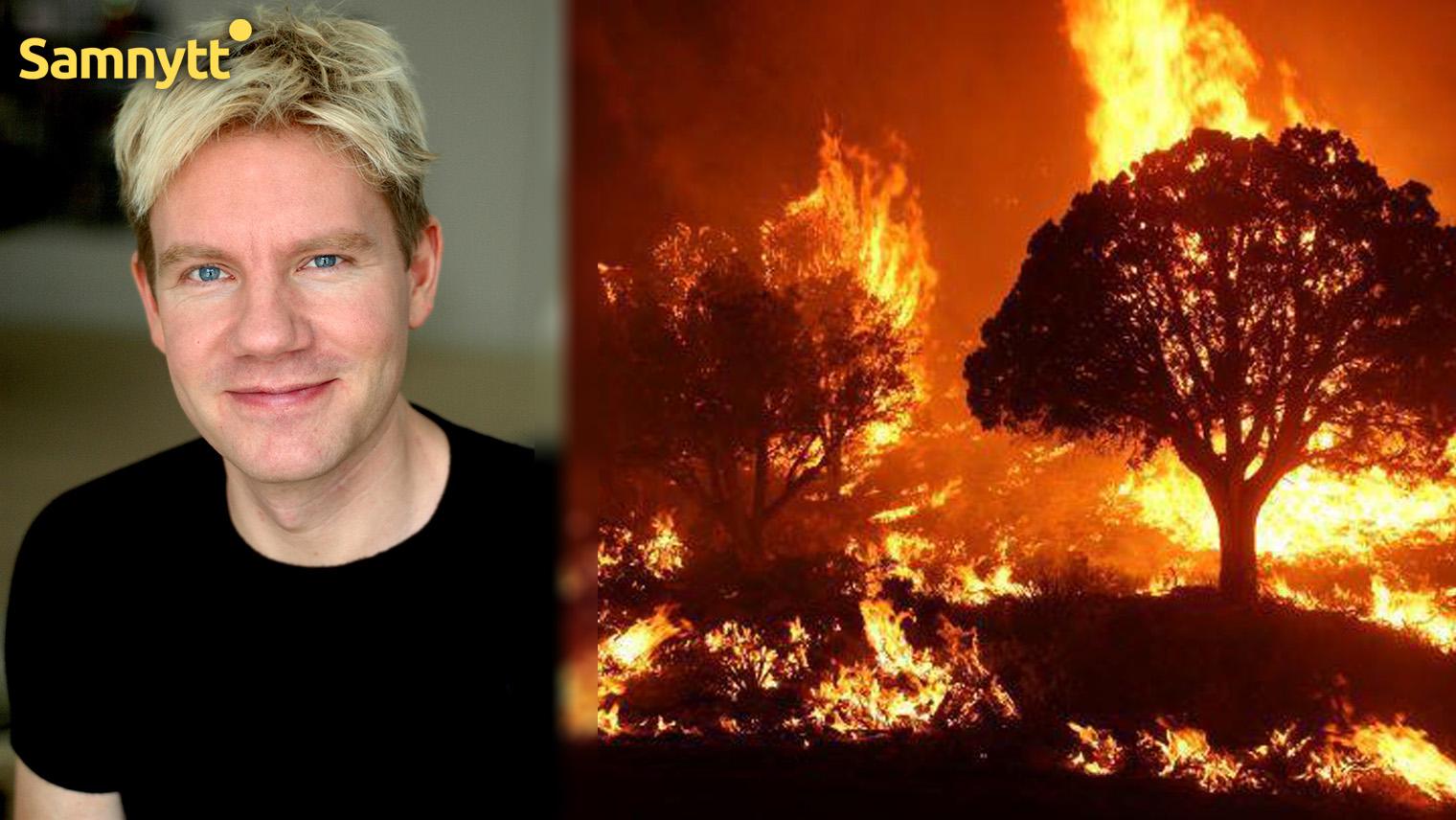
Media reporting paints a picture of a planet in flames due to climate change. But global statistics tell a completely different story. According to political scientist and climate commentator Bjørn Lomborg, the annual area affected by fires has almost halved over the past hundred years, and 2026 may become a record year with exceptionally few fires. He now criticizes the media and politicians for ignoring this trend and advocating costly climate measures instead of more effective firefighting.
The widespread forest fires in France and Spain have caused massive destruction this summer, forcing hundreds of thousands of people from their homes. Meanwhile, smoke from Canadian wildfires has spread across American cities, fueling new alarmist reports about the consequences of climate change.
Yet behind these dramatic images, a completely different global development is taking place, claims Danish political scientist and climate commentator Bjørn Lomborg, head of the Copenhagen Consensus Center and affiliated with Stanford University’s Hoover Institution. In three articles, published in the Wall Street Journal, The Telegraph, and Business Day in August, he delivers sharp criticism against what he describes as one-sided and misleading reporting on the world’s forest and land fires.
41 Percent Less Burned Land Than Normal
According to satellite data referenced by Lomborg, the cumulative land area affected by fire worldwide up to August 19 this year was 41 percent lower than the average for the same period in 2012–2025. If the trend continues, 2026 could be the year with the smallest burned land area since satellite measurements began in 2001, and possibly even the lowest since the early 1900s.
SEE ALSO: Researcher: Climate Threat to Global Food Overstated
Lomborg emphasizes that the long-term trend is even clearer. At the beginning of the last century, nearly four percent of the Earth’s land area burned annually. Today, that proportion is roughly half as large. According to him, this is not a random fluctuation, but the result of improved agriculture, more effective land use, and modern firefighting.
– Climate change is a global problem and should therefore be assessed with global data. To point at severe fires in a corner of a continent while ignoring that there is markedly less fire across the planet as a whole is the very definition of cherry-picking facts to suit one’s own narrative, writes Lomborg.
Europe Has Had Fewer Fires
That individual countries are severely affected does not necessarily mean, according to Lomborg, that fires are increasing on a broader geographic scale. France and Spain have endured a difficult fire season, but according to his compilation, the burned area in Europe (excluding Russia) as of August 19 was still 27 percent below the average for the same period in 2012–2025.
The fact that Russia is sometimes included in European statistics has occasionally been offered as an explanation for the low numbers, since the country encompasses enormous forest areas. But even when Russia is completely excluded, a clear reduction remains. The same pattern recurs on other continents.
SEE ALSO: Researcher: Europe’s Climate Policy Is Economic Suicide
In North and South America, the combined fire-affected area was at record lows for the satellite series. In Africa, where the largest land areas usually burn, levels were 43 percent below average. Oceania saw a 16 percent reduction, and even Asia reported unusually low levels.
Canada, whose widespread fires and smoke have received major media attention, also had a smaller burned area than the average. Lomborg argues that this illustrates how dramatic local events can create a misleading impression of the global trend.
Climate Change Has an Impact – But It’s Not the Whole Explanation
Lomborg does not deny that a warmer climate can increase fire risks. Higher temperatures can dry out vegetation and prolong the periods during which fires can start and spread more easily. But he maintains that human management of land and forests primarily determines how extensive fires actually become.
Among other things, he notes that effective firefighting can paradoxically contribute to future major fires. When small fires are consistently extinguished, dead wood, shrubs, and other combustible vegetation can accumulate over time. If a fire does eventually arise, huge amounts of fuel are available, making it much harder to control.
Climate alarmists????
They scream: World on fire!
Data: No
Alarmists: Oh wait, real problem is droughts, not fire
And show fake map:
Many countries wrong (Russia not red)
Not drought (“not a score of countries currently in drought”) but drought risk
https://t.co/mKSNi91TXf
— Bjorn Lomborg (@BjornLomborg) October 1, 2026
As an example, he mentions Canada, where the area treated with controlled burns has dramatically decreased according to his sources. In 1990, more than 35,000 hectares were managed through such burning. By 2023, the figure had fallen to just 182 hectares — a reduction of 99.5 percent.
Lomborg believes this development helps to explain why Canada has sometimes suffered particularly large fires, despite the long-term trend being downward.
Fewer Deaths Due to Smoke from Fires
Another trend Lomborg believes receives too little attention concerns mortality from air pollution caused by vegetation fires. Referring to a study published in the medical journal The Lancet in 2024, he writes that deaths from such air pollution have dropped substantially since 2000.
SEE ALSO: Researcher: Reason Must Prevail Over Climate Panic
According to his calculations, wildfire smoke causes about 1.6 million deaths worldwide annually. This is still a very high number, but about 400,000 fewer than if the mortality rate relative to population had remained at the same level as in 2000. He points out that this positive trend is rarely noted in climate reporting.
Criticizes Climate Measures – Advocates Better Forest Management
Lomborg is particularly critical of the way massive emission reductions are often presented as the most important solution to forest fire problems. He argues that even the most far-reaching climate measures would have a relatively minor impact on fire risk over the next few decades.
For example, he refers to model calculations of the devastating Palisades Fire in Los Angeles in 2025. Without further climate measures, a similar fire in 2050 could be about 7.2 percent more intense, the calculations suggest. Even with extensive global emission reductions, the increase would still be around 5.5 percent.
With better preventive actions, such as controlled burning, clearing flammable vegetation, building fire-resistant structures, and careful urban planning, however, the model suggests the fire’s intensity could decrease by about 15.4 percent compared to 2025. Lomborg therefore believes resources should be much more heavily invested in concrete preventive actions.
Criticizes the Media for Spreading a False Picture
The recurring criticism in Lomborg’s articles targets the media’s selection of news. Large and devastating fires receive extensive coverage, while years with unusually little burned land area rarely get any attention at all.
The result, according to him, is that the public gets the impression that wildfires are constantly increasing in number and intensity, even though global statistics on burned land area show a long-term decline. He also questions why climate change is regularly blamed for large fires, while other factors are much less often highlighted.
– If climate change is to be blamed for every fire, then to be logically consistent, it should also get the credit when burned land area decreases, he writes.
Lomborg concludes by warning that a one-sided focus on emission reductions risks overshadowing the need for effective local fire management policies. His conclusion is that people affected by wildfires need better preventive actions and more effective protections — not a climate policy debate that, in his view, too often overlooks the most immediate and practically achievable solutions.