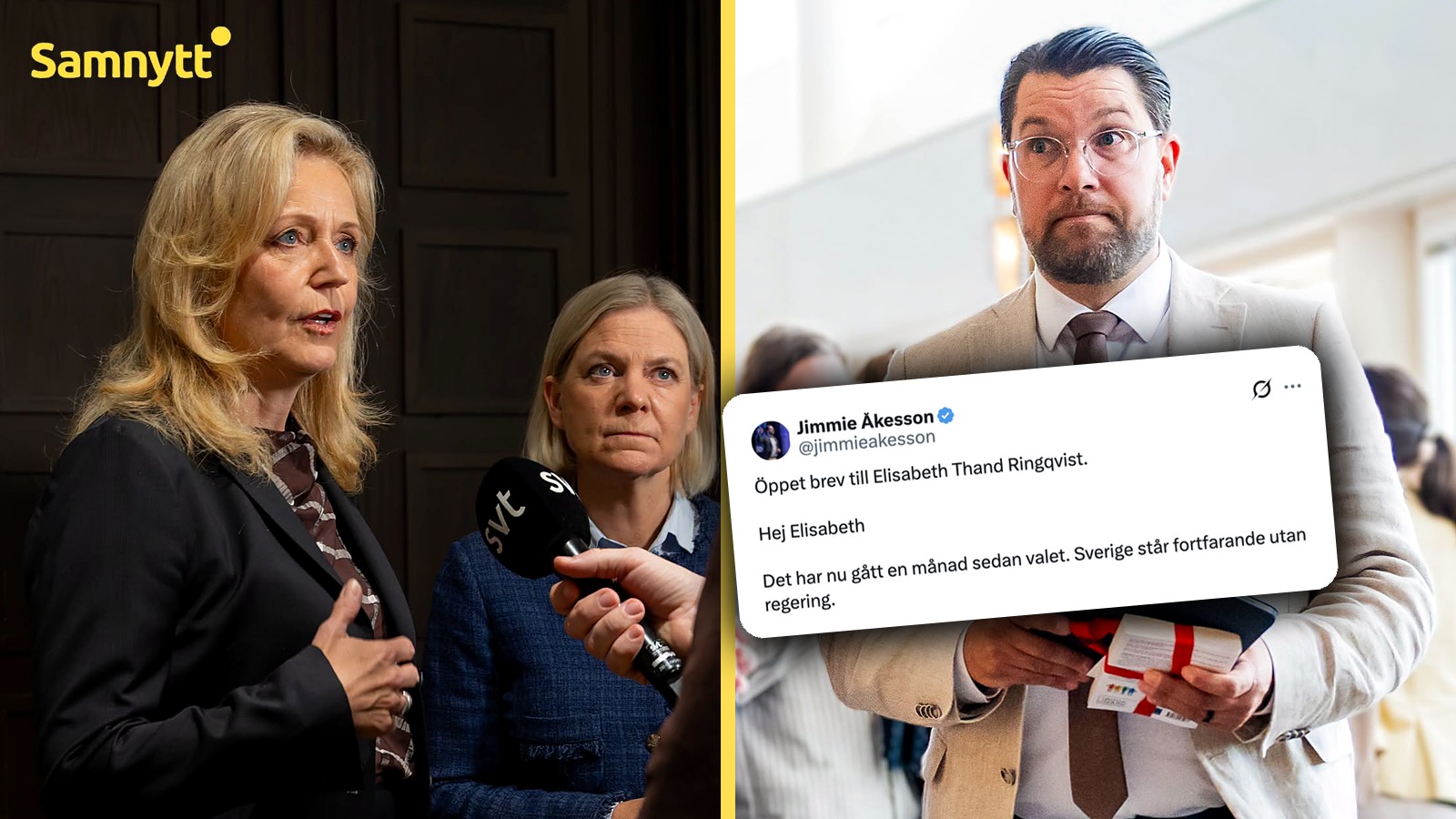
Sweden Democrats leader Jimmie Åkesson reaches out to the Centre Party’s Elisabeth Thand Ringqvist in an attempt to break the political deadlock in the parliament. In an open letter, he invites the Centre Party leader to a meeting without preconditions and emphasizes that the Sweden Democrats have no red lines for talks. At the same time, the party stands firm on its demand to either be part of a government or to go into opposition.
It is in an open letter on social media that Jimmie Åkesson addresses the Centre Party’s leader, Elisabeth Thand Ringqvist, directly.
The background is the deadlocked parliamentary situation following this week’s prime minister vote, in which all parliamentary parties except the Social Democrats voted against Magdalena Andersson.
The Sweden Democrats’ leader describes the situation as concerning and argues that the political divisions between parties in parliament risk making it more difficult to form a functional government.
He specifically points to the deadlock between the Sweden Democrats and the Centre Party, who have long stood far apart on the issue of forming a government.
With this letter, I would like to invite you to a meeting and an unreserved discussion about the parliamentary situation and the deadlocks that evidently exist. Not least between our respective parties.
– Jimmie Åkesson
Questions the Possibilities
Åkesson also sends a clear message to the Centre Party and its prospects of creating a workable government foundation together with the red-green parties. He questions how parties with such different political starting points could agree on a common government policy.
As an outside observer, I find it very difficult to see how you will be able to form a functional government given the current conditions.
– Jimmie Åkesson
The Sweden Democrats’ leader also refers to the unsettled international situation and stresses that Sweden needs a stable and decisive government. According to Åkesson, the country cannot afford for political divisions to continue blocking the formation of a government, especially not in a time marked by global uncertainty and major security policy challenges.
He therefore warns of what he describes as “a political deadlock allowed to continue indefinitely.”
Sticks to the Demand for Government Participation
Even though Åkesson is open to talks with the Centre Party, the invitation does not mean that the Sweden Democrats are prepared to abandon their previous position on the party’s role in a future government.
The Sweden Democrats’ leader emphasizes that the party has no red lines regarding political talks, but also underlines that the Sweden Democrats do not intend to settle for the role of a supporting party to a government in which they themselves lack ministerial posts.
Our position remains unchanged. We will either be part of a government or be in opposition.
– Jimmie Åkesson
Thus, the Sweden Democrats’ previous demand stands, while Åkesson signals a willingness at least to try to bridge the differences that have so far characterized the relationship between the parties.
Åkesson’s invitation comes at a time when government formation remains unresolved after Magdalena Andersson was voted down in the parliament. The Speaker, Andreas Norlén, is expected to announce new information on Monday about how the process will continue and what possibilities exist to find a candidate for prime minister who can be tolerated by parliament.
The Full Letter
Open letter to Elisabeth Thand Ringqvist.
Hello Elisabeth
It has now been a month since the election. Sweden still has no government.
Four years ago, the Tidö Agreement had already been presented at this point and the practical basis for a new government cooperation had been established. The contrast to today’s situation is in many ways striking.
Parliament has now voted against Magdalena Andersson and we are awaiting the speaker’s decision on who will get the next exploratory mandate. From several quarters, Ulf Kristersson is being pointed out as the next in line. This, despite the fact that the parties that went into the election with Magdalena Andersson as prime ministerial candidate actually hold a majority in parliament.
Just as after the 2018 election, government formation now seems to hinge on your red lines. The difference is that this time the situation appears even more complicated, not least because the Left Party is now demanding to be included in the government. As an outside observer, I find it very difficult to see how you will be able to form a functional government given the current conditions.
The international situation is still uncertain, and unfortunately, it seems it will remain so for the foreseeable future. It is important that we have a government under such circumstances with a mandate to navigate according to Sweden’s interests.
Quite simply, Sweden cannot afford a political deadlock that is allowed to continue indefinitely.
It is against this background that I now turn directly to you. With this letter, I would like to invite you to a meeting and an unreserved conversation about the parliamentary situation and the deadlocks that are clearly present. Not least between our respective parties.
As is well known, my party has no red lines and it is my firm belief that we politicians and those in power must be able to sit down and talk about things that concern us all, no matter how far apart we are politically. I am also convinced that this is something that voters, quite rightly, expect from Sweden’s political leaders.
To avoid misunderstandings and unnecessary speculation, I would like to be clear about one thing. This invitation does not mean that the Sweden Democrats are changing their stance regarding our own role in the government issue.
Our position remains unchanged. We will either be part of a government or be in opposition.
This position does not, however, prevent talks. It never has. Being able to talk is not the same as agreeing, and being political opponents does not have to mean that you refuse to meet and talk.
It may be tempting to interpret this as yet another chapter in the political game. But forming a government is not a game. A prolonged deadlock, especially combined with a very troubling international situation, risks being directly harmful to Sweden – harmful to the hard-working Swede, to growth, to business, and not least to sparsely and rural areas.
Elisabeth, we do not need to agree on Sweden’s political direction to be able to talk to each other about Sweden’s parliamentary situation. On the contrary, it may be precisely when divisions are greatest that the need to meet is most pressing.
I look forward with confidence to your response.
Sincerely
Jimmie Åkesson