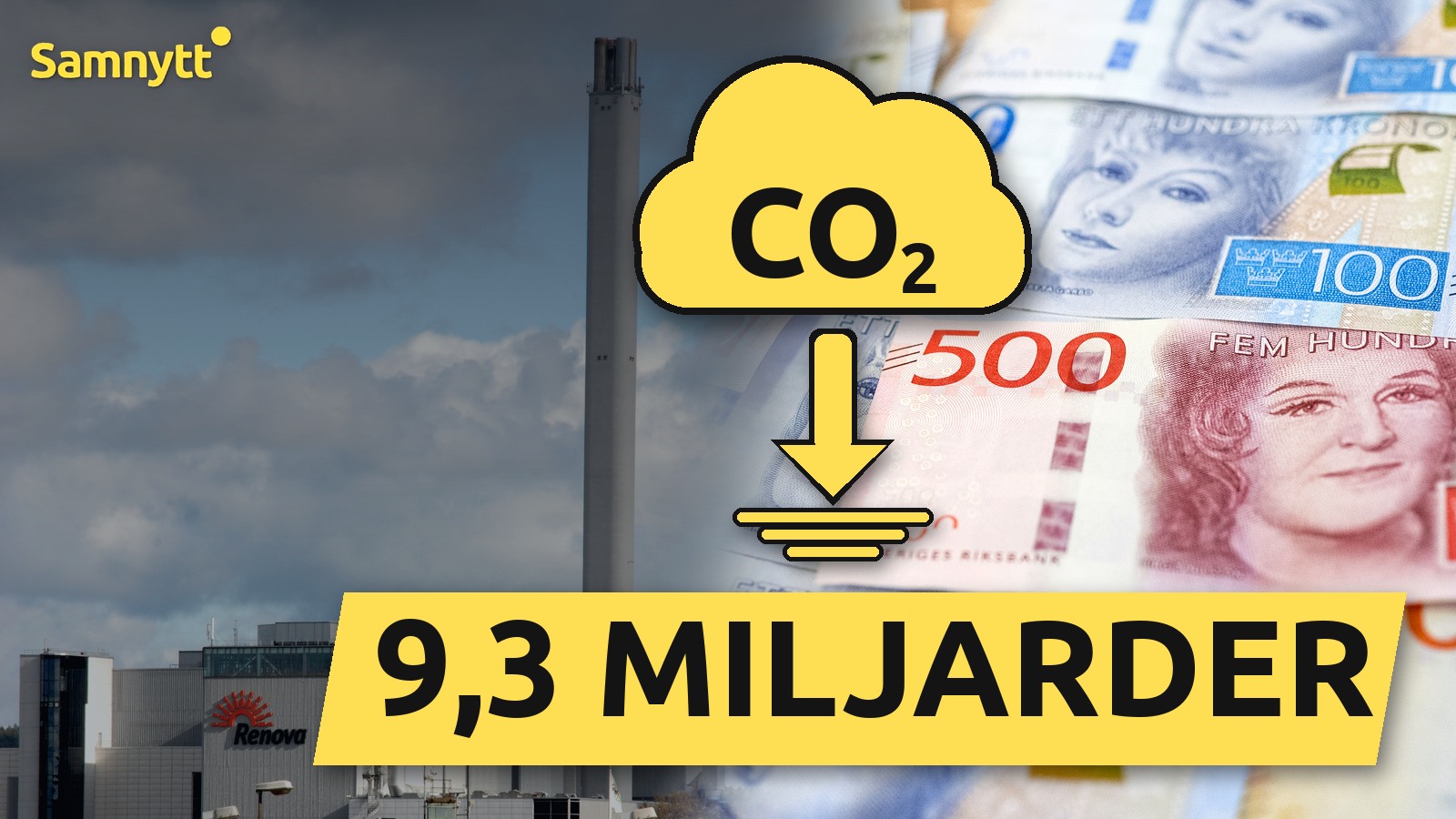
Waste and energy companies Renova, Sysav, and Öresundskraft will jointly receive SEK 9.3 billion from the state to capture carbon dioxide from their facilities and store it deep underground. Together with the SEK 20 billion allocated to Stockholm Exergi last year, the government has now pledged about SEK 29.3 of the SEK 30.7 billion set aside for the technology through 2046. At the same time, the Swedish Energy Agency itself notes that the costs have become significantly higher than anticipated.
The money is distributed in the second so-called reverse auction, where companies compete to store carbon dioxide at the lowest possible subsidy per tonne. Only three companies applied when the application period closed on August 13, and all three are receiving support, according to the announcement from the Swedish Energy Agency on Friday.
Sysav in Malmö plans to store 3.6 million tonnes of carbon dioxide during the subsidy period, Öresundskraft in Helsingborg 1.26 million tonnes, and Renova in Gothenburg 890,000 tonnes. In total, this makes 5.75 million tonnes. All three companies are municipally owned. Storage must be operational no later than four years after the decision, and funds are paid out in line with the actual amount of carbon dioxide stored. The subsidy can be used both to build the facilities and to operate them.
On average, the state will pay just over SEK 1,600 for each tonne of carbon dioxide stored. The agency does not disclose how much each company receives per tonne. In the first auction, Stockholm Exergi received SEK 1,760 per tonne to store just over 11 million tonnes over 15 years.
READ ALSO: The Next Green Bubble? Billions for Carbon Capture Face Harsh Criticism
More Expensive and Slower Than Estimated
In a report to the government this spring, the Swedish Energy Agency writes that the costs for separating, transporting, and storing carbon dioxide are considerably higher than the agency itself estimated in 2021. The projects are also taking longer than expected. The cited reasons include geopolitical unrest, political uncertainty, and general cost increases. The companies have also been given four years instead of three to achieve initial storage, having argued that the earlier timeline was too short.
At the same time, the government has reduced the size of the fund. Initially, SEK 36 billion was allocated, but the 2026 budget lowered that to SEK 30.7 billion. According to the agency’s calculations, this means just over 3 million tonnes less stored carbon dioxide. The entire support system is now expected to result in nearly 17 million tonnes of stored carbon dioxide by 2046.
Öresundskraft Was Rejected Last Time
In the first auction, six companies applied, but only Stockholm Exergi received support. Öresundskraft was one of the companies rejected in January 2025. Since Stockholm Exergi took two-thirds of the budget, money was the limiting factor for how many could receive support this time around. After the first auction, some stakeholders already felt that too much of the budget was granted to a single project, according to the review published by the agency in spring 2025.
Government support is not the only source of revenue. Stockholm Exergi’s project is also funded with money from the EU’s innovation fund and by selling so-called negative emissions—credits that other companies can buy to offset their own emissions. For the second auction, only such revenues that were already secured could be deducted, and new revenues must be reported so the subsidy can be adjusted.
READ ALSO: Green Project Consumes Money – Turns to Taxpayers
Only carbon dioxide from biological material, such as forest raw material, is eligible for support. When waste is incinerated, carbon dioxide from fossil sources like plastic is also generated. If this must be captured for the facility to function, the companies must cover those costs themselves.
The Support Has Been Appealed in the EU
The support system was approved by the EU Commission in 2024, but the decision has been appealed to the EU tribunal by the company Danube CCS Ventures. The Swedish Energy Agency has provided documentation to the Government Offices of Sweden for the legal process.
The agency views the decision as a step toward the climate goal of net zero emissions in 2045. Director General Caroline Asserup also argues that the support creates business opportunities in a new sector, strengthening Swedish competitiveness.