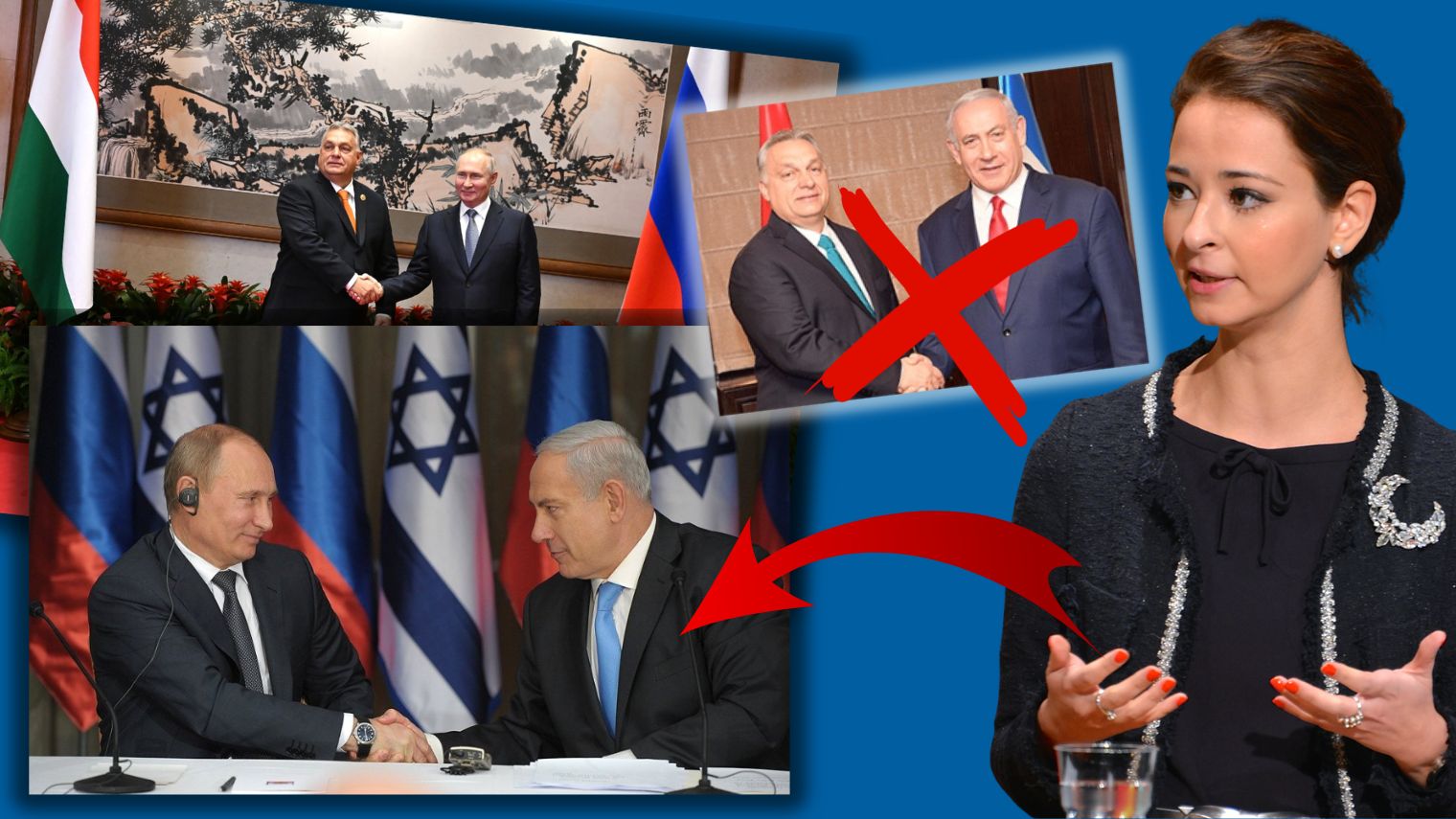
On Monday, it was noted that Israel’s Prime Minister Benjamin Netanyahu sent a video greeting to Hungary’s Prime Minister Viktor Orbán, praising him as a strong leader ahead of the April election. This drew strong reactions from pro-Israel liberals, who branded him as pro-Russian. SVT personality Edward Blom called the whole thing “horrible” and “over the line.” He argued that Netanyahu is therefore “for Russia and against democratic Europe” — a view that EU parliamentarian Alice Teodorescu Måwe (KD) agreed with. At the same time, both seem to have missed that Israel has a relationship with Russia similar to Hungary’s, maintaining contact with Putin after the invasion, with no sanctions and no weapons delivered to Ukraine.
The background is that Israel’s conservative Prime Minister Benjamin Netanyahu is giving clear support to Hungary’s conservative Prime Minister Viktor Orbán ahead of next month’s election, describing him as a leader who “has been like a rock” for Hungary.
That is something U.S. President Donald Trump also did last week. On Saturday, Trump expressed his “full and total support” for Orbán ahead of Hungary’s election.
In a video message to the conservative conference CPAC in Hungary, Trump said, among other things:
“The Prime Minister has been a strong leader who has shown the world what is possible when you defend your borders, your culture, your heritage, your sovereignty, and your values.”
Trump also highlighted Hungary’s “strong borders” and noted the country will continue to work hard on migration policy with Orbán at the helm.
???????????????? Thank you for your support, Mr. President @realDonaldTrump! pic.twitter.com/3Ng3LUpgUy
— Orbán Viktor (@PM_ViktorOrban) March 21, 2026
In another video message to the CPAC conservative conference in Budapest, Netanyahu said:
“We need leaders who can protect against this growing wave of Islamist terrorism and who can ensure security and stability for their own countries. This is something Viktor Orbán has in abundance,” he said, continuing:
“Viktor Orbán means security, safety, and stability.”
He went on to thank Hungary for standing up for Western civilization and against radical and fanatic Muslims.
Israeli Prime Minister Netanyahu supports Orban, the enemy of Europe and friend of mass murderer Putin, in the Hungarian parliamentary elections:
"I want to thank my friend Viktor Orban. He has been like a rock. We live in turbulent times.
We need leaders who can stand up to… pic.twitter.com/SSa8avyzbd
— Jürgen Nauditt ???????????????? (@jurgen_nauditt) March 22, 2026
These messages have led some in the so-called conservative right in Sweden—or, as some claim, actually liberals—to turn against Netanyahu, whom they had otherwise supported in post after post. They seem to have a hard time understanding how the Israeli prime minister can suddenly say something positive about Orbán, who is so heavily questioned and criticized by Sweden’s political and media establishment.
In a post on X, formerly Twitter, SVT personality and cultural historian Edward Blom wrote that “this is over the line” when Netanyahu describes Orbán as a strong leader and a friend. Blom, who at the end of February stated in a social media discussion that it is “infinitely worse” that Hungary maintains diplomatic contacts with Russia — on which it depends for its energy infrastructure — than gang rapes in Sweden.
“It’s terrible that Netanyahu supports Orban and therefore is for Russia and against democratic Europe. That he needs to keep Trump onside is a given for Israel’s survival, but this is over the line.”
This was something KD senior politician and EU parliamentarian Alice Teodorescu Måwe agreed with, writing: “I agree.”
Neither she nor Edward Blom has explained how supporting Orbán’s leadership or the fact that he has won four elections (several with a constitutional majority) would make one “against democratic Europe.”
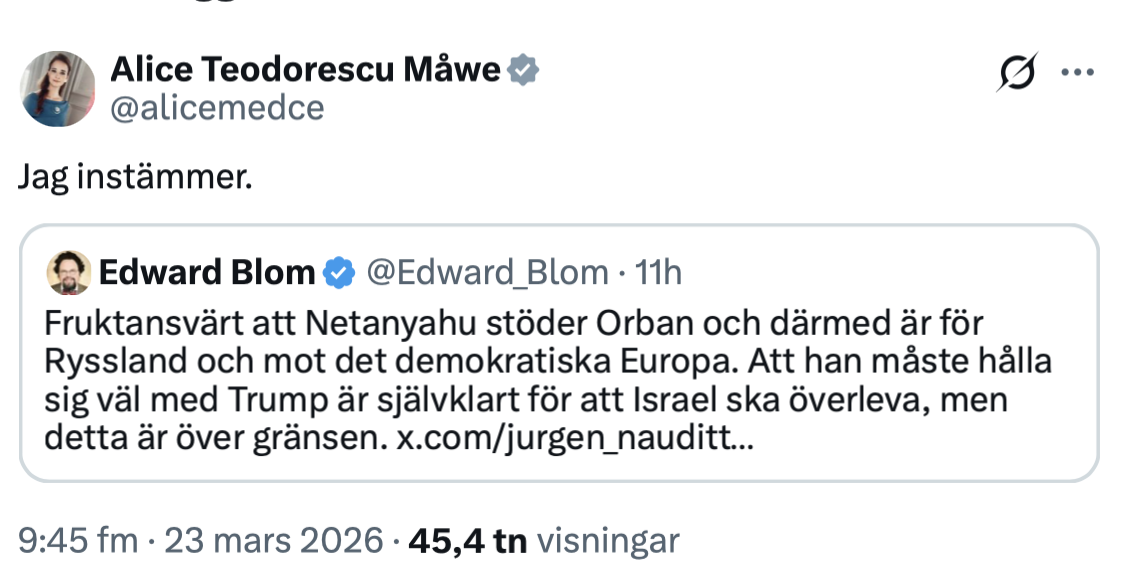
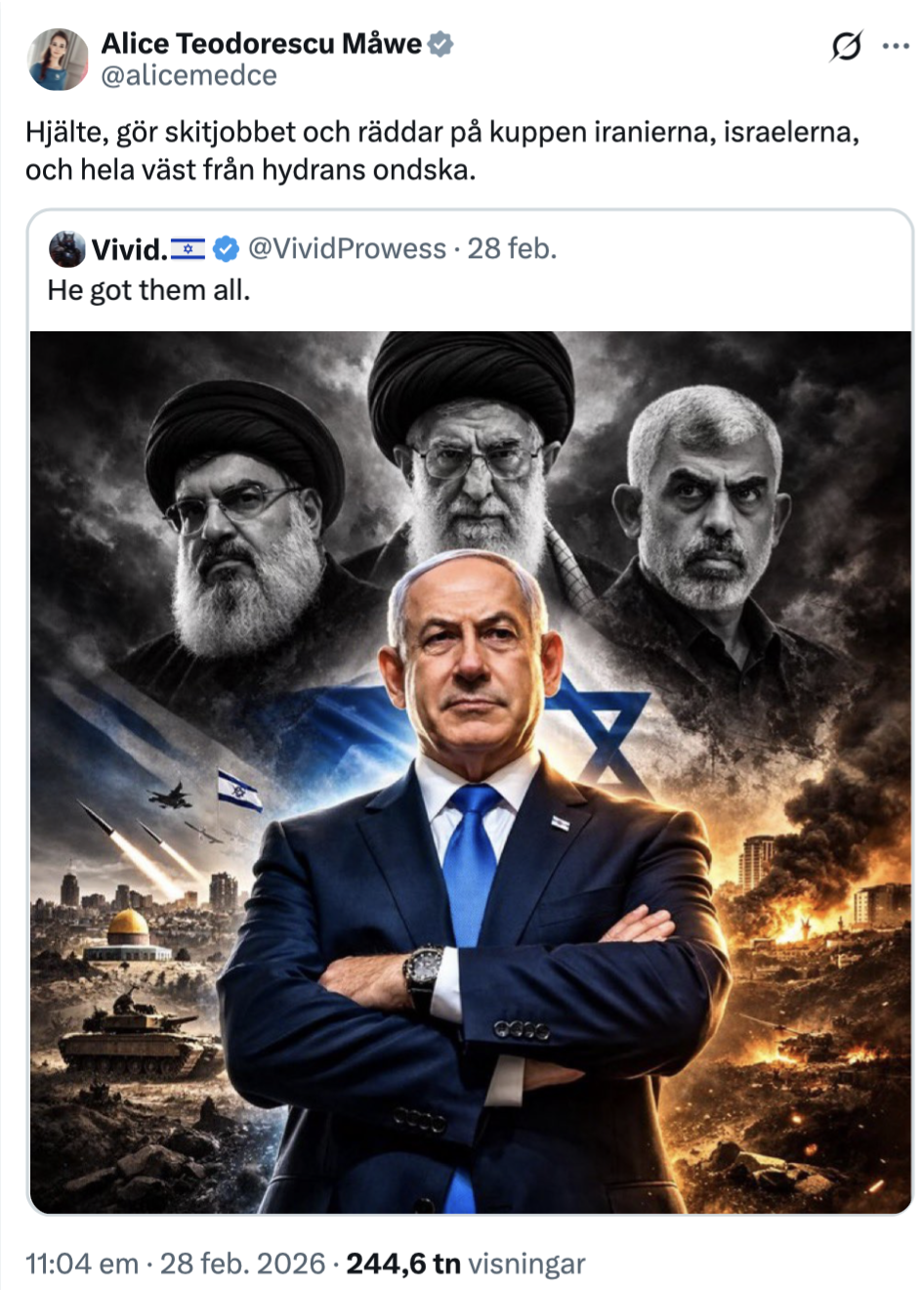
Alice Teodorescu Måwe, who had previously shared Netanyahu’s posts and tributes day after day, has now reversed her position. Netanyahu has played the forbidden Russia-card in the liberal world order.
According to the KD liberal, he has crossed a line by expressing support for Viktor Orbán — something perceived as particularly serious because Hungary still maintains diplomatic contacts and trade relations with Russia.
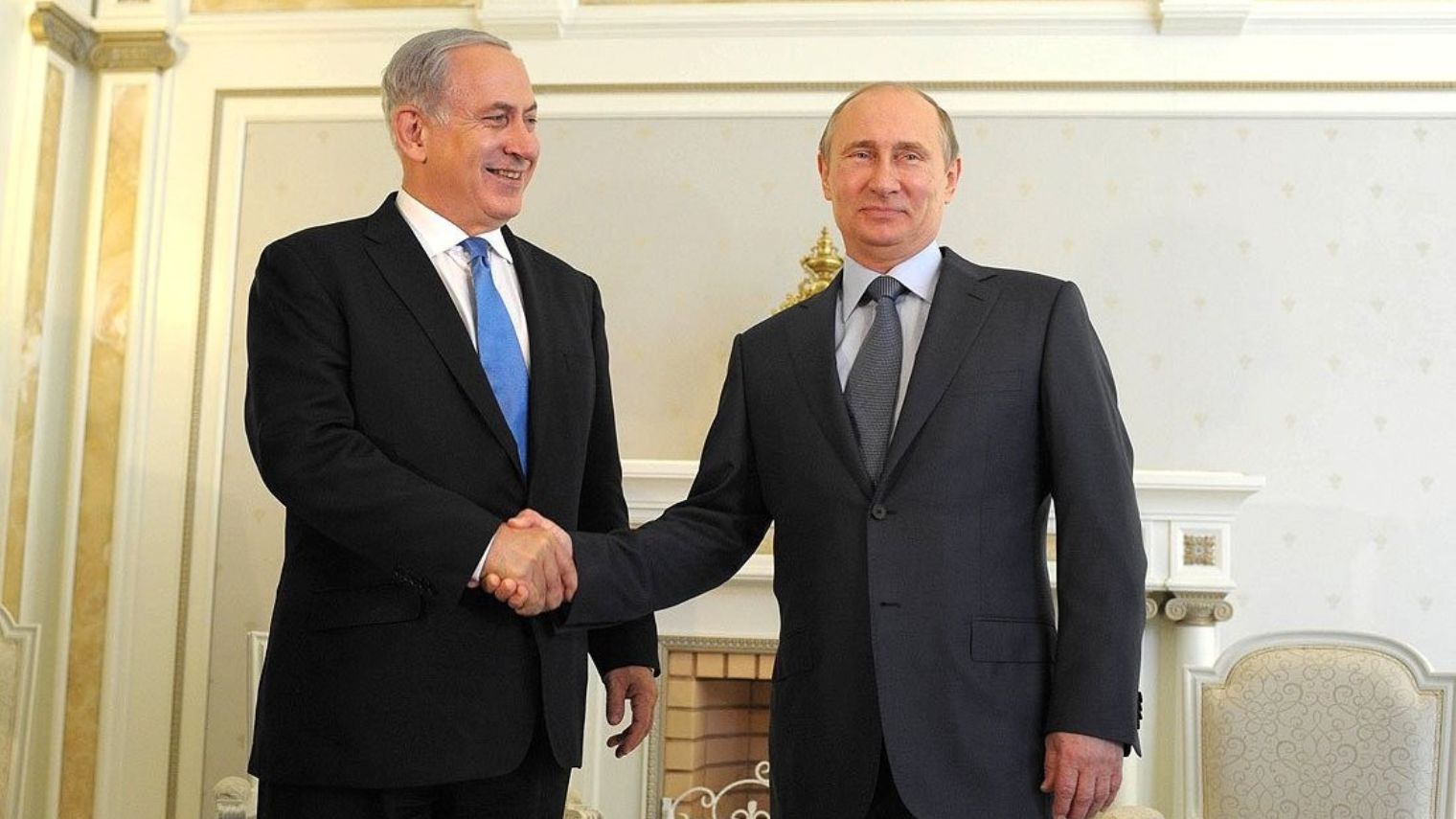
Israel trades with Russia – does not donate weapons to Ukraine
What Alice Teodorescu Måwe and Edward Blom miss when they criticize Israel’s Prime Minister Benjamin Netanyahu for showing support for Hungary’s Prime Minister Viktor Orbán ahead of the election, and equate this with siding “with Russia and against democratic Europe,” is that Israel itself maintains a similar stance, with both diplomatic and trade relations with Russia.
This makes their criticism rather flat and at the same time highlights how emotionally driven and poorly informed they are in international politics – especially EU parliamentarian Alice Teodorescu Måwe, who, after all, operates at the highest political level in Europe.
Teodorescu Måwe is an EU parliamentarian and apparently dedicates much of her political activity to Israel, but she seems to have a notable lack of knowledge about the same country – to the extent that one almost needs to inform her about Israel’s relationship with Russia. Let’s do just that.
She considers it terrible and a threat to democratic Europe that Netanyahu, who has served a total of 19 years as prime minister in various periods, praises Orbán. But at the same time, she has overlooked that the same Netanyahu and other Israeli prime ministers have maintained a steady relationship with Russia over the years – even after the invasion of Ukraine in 2022.
Moreover, Israel has refrained from sending weapons to Ukraine after Russia’s invasion and has instead provided humanitarian aid.
Like Hungary, Israel took the initiative for peace negotiations at the beginning of the war. Former Prime Minister Naftali Bennett acted as a mediator between Russia’s President Vladimir Putin and Ukraine’s President Volodymyr Zelenskyy.
Naftali Bennett held direct talks in Russia with Putin, among others. According to Bennett, it was also he who, at the start of the war, pleaded with Putin to let Ukraine’s President Volodymyr Zelenskyy live — a promise, according to Bennett, given by Putin. He recounted this in a podcast.
Israel’s policy of refraining from military aid to Ukraine is explained by not wanting to jeopardize its relationship with Russia. Another main reason is the strategic need for operational freedom in Syria, where Russian forces have over the years largely controlled the airspace and still have military bases.
Israel has also denied that the Patriot air defense systems that Ukraine received — and were claimed to have come from Israel — were donations. These systems actually belonged to the U.S. and were returned to be reallocated via Israel to Ukraine.
It should also be noted that Israel has not imposed any sanctions on Russia after the 2022 invasion of Ukraine; the countries continue to trade, and there are even direct flights between Tel Aviv and Moscow. Despite the steady relationship between the countries, neither Alice Teodorescu Måwe nor Edward Blom has raised objections about this during the four years the war in Ukraine has been ongoing.
Perhaps this episode and the current situation in the EU are a clear example of how reality in international politics and diplomatic relations is far more complex than the often limited narrative among leading EU politicians.
Israel acts diplomatically, like Viktor Orbán in Hungary, based on its own national interests and puts its own country first, while clearly holding the stance that it does not need to agree on all issues and conflicts in other countries.
Netanyahu’s son: Orban puts Hungarians first – pushes back against the EU
It was not only Israel’s Prime Minister Benjamin Netanyahu who praised Orbán in a video message at the CPAC conservative conference in Budapest.
His son, Yair Netanyahu, was also invited and attended the conference in person, where he participated in an on-stage conversation.
He praised Orbán for putting Hungarians first and for daring to stand up to the supranational machinery in Brussels — something he claims is extremely rare in today’s EU.
“The Prime Minister has done a fantastic job and truly safeguards Hungary’s sovereignty vis-à-vis the European Union. Many Western European countries have handed their sovereignty over to unelected bureaucrats in Brussels, who may not always have their own country’s and people’s best interests at heart,” Yair Netanyahu said, and continued:
“Prime Minister Orbán, on the other hand, has put the Hungarian people’s and Hungary’s interests first and knows how to resist Brussels when demands are made that go against the country’s interests.”
S veteran: Undermining a democratic Europe
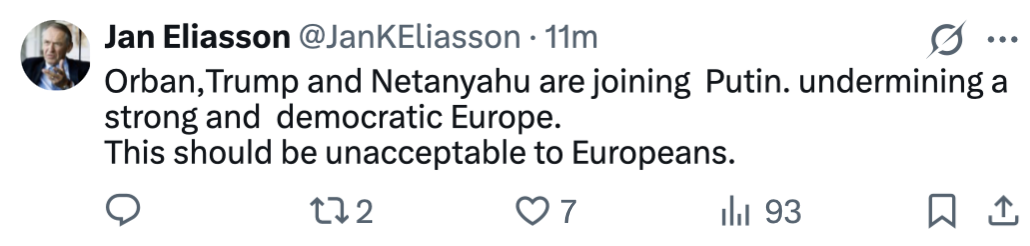
The discussion about Netanyahu and Orbán prompted several reactions on Monday. Even Social Democrat veteran and former UN top official Jan Eliasson got involved in Edward Blom’s post.
Eliasson argues that Orbán, Netanyahu and Trump undermine “a strong and democratic Europe” — something he describes as unacceptable, without elaborating on exactly how this happens.
At the same time, Eliasson’s own role raises questions; he has previously organized events with Iran’s then Foreign Minister Javad Zarif in Stockholm, where he both embraced and praised him publicly with laughter and smiles. This raises the issue of which contacts are considered legitimate. While some political leaders are criticized for their diplomatic relations, Eliasson himself has had close and publicly positive meetings with representatives of the Iranian regime.
ALSO READ: S veteran troubled by the new Sweden: Taxi drivers scam passengers for 4,000 SEK per ride