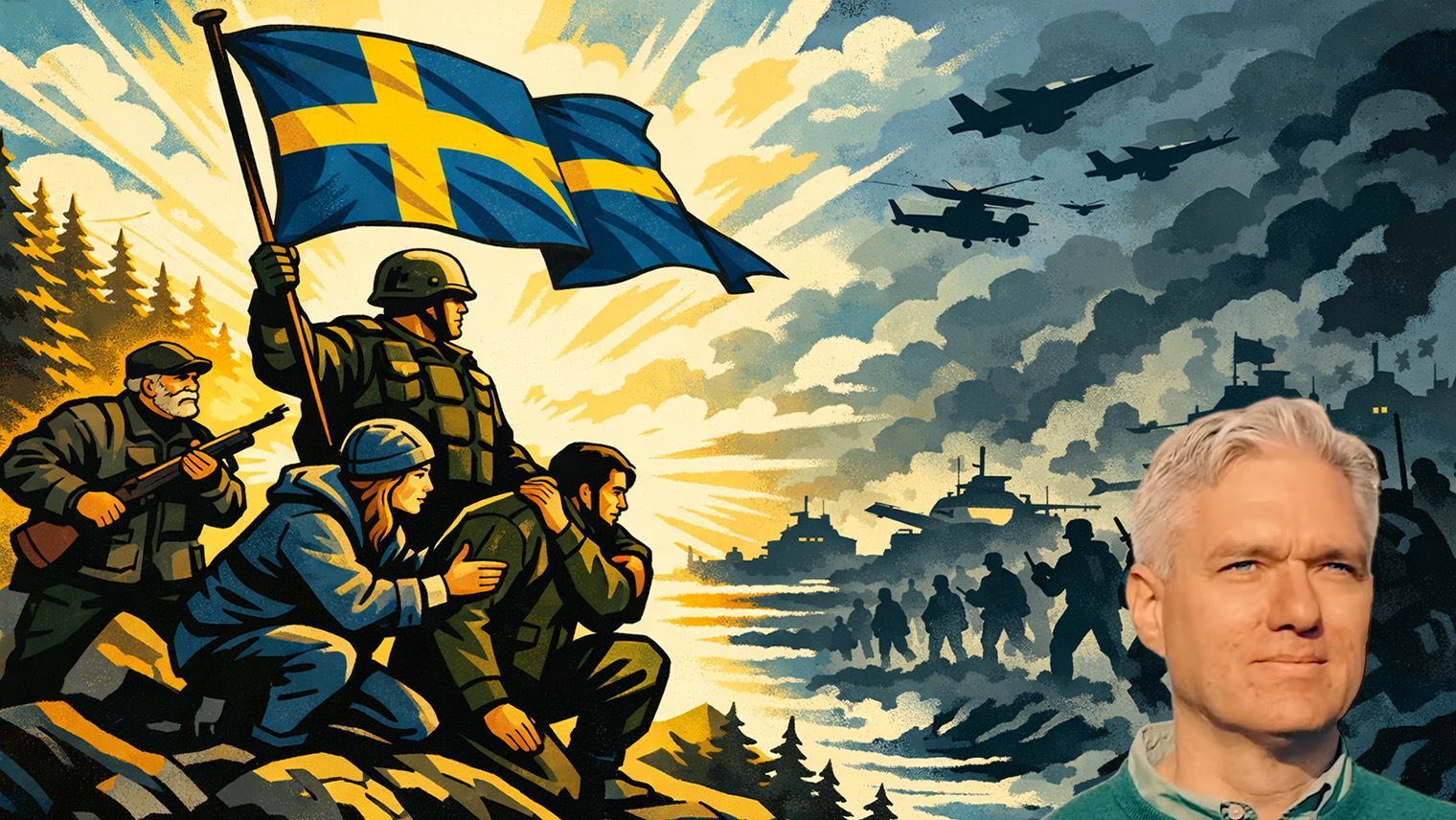
DEBATE • Everyone knows that Russia is the greatest threat to Sweden after the climate crisis. For Pål Jonson and Ulf Kristersson have said so on TV and at Folk & försvar.
Everyone knows that Russia conducts constant influence operations against Sweden under devious disguises such as painting sellers and Belarusian nuns. They carry out cultural imperialism with the help of the music ensemble Södra Bergens Balalaikor and influence Swedish state TV to broadcast exciting Russian action movies every day without LGBTQ representation or diversity.
They bribe our leaders to introduce censorship laws and open Sweden’s borders, manipulate the judiciary to persecute Swedes for opinion crimes – all to undermine Swedes’ trust in our world-class democracy and the EU Commission’s President Ursula von der Leyen. Worst of all, perhaps, is that Putin influences Swedes at the ballot box so that they vote for the Sweden Democrats.
The only way to protect democracy is to, once and for all, defeat Russia on the battlefield, preferably in Poltava, which they will soon retake from Ukraine. To avoid a repeat of the last time, in 1709, we need to prepare ourselves. Here follows a plan for how we can finally defeat Ivan, the Russian bear, the fierce enemy.
High Birth Rates
First and foremost, a large population is needed. The now catastrophic birth rates need to be reversed. Russia has a population nearly 15 times larger than Sweden. Fortunately, Russia doesn’t have particularly good birth rates either, but they have made it a national priority and therefore have a slight advantage.
However, we could easily take the lead. The biggest obstacle to healthy birth rates is not economics, but attitude. We need to redirect Swedish public budgets away from climate anxiety, feminism, gender transitions, and the normalization of non-childbearing sexual variations, to promote traditional gender roles, early family formation, and large families with many children.
Simply by putting up advertising images in public spaces of beautiful young families with many children, an entirely new child-friendly culture would quickly emerge. But, of course, economic factors help. Tax exemption should be provided to actual men who support stay-at-home moms and children.
After three generations with an average of 4.5 children per woman (and man), we would have a population on par with Russia, ceteris paribus. With 6 children per woman, we would surpass them within two generations. We could also award medals to mothers and fathers with many children, a tried and tested trick for, as the saying goes, “raising the status of the profession.”
Love for Blood and Soil
The next step requires us to restore patriotism, indeed, the love for Swedish blood and soil. Few Swedish men would be inclined to risk their lives in Poltava to protect democracy, paid paternity leave, the open society, Ulf Kristersson, or Maggan Andersson. Here we sadly lag far behind Russia, which has plenty of warriors volunteering to go to the front and fight for honor, glory, their nation, their people, and their Christian faith.
This too is actually quite easy to achieve. Dust off the tales of Nordic heroes, feats, discoveries, progress, history, Germanic customs, and Christian traditions and use the regime’s media to disseminate them. The school system should also be used to spread the same message, with special emphasis on local history and personalities. This would probably require replacing 90 percent of the teaching staff and principals first. But with a regime-controlled school system like Sweden’s, that’s no big deal.
This section also includes that the motivation should be the fight for our own. Not for foreign interests, peoples, states, not for unions or organizations, not for :censored:6:cdd6bbaa89: goals and ideals, not even for our own state. The guiding motivation should be that we do what benefits us as a people and a society.
Weapons Training
In war, people shoot at each other. It hurts. The population needs weapons training from an early age. During the first half of the 20th century, shooting practice was compulsory for school youth. Owning a rifle was natural. Yet people didn’t go around shooting each other randomly because we were a homogenous people guided primarily by sound values, rather than by law.
The state considered it a security issue for the people to be able to defend the state. That people could also defend the people whom the state depends on was not seen as a threat. Shooting clubs and home guard associations could be found everywhere in the country.
As the state has lost trust in the people, it has made gun ownership increasingly suspicious and complicated. Sweden has 23 firearms per 100 inhabitants, which is better than Russia’s 12. About 6 percent of Swedes own at least one firearm, so although we are ahead of Russia, this needs to be raised to previous levels. The American constitutional protection of private gun ownership is an example to strive towards.
Restore the Production Economy
A soldier may serve the state, but war is not a service economy. War requires the production of war materiel and supplies. This must happen at home, because trade is the first thing to be disrupted in war. We must minimize dependence on foreign powers. Sweden needs to become a production country again.
The reason Sweden has become a service economy is not because we’re much smarter than the Chinese, but because taxes and regulations have driven production abroad. Goods can just as easily be made in China and shipped here. Haircuts and other services, on the other hand, have to be performed on site. Production can flee, but services are bound to stay.
The US is trying to restore its production economy by using the stick of tariffs to make it hard for foreign companies to sell their goods in the US. A better way is to lure them back with carrots. A sharp reduction in taxes and enthusiastic cutting of regulations and bureaucracy. Then manufacturing companies would make money again. Factories would spring up on their own, entirely without municipal business coordinators.
To lower taxes and cut bureaucracy, the tax-consuming welfare state must be trimmed down, and large numbers of bureaucrats should be made available for the real labor market.
Cheap Energy
To produce, energy is of course required. One cannot support a production and war economy with windmills. Nuclear power is the most efficient, cheapest, and most environmentally friendly technology humanity has yet invented. A solid investment in nuclear power would bring us low electricity prices again, which is essential for production. We could make good money selling electricity to so-called green countries in Europe. Investing in nuclear would also restore Sweden’s cutting-edge expertise in nuclear technology.
We could finish building the atomic bomb we once started. That would make Ivan think twice before sending over Belarusian nuns again. War runs on gunpowder and diesel. Unfortunately, we have no diesel of our own, so before we defeat the Russians and take over their oil fields, we need good relations with suppliers who have sound values, sounder than the Russians’, such as the Arab countries. After all, a moral superpower like Sweden only trades with LGBTQ-certified suppliers with the right values.
Easy as Pie
All in all, it’s actually quite easy to beat Russia once and for all. In about three generations. All we have to do is reintroduce policies with traditional, patriotic, family-friendly values that promote production and cheap energy, through deregulation, a slimmed-down welfare state, and low taxes. And find a political party that supports all that.
The Alternative? Humility and Good Relations
If we don’t want to take such corrective measures, we must instead exercise a bit of humility, diplomacy, promote good relations and, why not, mutually beneficial trade relations.
Klaus Bernpaintner
(Article previously published on Folkungen.se)