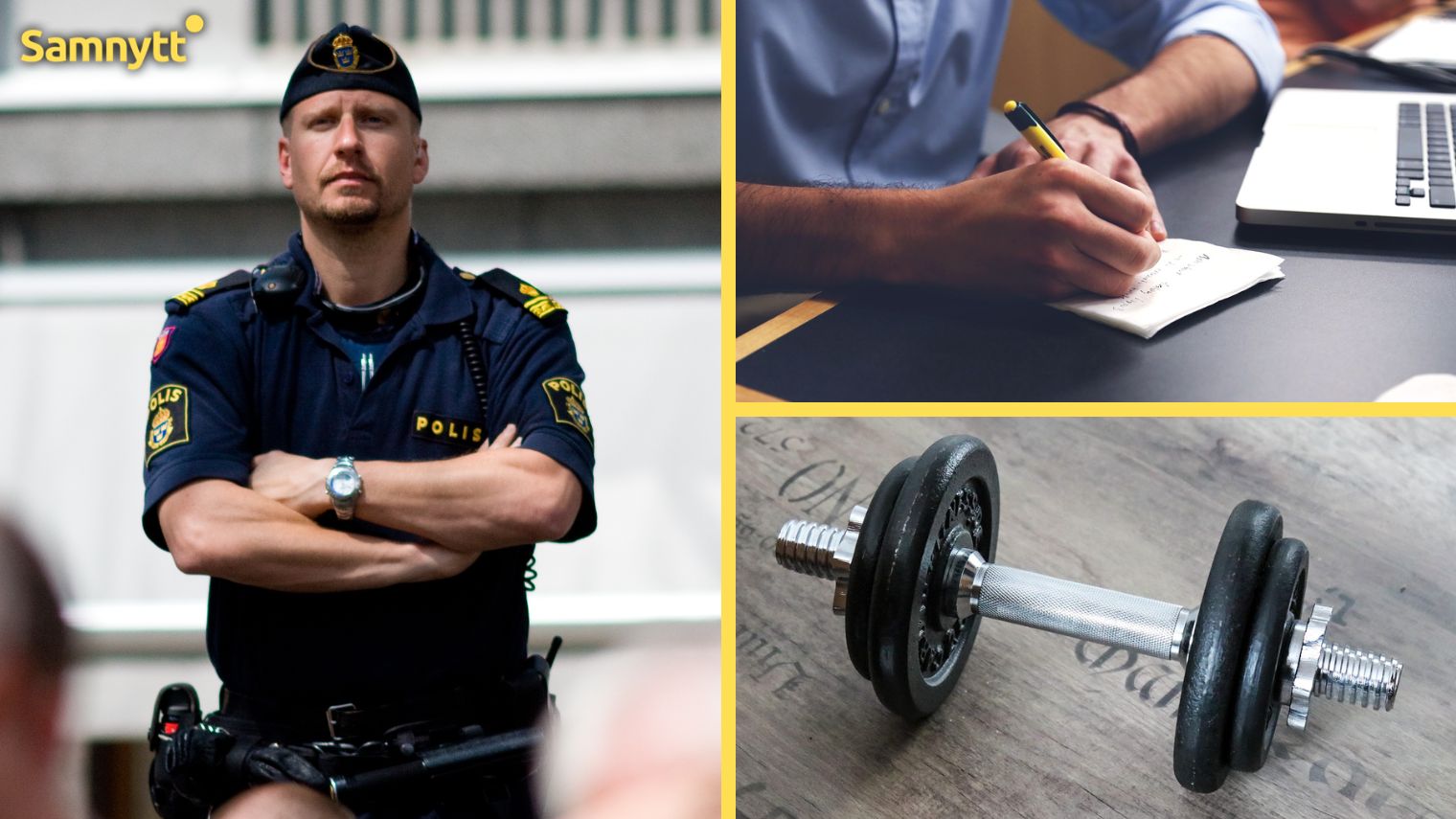
A working group within the Swedish Police Authority has now presented several proposals for changes to the admission requirements for police training. The work began following the harsh criticism directed at the current admissions process by the Swedish National Audit Office about a year ago. Since then, the group has reviewed the entire system and analyzed which qualities and competencies are actually required for the police profession.
According to Anders Henckel, head of the police training unit and deputy project manager in the working group, they have “turned over every stone” in the process of developing new proposals. One of the main areas has been addressing criticism of the so-called trapdoor principle, where applicants are immediately disqualified if they fail a single part early in the process. Critics have argued that this risks filtering out people who could otherwise have made good police officers.
The working group is now proposing a new comprehensive selection model. People with very high results would be admitted directly, while applicants who meet the minimum requirements but perform less strongly would be placed in a reserve group. At the same time, the group emphasizes that they do not want to lower the standards.
Several changes concern the physical tests. The group wants to introduce a new running test to measure endurance and mobility, since job analyses show that police officers must be able to run even in challenging terrain. The current Isokai test is proposed to remain, but with modifications so that it measures maximum strength instead of an average value.
READ ALSO: Confirmed: No police uniforms at Pride
In addition, gender-differentiated standards are proposed. The idea is for the tests to provide more equal conditions for women and men by placing greater emphasis on leg strength rather than pure upper body strength.
At the same time, the working group wants to supplement the Isokai test with new strength tests that measure, among other things, core and upper body strength. Henckel told Polistidningen that “it may take some time to develop” such a test. The group also wants to investigate how police officers’ physical abilities can be maintained after admission to the training program.

Changed Language Requirements
The language requirements could also change. The working group wants to investigate the possibility of introducing a special Swedish language test for applicants. However, the issue is described as complicated, and according to the group, such a test would not be in place for at least about a year.
The educational institutions responsible for police training reportedly also request a Swedish test and already have extensive requirements for police report writing in their curricula.
Other proposals include an upper age limit of 59 years, stricter psychological interviews, and revised medical requirements whereby certain previous obstacles would no longer automatically prevent an applicant from becoming a police officer.
Requirements
General eligibility requirements
Upper age limit 59 years
Swedish test to be investigated
Psychological requirements
Stricter psychological interviews
Physical requirements
Gender-differentiated standards regarding Isokai
Applicants must meet all physical competencies
Running element introduced
Isokai measures maximum value
Additional muscle test introduced
Maintenance of physical ability to be investigated
Revised medical requirements, meaning the following are not absolute barriers
Viral hepatitis, well controlled and low infectiousness
HIV, stable treatment and low transmission risk
Tumors, treated and with very low risk of recurrence
PTSD, after a 5-year remission period
Epilepsy in remission after childhood
Rheumatism, well managed
Not fully functional color vision
Other medical requirements
BMI between 18.5 and 34.9
Applicant must bring a list of dispensed medications from the past five years
READ ALSO: Fiasco for the Police Diversity Plan