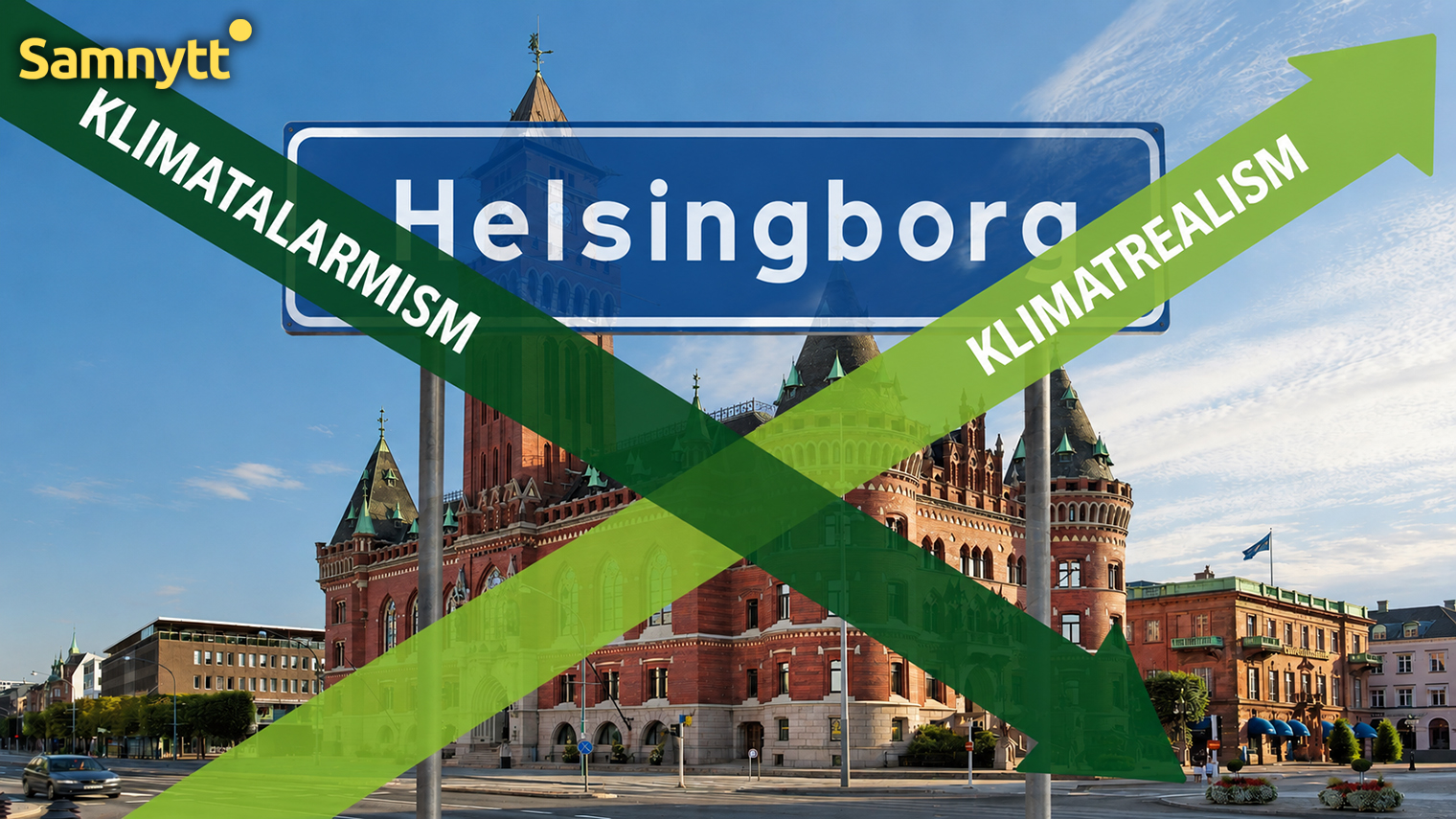
The political leadership in Helsingborg is now signaling a clear shift in climate policy. The overly ambitious goal of climate neutrality by 2030 officially remains, but the administration concedes it will be difficult to achieve and no longer wants to push for measures that complicate everyday life for residents and businesses. Instead, the focus will shift to growth, employment, and preparedness.
When Helsingborg set the goal in 2022 to become climate neutral by 2030, ambitions were high. The city was chosen as one of Europe’s leading climate cities and signed a climate contract together with other municipalities that wanted to lead the transition.
At the same time, Sweden as a whole has been climate neutral for a long time and has achieved net zero emissions. Including the so-called carbon sink, as much CO2 equivalent is absorbed as is emitted in the country.
Regretting Ambitious Posturing
For several years, the goal has been a central part of Helsingborg’s brand and has been used to profile the city as innovative and sustainable. But now, with four years left to the target year, leading politicians admit they likely would not make the same decision today.
Municipal Council chairman Christian Orsing (Moderate Party) says that he would not have set the same goal under today’s circumstances. Environment Committee chairman Amir Jawad (Liberal Party) also believes that the :censored:6:cdd6bbaa89: situation has changed so much that the decision would likely have been different.
Lars Thunberg (Christian Democrats) emphasizes at the same time that what matters most is not exactly reaching the 2030 goal, but that the city continues to move in the right direction.
Impossible to Reach Emissions Target
Developments are also not heading in the direction required to meet the goal. Between 2022 and 2023, Helsingborg’s carbon dioxide emissions actually increased somewhat, when they instead would have needed to drop sharply to meet the unreasonable targets.
ALSO READ: IPCC abandons extreme climate scenario – critics call it costly alarmism
The biggest challenges lie within the transport sector, where fossil emissions still account for a significant share. Despite the fact that the City Council as recently as 2024 adopted a climate plan to reach the goal, the administration now believes that climate issues must be balanced against other societal interests.
“How Much Do We Want to Mess With the People of Helsingborg?”
Christian Orsing believes there is a limit as to how far politics can go on climate matters without causing negative consequences for residents and business.
– How much do we want to mess with the people of Helsingborg? he asks in an interview with Helsingborgs Dagblad.

According to Orsing, it must be taken into account that Helsingborg is an important logistics city with major employers in transport, warehousing, and commerce. He also highlights the city’s significance for Sweden’s food supply and preparedness.
The administration therefore does not want to implement measures that severely restrict traffic or make it harder for businesses to operate.
Transition Through Incentives Instead of Coercion
At the same time, the political leadership emphasizes that the city’s climate ambitions are not being abandoned entirely—just made more reasonable and not prioritizing them above all else. Lars Thunberg says that many residents and businesses want to contribute to the transition, but that the city needs to make it easier to do the right thing, rather than impose restrictions.
Christian Orsing describes the new direction as a policy where incentives will replace mandates.
The municipality wants to continue investing in public transport, cycling opportunities, and charging infrastructure, and make it easier to switch to fossil-free fuels. However, they do not want to make car ownership or car travel more difficult.
– We will not mess with Helsingborg and make it harder to use the car.
According to Orsing, it’s about finding a balance where climate benefits can be achieved without worsening people’s daily lives or companies’ competitiveness.
Businesses More Realistic – City Wants to Support, Not Force
For several years, Helsingborg has tried to mobilize the business community behind the over-ambitious climate goals, including through the Helsingborg Declaration, which was intended to contribute to cutting emissions from the transport sector.
ALSO READ: Climate Researchers Downplay the Worst Doomsday Scenarios
Orsing notes that nowadays, some companies have become more realistic in their climate ambitions, while others continue to invest in the transition. The municipality’s role, he argues, is to create opportunities for those who want to lead the way, but respect those who prefer a more measured pace.
He singles out the city-owned companies as important tools for helping businesses replace fossil energy sources with, for example, electricity, district heating, and biogas—but with voluntariness instead of compulsion.
Belief in 2030 Replaced by Realism
As the electoral term nears its end, the city administration’s representatives are now considerably less confident that climate neutrality can be achieved within four years.
Lars Thunberg thinks it will be very difficult to reach the goal. Christian Orsing says that the outlook has deteriorated with changes in the outside world and that the municipality must face reality. Amir Jawad does not want to rule out the possibility entirely but describes the goal as very challenging.
– We cannot predict this. But the prognosis to reach it, clearly, has worsened.
Taken together, these statements mark a clear shift in Helsingborg’s climate policy. From having been a profile issue with climate neutrality as the overriding goal, the administration is now speaking increasingly of balance, voluntarism, and of avoiding measures that are perceived as a burden for residents and companies.