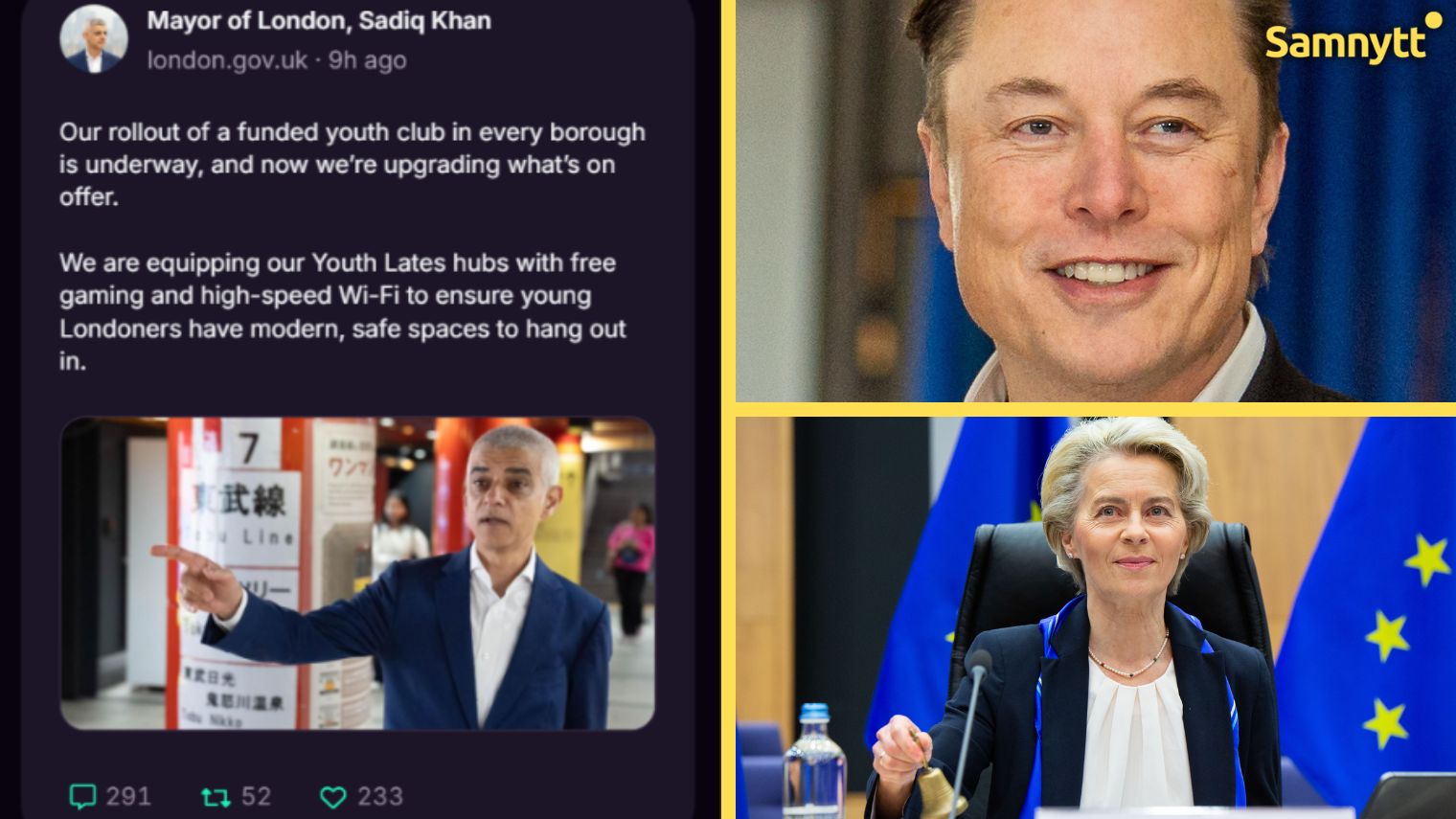
A new Swedish social media platform is aiming to challenge Elon Musk’s X, formerly Twitter, while also reducing Europe’s dependence on American tech giants. The platform, called W Social, was launched on June 17 and has already attracted several of the EU’s most influential politicians and institutions. The initiative is backed by Swedish entrepreneurs and investors who argue that Europe needs its own alternative for digital public debate.
The launch comes against a backdrop of a growing European discussion about digital sovereignty, data protection, and the influence of major American platforms over the public conversation.
W Social is operated by the Swedish company W Social AB and was first presented at the World Economic Forum in Davos earlier this year. The company describes itself as a pan-European initiative with investors and entrepreneurs from several European countries. The headquarters is located in Sweden, while much of the development takes place in Ukraine.
The company’s CEO is Anna Zeiter, who has previously held leading roles in the technology and e-commerce sectors. One of the most prominent figures behind the project is Swedish climate entrepreneur Ingmar Rentzhog, founder of the climate network We Don’t Have Time.
According to reports, the company has raised around 50 million SEK from investors, including former finance minister Pär Nuder and entrepreneur Alexander af Jochnick.
READ ALSO: EU launches investigation – wants to remove Grok from the European market
Unlike the biggest social platforms, W emphasizes that all data will be stored in Europe and that operations are governed by European legislation. The company also states that users must verify they are real people before they can publish content, although they may appear under a pseudonym publicly.
Technically, the platform is built on the same open protocol as the fast-growing social network Bluesky. This means that content and followers, to some extent, can be shared between different networks using the same technology.
The company markets itself with promises of greater privacy, fewer bots, and more control over user data. The initiative aligns with the broader European ambition to reduce dependency on American and Chinese tech companies.
Top EU Leaders Join
At launch, several high-ranking European leaders were already on the platform. Among them were European Commission President Ursula von der Leyen, European Council President António Costa, and ECB head Christine Lagarde. Several EU institutions and media organizations have also opened accounts.
Costa’s office stated that the decision to join was partly based on the platform being European, that data is stored within Europe, and that the company emphasizes privacy protection.
Look, who I just met at the #MunichSecurityConference and who seems excited to join the W waitlist, @GavinNewsom ????????
Europe is building its own challenger to X.
Privacy. Freedom. Sovereignty.
Welcome to https://t.co/v38yzhKRzO pic.twitter.com/wedFecf2D9
— Anna Zeiter (@anna_zeiter) February 13, 2026
From Twitter to X
The background to the initiative goes back to the autumn of 2022 when Elon Musk acquired the then-Twitter for around $44 billion. After the takeover, significant changes were made. Thousands of employees had to leave the company, several previous regulation and moderation teams were dismantled, and the platform’s content policies were altered.
In 2023, Twitter also changed its name to X as part of Musk’s ambition to create a broader digital platform. The changes led to recurring conflicts between X and European policymakers. The European Commission has on several occasions scrutinized the platform within the framework of the union’s digital regulations, particularly the so-called Digital Services Act (DSA), which requires handling of disinformation, transparency, and risks associated with major online platforms.
The relationship between Musk and many European politicians has become increasingly strained in recent years. Critics within the EU have accused X of giving too much room for disinformation, conspiracy theories, and manipulative accounts. At the same time, Musk has accused the EU of overregulation and of threatening freedom of expression.
READ ALSO: EU offered Elon Musk a deal to secretly censor users
Meanwhile, issues concerning data storage, dependence on American cloud services, and Europe’s technological independence have become increasingly important in Brussels. The discussion has intensified even further since Donald Trump’s return to the White House and the growing tensions between Europe and the US across several tech and trade areas.
It is within this environment that W is trying to position itself—not just as another social network but as a symbol of European digital independence.
Criticism and Questions about EU Connections
The launch has also met with criticism. Some observers have questioned whether the platform risks becoming too closely associated with the EU’s institutions when several leading EU politicians joined from the start. Discussions have also arisen over the requirement for identity verification and how it affects online anonymity.
However, the company has emphasized that W is a privately owned Swedish company and is not financed by the EU. Claims that the platform is an EU project or financed with taxpayer money have been dismissed by both the company and the European Commission.
Could W Become Europe’s Answer to X?
Despite the attention-grabbing launch, W faces a difficult challenge. X still has over one hundred million users in Europe, while Meta’s platforms and TikTok dominate the market. Several other European alternatives have also been launched or are under development.
But for the founders, the project is about more than user numbers. The goal is to create a European-controlled digital public space where data, revenues, and decision-making remain within Europe, thereby reducing the dependence on the American tech giants that have long dominated social media.
How to create an account
To create an account on W, users must first verify their identity through the company’s special service W Identity, which is done via a separate app. Registration is completed by providing an email address and phone number, scanning a passport or national ID card, and then taking a selfie which is compared with the ID document.
According to the company, the platform does not gain access to complete personal data, only information confirming that the user is a real person. At the same time, it should be possible to appear under a pseudonym to other users.
The identity verification requirement is a central part of W’s strategy to counteract bots, fake accounts, and organized influence campaigns, but it has also raised questions about privacy and whether users are willing to submit ID documents to access a social network.
READ ALSO: 150 EU officials monitoring when Musk interviews AfD’s party leader