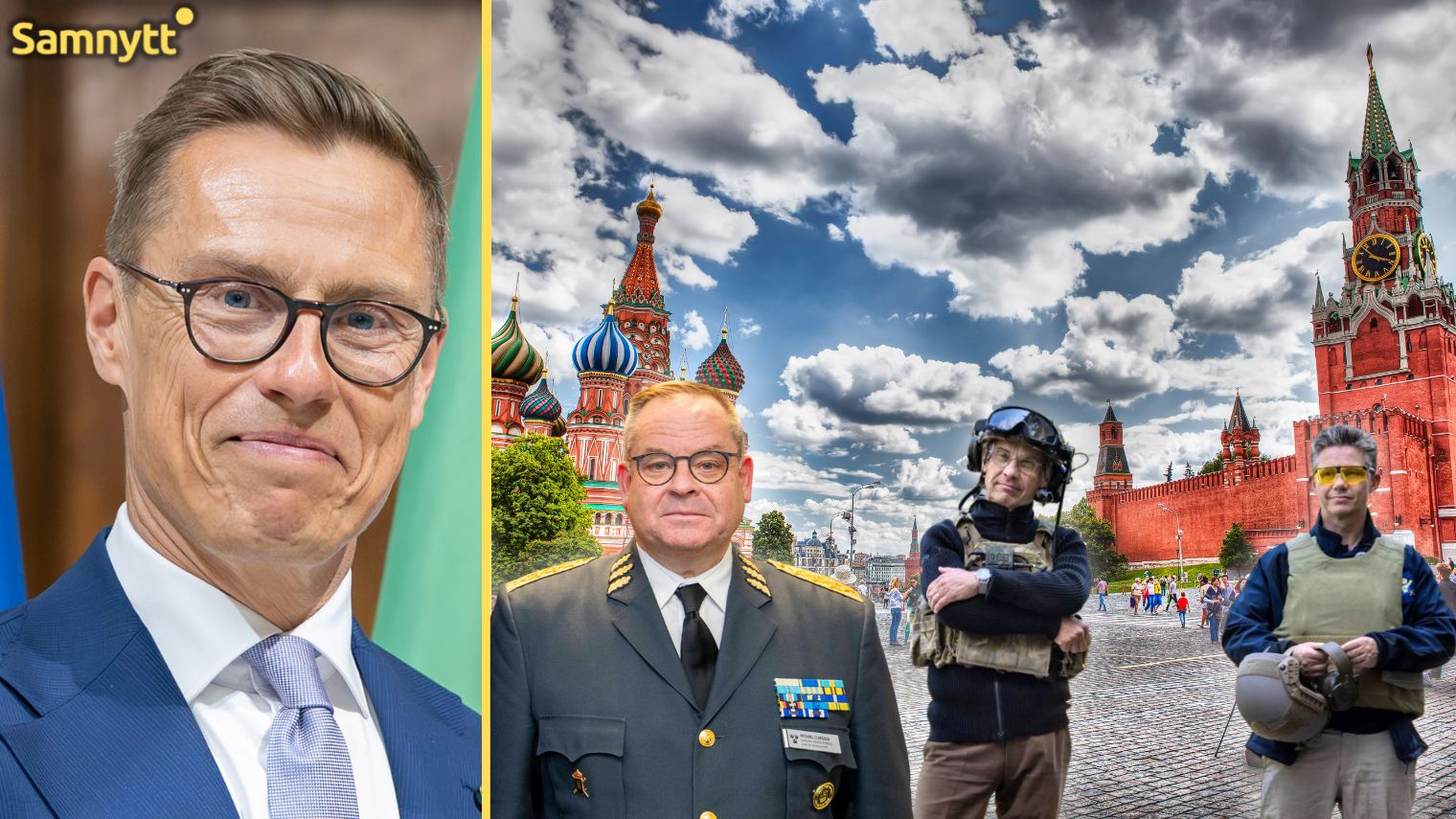
Finland’s president dismisses alarmism about an imminent Russian attack on Europe. According to Alexander Stubb, the warnings are not based on facts and on the contrary risk playing into Moscow’s hands. In doing so, he directly contradicts Swedish military assessments that Russia may be ready to test NATO already now.
Finland’s president Alexander Stubb levels unusually sharp criticism at the increasing warnings from several European countries that Russia is about to attack a NATO country to test the alliance’s defense guarantee.
In an interview with Hufvudstadsbladet, he explicitly rejects the scenarios that have been raised over the past year by, among others, Swedish military and intelligence analysts.
– As president, commander-in-chief, and Finn, I see no evidence that this will happen.
Direct Response to Swedish Assessments
Particularly notable is that Stubb’s statements contradict Sweden’s commander-in-chief Michael Claesson, who as recently as May warned that Russia may be prepared to test NATO already now.
Claesson pointed to the possibility that Russia could attack “an island in the Baltic Sea region” to test the alliance’s cohesion, posing the rhetorical question of why Moscow would wait to exploit perceived weaknesses in the West.
READ ALSO: Germany’s Warning: Major War in Europe Before 2029 as Russia Rearms at NATO’s Border
But the Finnish president does not buy that argument.
– I have a completely different opinion. If the purpose is to prepare the population, increase the defense budget, or strengthen the defense industry, so be it. But such statements must be based on facts, and I see none.
Stubb’s criticism carries weight as he, as president and commander-in-chief, has access to Finland’s most comprehensive intelligence from both the security police and the armed forces’ intelligence service.
Stubb’s Cure for Russia-Fear: “Go to the Sauna, Take an Ice Dip, and Stay Calm”
Stubb goes further than just dismissing the threat. He believes that the very debate about an immediate Russian attack risks becoming part of the influence operations that the Kremlin seeks.
According to the president, Russia’s goal is to create uncertainty and imbalance in Europe, and he describes the recurring alarms as something that in practice may support this strategy.
– I want to urge my European colleagues to follow our Finnish example – go to the sauna, take an ice dip, and stay calm.

The message is clear – Europe should act rationally and base decisions on actual intelligence, rather than speculating about an imminent war between Russia and NATO.
Russia Has a Different Focus
Supporting his assessment, Stubb points out that Russia is still heavily tied down by the war in Ukraine and that it lacks logic to open a conflict with the entire NATO alliance at the same time.
He estimates that the war in Ukraine will continue for at least a few more months and sees no signs that Vladimir Putin is ready for serious peace negotiations. At the same time, he argues that Ukraine’s position has been strengthened and that even the US perspective on negotiations is starting to change.
Stubb describes his own role as maintaining close contact with both Ukraine’s president Volodymyr Zelenskyy and American officials to facilitate information sharing and future diplomatic solutions.
Diplomacy Even with Opponents
The president also emphasizes that a future peace process will require talks with Russia, no matter how uncomfortable that may be.
He does not foresee any democratic breakthrough in Russia in the foreseeable future, but at the same time believes that Europe will eventually have to find ways to establish a functional relationship with its large neighbor.
For Finland, according to Stubb, a stable Russia is preferable to a chaotic and unpredictable one.
But when it comes to the most debated question right now – the risk of an immediate Russian attack against NATO – his conclusion is unequivocal: there is currently no evidence supporting the Swedish and European alarms that have dominated the debate in recent times.
READ ALSO: Researcher: Swedish Media and Politicians Mislead with Propaganda About the Ukraine War