More than half of residents in so-called vulnerable areas are open to moving abroad. Young people with immigrant backgrounds are especially likely to consider or have considered leaving Sweden. The reasons include work opportunities and developments in society, according to a new survey.
On behalf of Järvaveckan Research, Indikator Opinion conducted a survey among residents in Sweden’s “vulnerable areas” on topics such as integration, political participation, and outlook on the future. One of the integration policy proposals that receives the strongest support from both sides is language requirements for jobs in healthcare, schools, and elderly care. 82 percent of residents in vulnerable areas and 92 percent in the rest of Sweden believe this is a good initiative.
A total ban on religious private schools is also popular, although differences are clearer here: 51 percent in vulnerable areas support it compared to 66 percent in the rest of Sweden.
READ ALSO: Hundreds of thousands of immigrants registered in Sweden without reason
The Social Democrats’ plans for forced mixing are rejected by Swedes, while immigrants are more supportive of the idea. Building more rental apartments in areas dominated by detached homes and tenant-owned flats is supported by 58 percent in vulnerable areas, but only 40 percent in the rest of Sweden.
Another area where opinions differ is what is required for successful integration. While Swedes are more likely to emphasize the individual’s motivation to want to integrate (45 versus 32 percent), residents in vulnerable areas highlight factors such as education and skills development (23 versus 16 percent) as well as anti-discrimination measures (14 versus four percent).
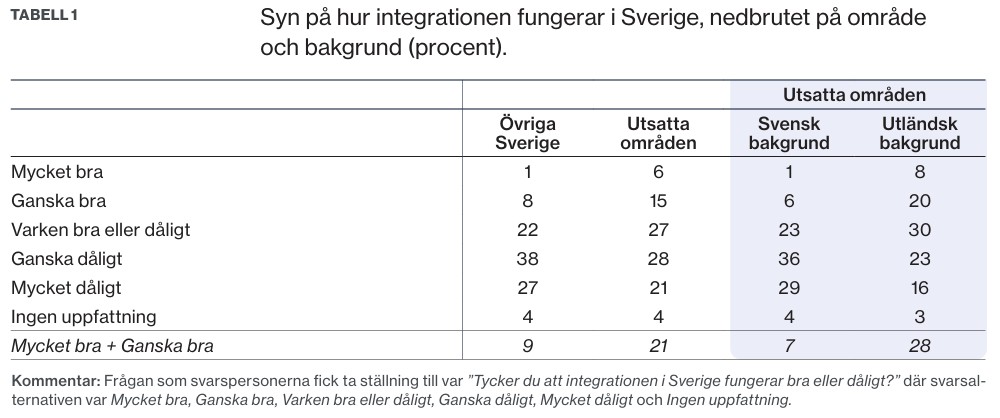
– The report shows both consensus and divisions. There is broad agreement on the importance of language in the welfare sector, but also clear differences of opinion on other commonly debated integration proposals. This underscores the need for a more nuanced conversation about where there is actually common ground on integration and where the dividing lines lie, says Ahmed Abdirahman, CEO and founder of the Järvaveckan Foundation.
Work and Language
Access to employment is highlighted as the single most important factor for integration, with 51 percent in vulnerable areas and 46 percent in the rest of Sweden naming this as crucial. About as many, 53 percent, in vulnerable areas state that lack of Swedish language skills is a barrier in working life. In the rest of Sweden, an even higher proportion, 64 percent, cite this as a barrier.
READ ALSO: Åkesson: This autumn’s election will be yet another immigration election
– There is broad agreement that jobs are key to integration. But the report also shows that we have different views on what holds people back. If the debate is to become less polarized, we need to be able to talk about both language and social barriers, says Ahmed Abdirahman, CEO and founder, Järvaveckan Foundation.
Greater Feeling of Influence Among Immigrants
People in vulnerable areas feel, to a greater extent, that they have the opportunity to influence societal development (48 percent), but at the same time, 60 percent feel that politicians do not care about them. The corresponding figures in the rest of Sweden are 38 and 50 percent, respectively.
Both groups look forward to this autumn’s election to about the same degree (65 and 64 percent, respectively).
Open to Moving
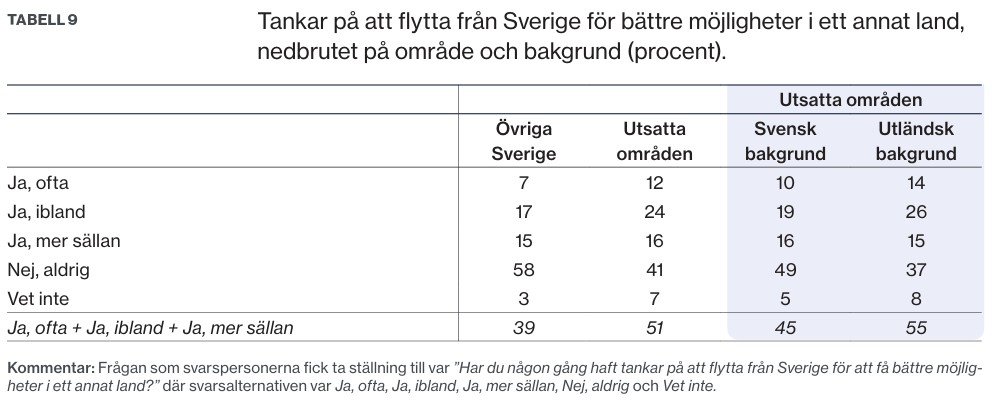
In vulnerable areas, 51 percent state that they have thought about leaving Sweden, and looking at those with foreign backgrounds only, the number rises slightly to 55 percent. In the rest of Sweden, the corresponding figure is 39 percent.
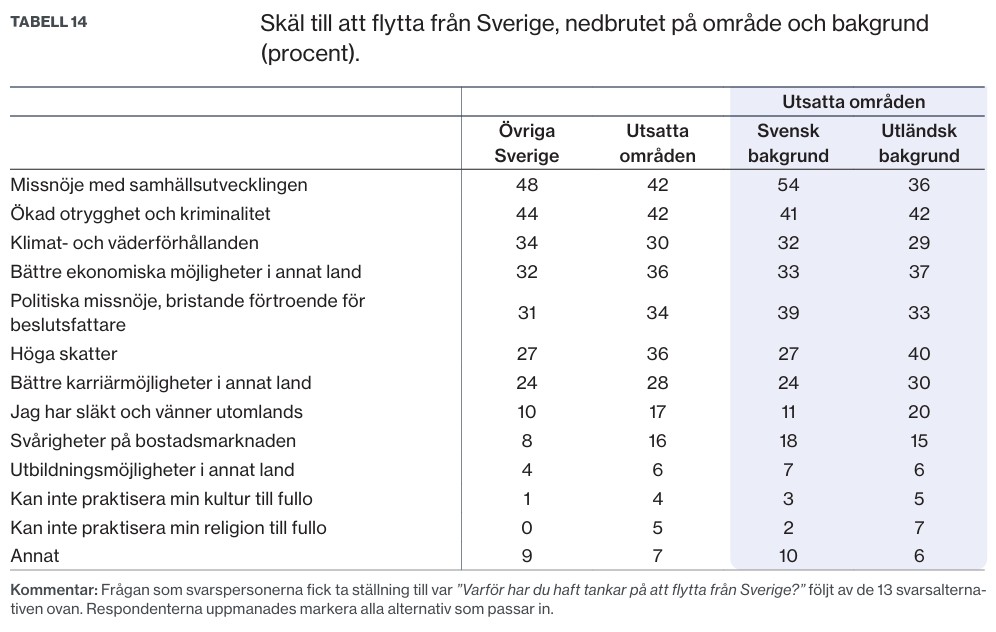
Those who stated that they had, to some extent, thought about moving from Sweden for better opportunities elsewhere were asked about their reasons. The most common reasons in both vulnerable areas and the rest of Sweden are dissatisfaction with societal developments and increased insecurity.
Overall, differences between vulnerable areas and the rest of Sweden are small, but more people in vulnerable areas mention high taxes (36 percent), having relatives and friends abroad (17 percent), and difficulties in the housing market (16 percent) as reasons for considering a move. Not being able to fully practice their religion is also a more frequent reason in vulnerable areas (five percent).
READ ALSO: Study: Western Europeans dissatisfied with immigration
In vulnerable areas, it is a larger proportion of those with Swedish backgrounds who cite dissatisfaction with societal developments as a reason for wanting to move (54 percent).
Breaking it down by country of birth in vulnerable areas, one finds that dissatisfaction with societal development is mentioned by significantly more people born in Sweden (52 percent) compared to those born outside Europe (29 percent). Among residents in vulnerable areas who are born outside Europe, high taxes are cited by the highest proportion within the group.
In both the rest of Sweden and vulnerable areas, better economic opportunities, better career prospects, and difficulties in the housing market are common reasons for thoughts of moving among young people aged 18–29. Looking instead at older age groups, regardless of region, climate and weather conditions emerge as one of the most cited reasons for wanting to leave Sweden.
Comparing young people, once again high taxes and housing market difficulties are more common reasons among residents of vulnerable areas. One in ten young people in vulnerable areas with foreign backgrounds also state that they cannot fully practice their religion.
Dissatisfaction with societal development is a significantly more common reason for thoughts of moving among young people in vulnerable areas with Swedish backgrounds compared to other groups. 57 percent of young people in vulnerable areas with Swedish backgrounds selected this alternative compared to 39 percent among those with foreign backgrounds.
At the beginning of the 20th century, Sweden was still primarily an emigration country. Around the turn of the century in 1900, only 0.7 percent of the population was born abroad, and the majority came from other Nordic countries. Meanwhile, the great emigration to North America continued well into the century, even though it declined after the 1920s.
After World War II, migration patterns changed significantly. Sweden entered a period of extensive labor immigration, mainly from Finland, Italy, and Yugoslavia, driven by the industry’s need for labor. In the 1970s, the inflow shifted towards increased refugee immigration, including from Chile, Iran, and later from conflicts in the Balkans. This development made Sweden a clear immigration country, and by 1995, nearly ten percent of the population had an immigrant background.
From the 1980s onwards, immigration has been dominated by refugees and family members from both European and non-European conflicts. There were clear peaks in 1994 (the Yugoslav wars), 2006 (the Iraq war), and 2015 (the Syrian war). In 2016, immigration reached the record level of 163,000 people, and after 2022 many refugees from Ukraine have also come to Sweden. Throughout the 2000s, immigration has remained high, with labor migration, asylum, and family reunification as the largest categories.
READ ALSO: Major differences in attitudes to norms in Swedish and vulnerable areas