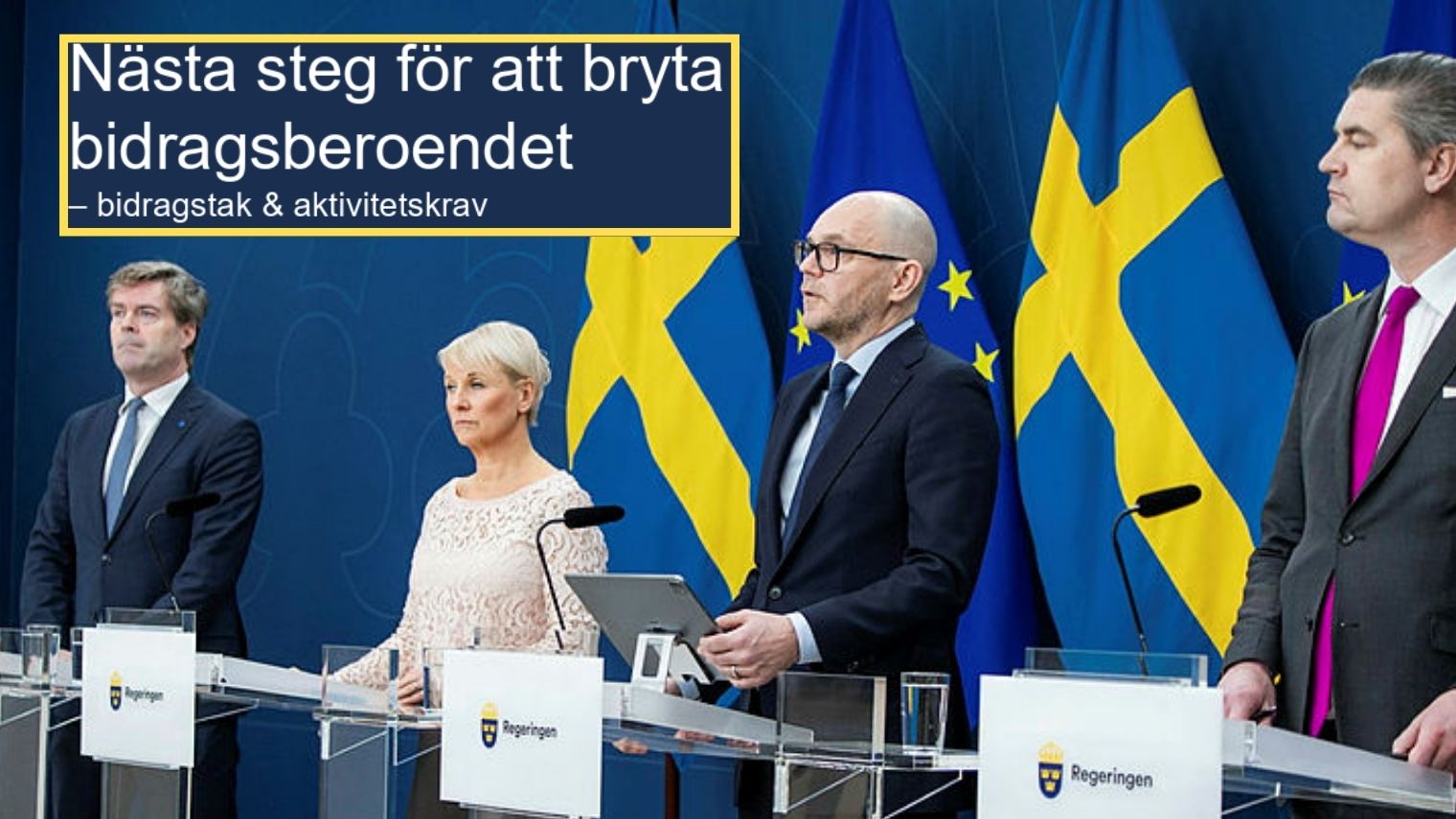
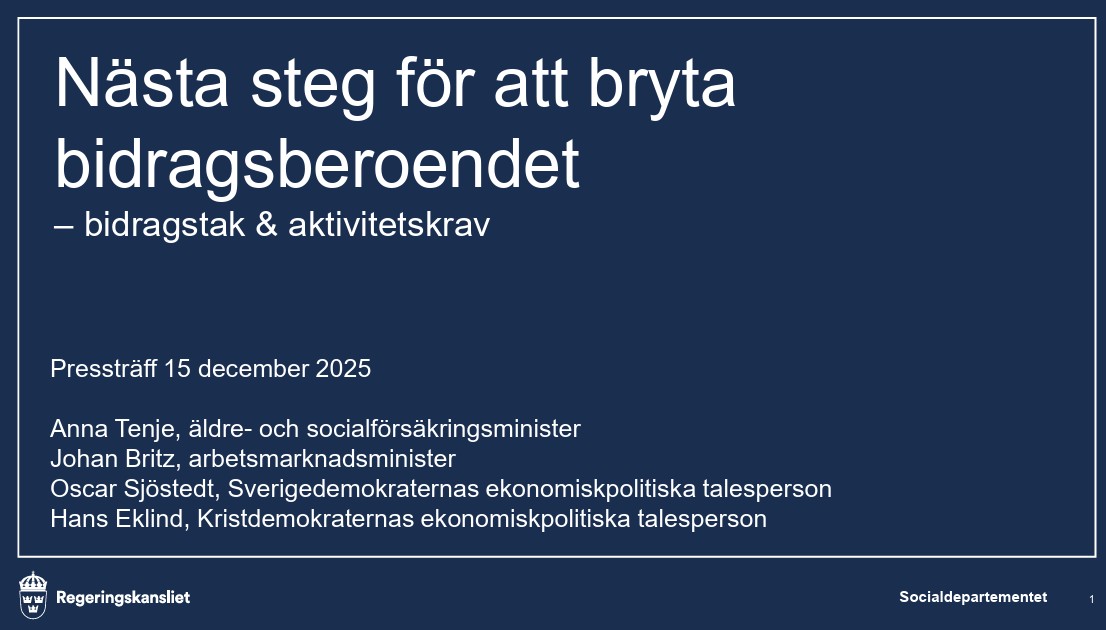
At a press conference on Monday, the government and the Sweden Democrats presented measures to break welfare dependency and so-called social exclusion among migrants. At the same time, they want to make it more profitable to transition from benefits to work.
According to the government, there must be clear requirements and expectations for people living on benefits, and with the reform, they hope that more children will see their parents go to work and that more people will support themselves with a salary.
“It needs to be more profitable to transition from benefits to work and self-sufficiency. Everyone who can work should work. We are implementing a benefit reform so that more children will see their parents go to work and have the opportunity for upward mobility instead of inheriting the same social exclusion that their parents are in,” said Minister for the Elderly and Social Insurance, Anna Tenje (M).
READ ALSO: Government to lower social benefits for large families
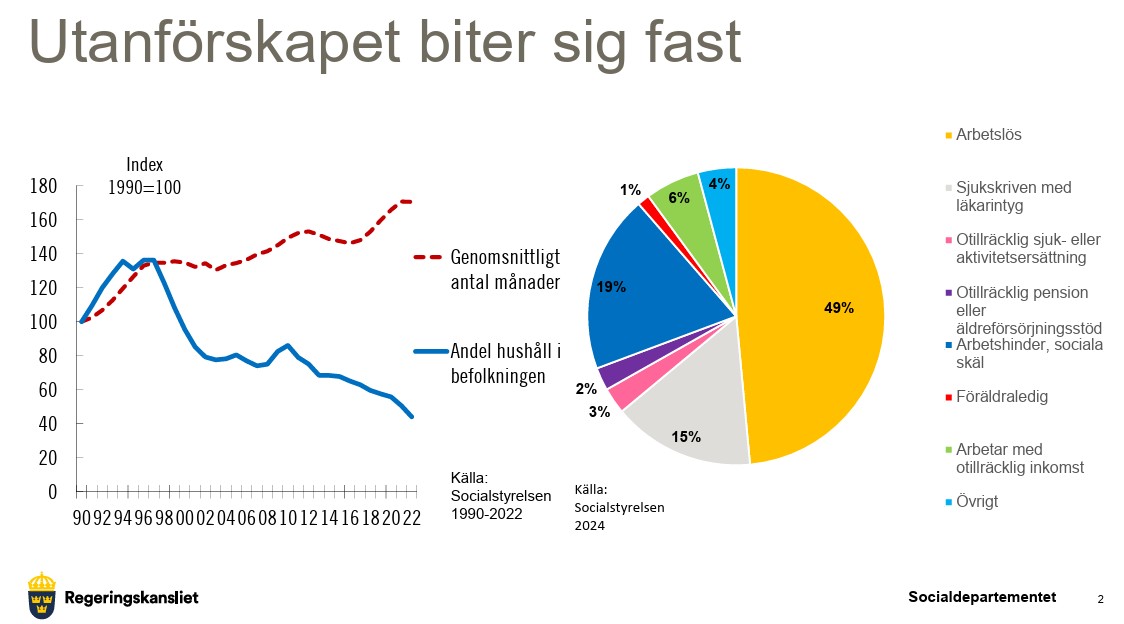
The consequences of long-term welfare dependency are described as devastating, and the government refers to studies showing that welfare dependency is associated with both mental and physical health problems, and that children growing up in welfare dependency and social exclusion are at great risk of inheriting this.
“It should never be more profitable to live on benefits than to work. With activity requirements and benefit caps, we create better opportunities for more people to become self-sufficient, while limiting economic support to individuals who are illegally staying in Sweden to emergency situations,” said the Sweden Democrats’ economic policy spokesperson, Oscar Sjöstedt.
Lagrådsremisser
To enable all this, they want to implement a comprehensive benefit reform, including a benefit cap and activity requirements for recipients of social assistance, as well as qualification for certain social insurance benefits.
They are now taking the next step in the process by deciding on the legislative council referral Activity Requirements for Recipients of Social Assistance and Reformed Social Assistance – Benefit Cap and Increased Employment Opportunities.
The reform in its entirety
A new activity requirement for recipients of social assistance
People who have received social assistance for at least three months must participate in activities to retain the support.
The activity level should correspond to the individual’s ability.
Municipalities are required to offer meaningful and work-oriented activities, such as language training, work-based measures, or structured job searches.
Failure to participate without acceptable reason should result in a reduction or withdrawal of support.
The Health and Social Care Inspectorate is given the opportunity to impose penalty fees for systematic deficiencies in the municipalities’ implementation.
An investigation into expanded childcare for children whose parents are subject to the requirement is planned.
A new benefit cap in social assistance
They are introducing a benefit cap to ensure that work always pays more than benefits. The benefit cap consists of three parts:
Modernized and stronger national standard: The national standard is updated based on current consumption patterns and has a new calculation model to make the support more accurate and fair.
Limitation of social assistance for larger households: Social assistance is limited for households with more than three dependent children or school-age youths under 21 years of age.
The national standard should serve as a cap: As a general rule, the social welfare board should not calculate amounts higher than the national standard. Support levels should be uniform throughout the country, with deviations only allowed in absolute exceptional cases.
Additional tightening and clarifications
Only individuals legally residing in Sweden should be eligible for economic assistance, except for emergency situations such as food or repatriation.
Support for subletting should generally only be provided if the lease is permitted, to counteract insecure forms of housing and crime in the housing market.
Requirement for a medical certificate is introduced when illness is cited as a reason for not participating in activities or being available for the labor market.
The social welfare board is explicitly authorized to impose requirements on assistance recipients with reduced work capacity, as well as a duty to cooperate with the Social Insurance Agency and the Public Employment Service through coordinated individual plans.
Who is covered?
Working-age individuals receiving social assistance and capable of participating in activities.
Large households where social assistance is currently high due to many children.
Individuals staying in the country without permission are not eligible for economic assistance beyond emergency aid.
Exemptions from the activity requirement include, among others, children, full-time employees, individuals on full sick pay/disability benefits, and parents of children under one year old.
Necessary change of direction
According to the Sweden Democrats, the benefit reform is a necessary change of direction to break the long-standing welfare dependency that has emerged after decades of inadequate requirements and weak work incentives. It should always pay off to do the right thing, and welfare should go to those who work, contribute, and truly need support, the party argues.
At the same time, they are reducing the pull factors in the system by ensuring that individuals who are not entitled to economic assistance will not receive it, creating clearer incentives for repatriation when support can no longer be used as a means of livelihood.
Through the reform, the work ethic is strengthened, welfare dependency is reduced, and resources are freed up for both municipalities and households. According to the Sweden Democrats, it is a fair and necessary change that increases trust in the welfare system and improves the conditions for more people to find employment.
The activity requirement is proposed to take effect on July 1, 2026, and the benefit cap on January 1, 2027. The proposal for penalty fees for municipalities is proposed to take effect on July 1, 2027.
Press conference:
READ ALSO: Family receives benefits equivalent to a monthly salary of 50,000 SEK