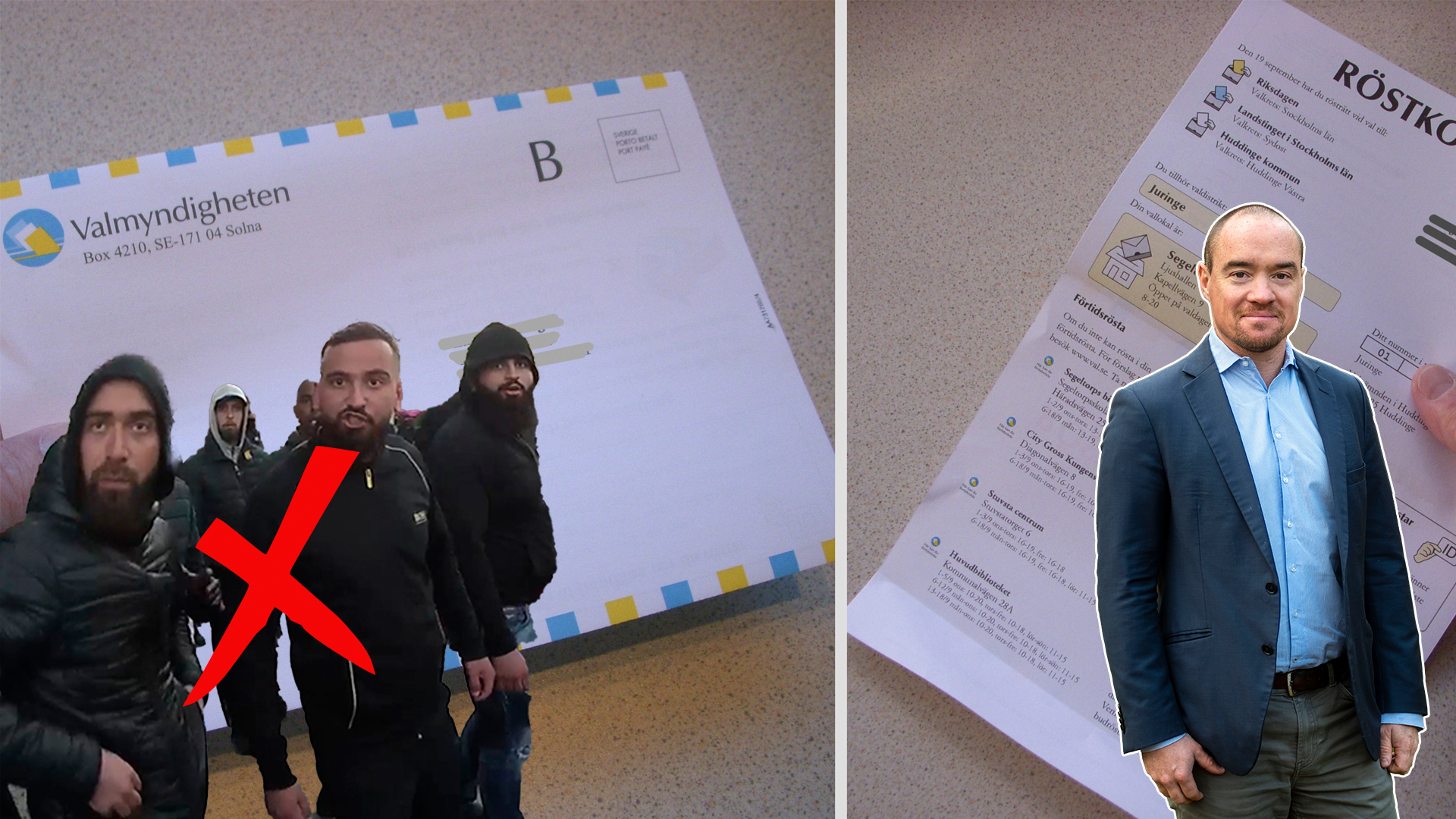
LEADER • There are occasions when politics should act quickly, clearly and without equivocation. This is one such occasion. The Tidö parties have a tool that too few seem to understand the magnitude of: the right to vote for non-citizens in local and regional elections is not constitutionally protected. It is a regular legislative decision. And it can be revoked as easily as it was introduced.
Therefore, the government should appoint a rapid investigation this spring with a single mission: to abolish the right to vote for non-citizens (IM) in municipalities and regions. The proposal should be able to be presented to the Riksdag well before the summer of 2026, so that it is clear to the voters before the election in September of the same year.
This is not a symbolic issue. It is a question of power. And in many municipalities, it concerns real majorities.
Today, there are a couple of municipalities where over 20 percent of the eligible voters lack Swedish citizenship and even more with over 10 percent. This is not an exaggeration. It is a fact that follows decades of mass immigration combined with generous rules for local voting rights. The result is that people who are not part of our country, who do not have a formal bond to the nation, who in many cases do not even speak the language, are involved in deciding on education, social services, elderly care, housing policy, and municipal priorities.
According to figures from Statistics Sweden (SCB) that I have compiled, we have over 600,000 foreign citizens who are eligible to vote in local and regional council elections.
Analysis of the municipalities
To get a clearer picture of the proportion of those eligible to vote in local elections, I looked at SCB’s statistical database. For each municipality, I looked at the number of non-citizens with voting rights versus citizens with voting rights in the 2022 election.
The analysis shows that the proportion of non-citizens of the total eligible population went from as high as 24 percent (Haparanda) to as low as 2.43 percent (Öckerö). For example, non-citizens in Botkyrka municipality make up 15.79 percent of the total number of eligible voters. In Sigtuna, it’s 15.39 percent, and so on. It’s bizarrely high. You can find the entire list in the table below.
Of course, all municipalities are affected by non-citizens being eligible to vote, regardless of how close the election is between different blocs, but to get an idea of how many municipalities where non-citizens are most likely to influence the outcome of the election, I looked at the SD+M+KD+L bloc division and measured this bloc’s total share of the votes for each municipality. At the municipal level, there are often also local parties that can slightly disrupt the comparison, but it still provides a good indication, especially since local parties cannot normally be attributed to specific blocs.
Ridiculously high figure
I did it so that in cases where the difference for SD+M+KD+L from the 50% mark in an election was less than the proportion of the population eligible to vote as non-citizens, I marked it with a 1 (for example: if SD+M+KD+L received 48 percent of the votes in a certain municipality, i.e. two percent from 50 percent, and the proportion of non-citizens eligible to vote in the same municipality exceeded two percent, I marked this municipality with a 1 in the table).
The idea is that if the proportion of non-citizens exceeds the difference between the blocs, it can be argued that their share of the votes can decide the election in either direction. This often happens to the advantage of the left, as immigrants generally tend to vote left. The pattern is certainly not 100% unambiguous – there are certainly non-citizens who do not vote at all or vote right, for example, Western immigrants or those from Eastern Europe, but the point remains.
So what was the result? In a total of 115 (!!) municipalities, the proportion of non-citizens was higher than the difference between the blocs. See the same table below. That is almost half of all the country’s municipalities, where non-citizens constitute such a high proportion that they can well and truly decide the election. And I haven’t even discussed all those who have been granted citizenship (but shouldn’t have).
This is a ridiculously high figure that should be cause for concern among the Tidö parties.
Changed power balance
So what happens if this group, non-citizens, no longer have the right to vote in local elections?
Firstly, the power balance would change radically. The Social Democrats and their satellite parties have for decades built local power bases in immigrant-dense areas, where loyalty is high and resistance to right-wing parties is almost total. In many municipalities, these votes are crucial for left-wing governance. If they are taken away, the entire municipal map can be redrawn.
Secondly, the incentives change. Citizenship regains its significance. Today, the state signals that it doesn’t matter if you are a Swedish citizen or not – influence will come anyway. That signal is devastating. If voting rights are tied to citizenship, a clear incentive for real integration, loyalty, and responsibility is created.
Thirdly, the legitimacy of local self-government is strengthened. Municipalities are not administrative service offices, they are political communities. When decisions are made by people who are not full members of the national community, trust is eroded. It is not xenophobic to assert this. It is elementary democratic theory.
Dare to change
Critics will talk about exclusion, about democratic rights, about