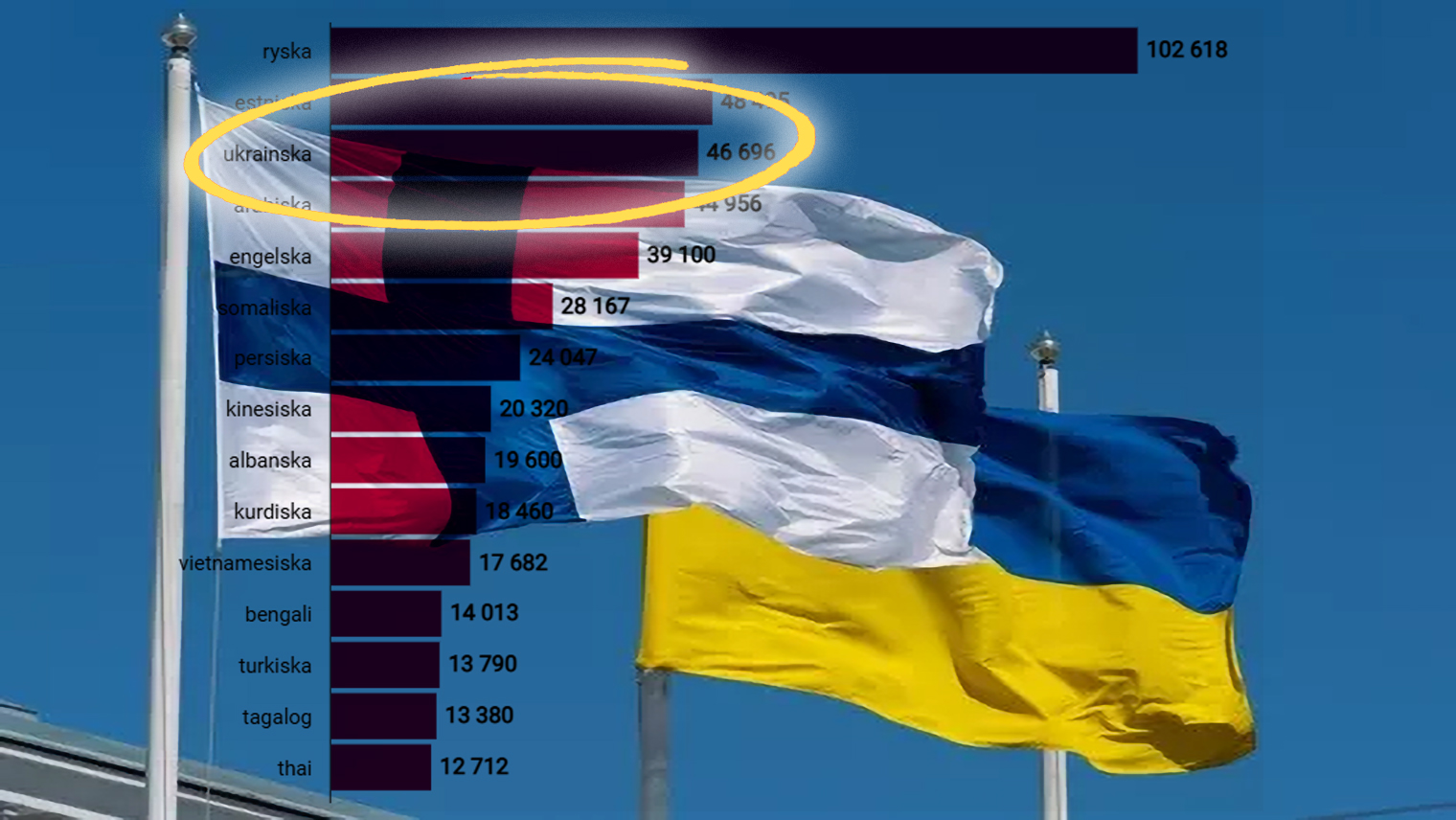
Population growth in Finland slowed significantly last year. The main reason is reduced immigration. At the same time, new figures from Statistics Finland show that Ukrainians have now surpassed Arabic speakers as the third largest group with a foreign native language in the country.
By the end of the year, Finland had 5.63 million inhabitants, an increase of about 17,000 people compared to the previous year. This is a considerably lower increase than in the two preceding years. This is reported by, among others, Hufvudstadsbladet.
Ukrainian Larger Than Arabic
Among people whose mother tongue is neither Finnish, Swedish, nor Sami, Russian continues to be the largest language group with around 103,000 people. Estonian is the second largest.
READ ALSO: Swedish Gang Crime a Horror Example in Finland
Ukrainian has now risen to third place, thus surpassing Arabic in terms of native speakers. Arabic speakers have been pushed down to the fourth largest group. Among foreign citizens residing in Finland, Ukrainians are now also the largest group.
Fewer Immigrants Slow Down Growth
The lower population growth is mainly explained by decreased immigration last year. At the same time, however, the number of people with domestic languages as their native tongue declined by just over 19,000 individuals.
People with a foreign background now make up 11.7 percent of Finland’s population. This is a historically high level for Finland, but still far below Sweden’s level, where the share amounts to at least 27 percent.
READ ALSO: Finland-Swedes and the Swedish Language Evoke Strong Feelings in Finland
For the first time, the number of second-generation individuals with a foreign background also exceeded 100,000. A large part of this group is very young—almost four out of ten are not yet of school age. Birth rates are high in many of the groups involved.
Significant Regional Differences
Population trends vary greatly between different parts of Finland. In 77 municipalities, the number of inhabitants increased, while 227 municipalities saw a decline in population.
Helsinki had the largest increase in absolute numbers with just over 10,000 new residents, followed by Espoo and Turku. The largest population decrease was recorded in Kouvola, Salo, and Savonlinna.