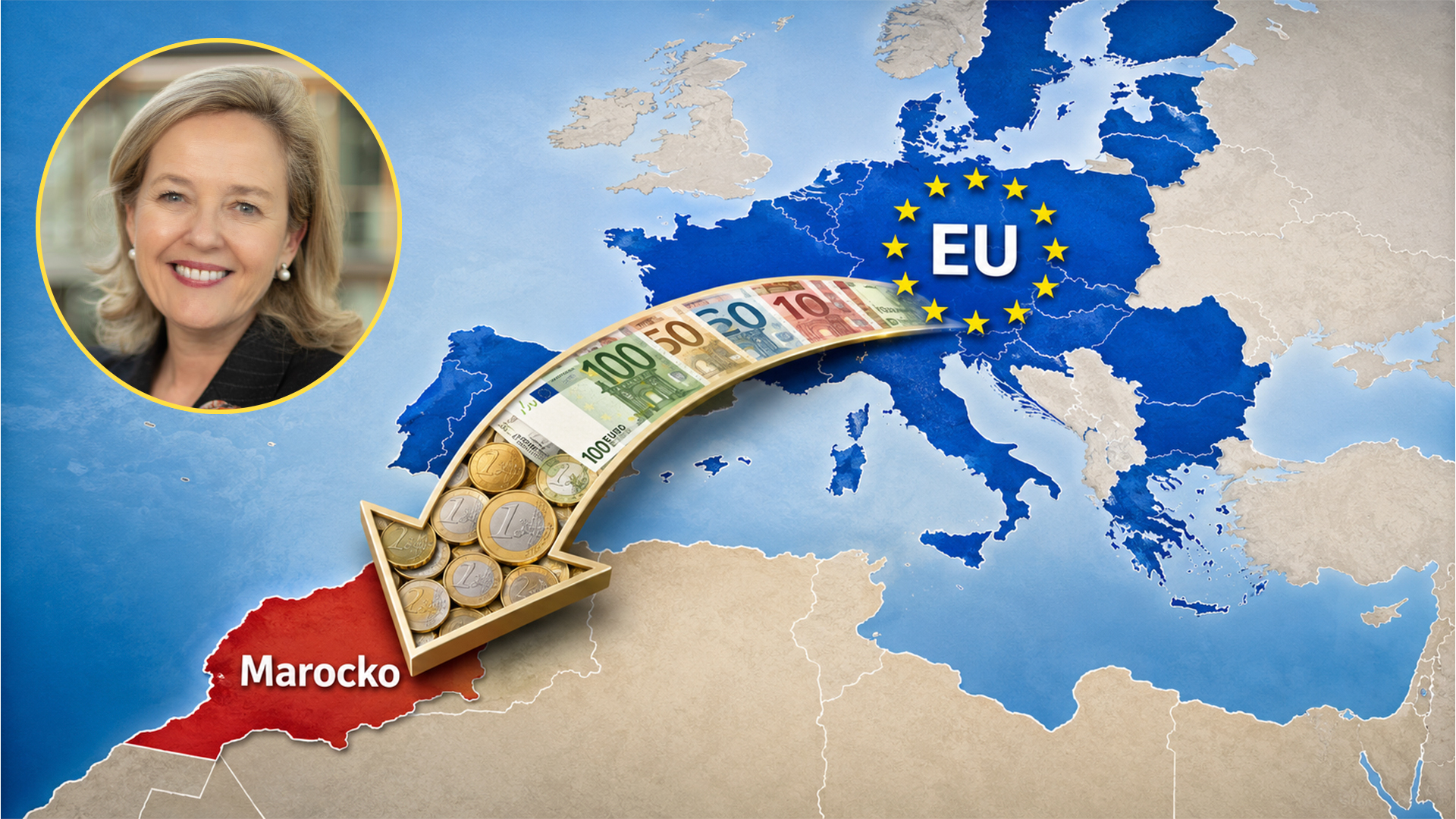
The president of the EU’s investment bank (EIB), Nadia Calviño, released a video yesterday where she proudly announced they will now finance public transport – but not in the EU, rather in Morocco. This move has been met with criticism.
Morocco and the European Investment Bank, EIB, have signed new financing agreements worth a total of 365 million euros, equivalent to just over four billion Swedish kronor. The funds will go toward strengthening and “climate-proofing” the country’s motorway and railway networks.
The agreements were signed in Rabat during EIB chief Nadia Calviño’s first visit to Morocco since taking office. According to the EIB, the initiative marks a new phase in the relationship between the EU and Morocco, with the bank now ramping up its support to the country.
The first agreement involves a loan of 50 million euros to the Moroccan railway operator ONCF. In addition, there is an EU grant of 15 million euros, earmarked for measures to make the railway system more resilient to climate change. The second agreement is a loan of 300 million euros to Autoroutes du Maroc, ADM, to strengthen the country’s motorway network.
Criticism of the Initiative
According to the EIB, the projects will improve safety, mobility, and the resilience of infrastructure, while purportedly providing concrete benefits for both citizens and businesses. The bank also claims the investments will contribute to regional integration and stronger economic ties between Europe and Africa.
At the same time, the initiative means that the EU’s financial arm continues to allocate significant resources to infrastructure outside the union’s borders. The financing comes with an EU guarantee, and part of the package consists of a direct EU grant. Critics of such arrangements have repeatedly questioned why European taxpayers should bear risks or contribute funds to major projects in third-party countries, especially when many EU countries themselves struggle with neglected infrastructure, energy crises, and strained public finances.
EIB president Nadia Calviño described Morocco as a long-standing and strategic partner.
– We are entering a new phase in our partnership, she said according to the bank, and emphasized the investments as an expression of the new dynamics in the relationship between the EU and Morocco.
Highest Level Since 2012
The EIB states that the bank plans to channel more than 700 million euros to Morocco during 2026. This follows a record year in 2025, when the bank signed financing amounting to 740 million euros to the country – the largest annual level since 2012.
In total, the EIB’s commitments in Morocco amount to over 12 billion euros since cooperation began in 1979. The funds have gone to, among other things, energy, transport, education, water and sanitation, health, and support for the private sector.
A significant part of the most recent financing has also gone toward reconstruction after the Al Haouz earthquake in September 2023. In June, the EIB paid out a second loan tranche of 500 million euros for the rebuilding of roads, schools, and healthcare infrastructure in affected areas. This brings the bank’s total commitment for earthquake recovery to one billion euros.
The initiative is part of the EU’s broader Global Gateway strategy, through which the union aims to strengthen economic and infrastructural ties with countries outside the EU. For Morocco, the EIB describes the country as a natural bridge between Europe, Africa, and the Atlantic region – and as an increasingly important partner for the EU’s economic and geopolitical interests.
Numerous Critics
The Sweden Democrats (SD) in the European Parliament are critical of the flow of money to Morocco. In a post on X, they say they would have rather seen the money used in Europe.
Instead of using our money to fix our trains or trams, a Spanish socialist gets to stand and boast about how your creditworthiness is being used to build trains and trams in Morocco! All parties except SD vote in favor of this.
Under the EIB’s own post, angry comments are piling up about why the EU should spend money on such things. One user relates to the behavior of Moroccans during the World Cup, when riots broke out in Brussels following the country’s win against Belgium.
This help is so well-deserved. The gratitude of the Moroccan people is legendary, and their love for Europe is evident every day. pic.twitter.com/xOm4UXqwrE
— Chatapult (@Chatapult19643) July 1, 2026