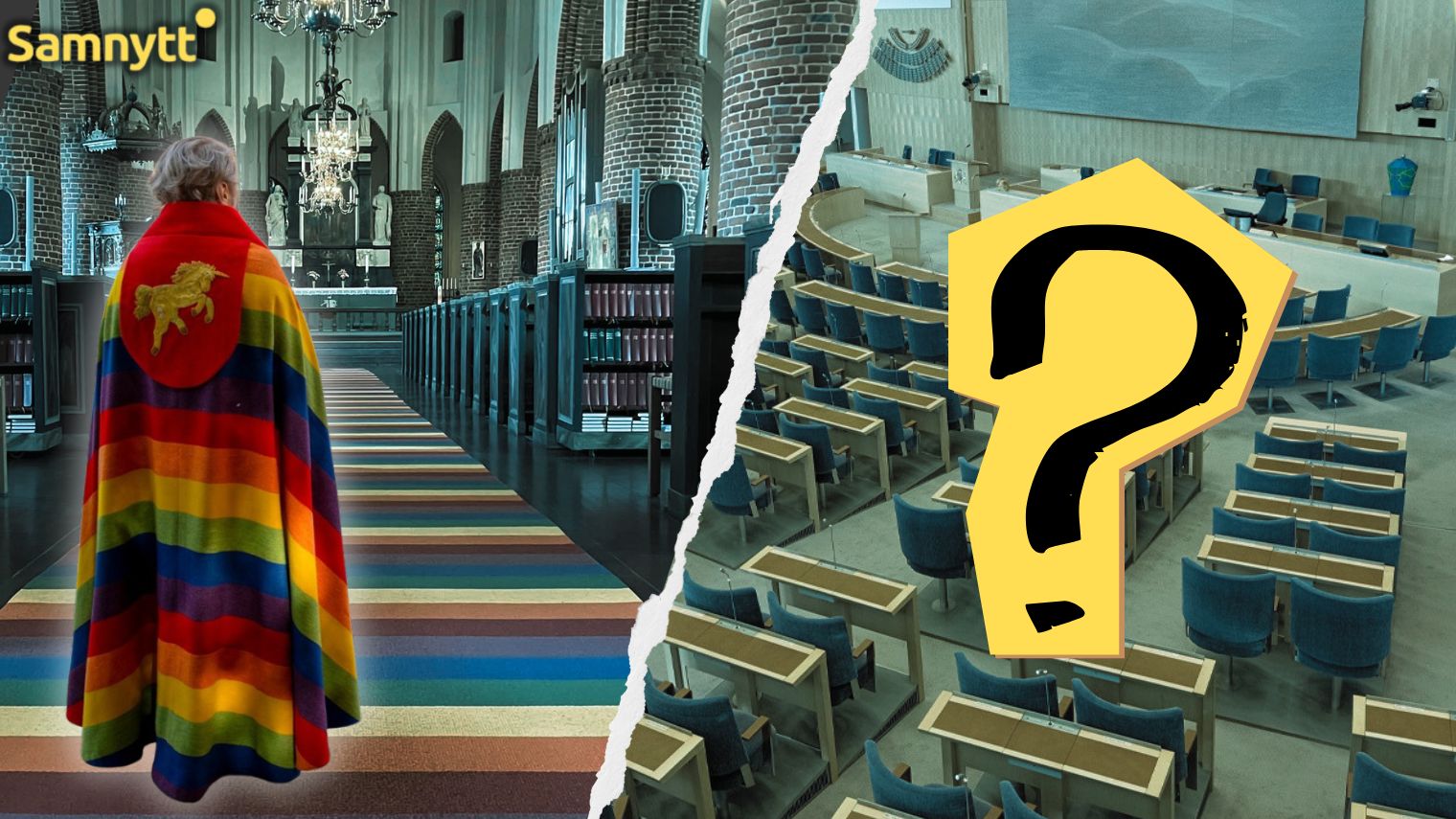
In recent years, the Church of Sweden has become politicized at a furious pace, and few can deny the direction this development has taken. The church organizes Pride and trans events and takes positions on various political issues. For many, the church is perceived as increasingly less Christian. A new survey confirms that the church today is a deeply divided organization.
The Church of Sweden usually claims that it is not about party politics, but rather that the positions taken are grounded in general Christian values and views of humanity. However, not everyone agrees with this.
To examine views on the Church of Sweden, Kyrkans tidning sent a survey to all 349 members of parliament, of which 137 responded. Of these, 85 stated that they are members of the Church of Sweden and were then asked more detailed questions.
READ ALSO: “Pride has become Sweden’s new God”
On the question of their attitude towards the Church of Sweden, the responses were predominantly positive—just over 75 said they are fairly or very positive. But when dividing the responses between the Red-Green and Tidö bloc parties, a completely different picture emerged—95 percent of the Red-Greens stated that they are positive, while the corresponding proportion on the Tidö side dropped to 55 percent.
Among those who are members and Red-Green, 90 percent said their political values are welcomed in the Church of Sweden and 60 percent feel more at home in terms of values in the church than before. 85 percent also felt that the church is politically independent of parties.
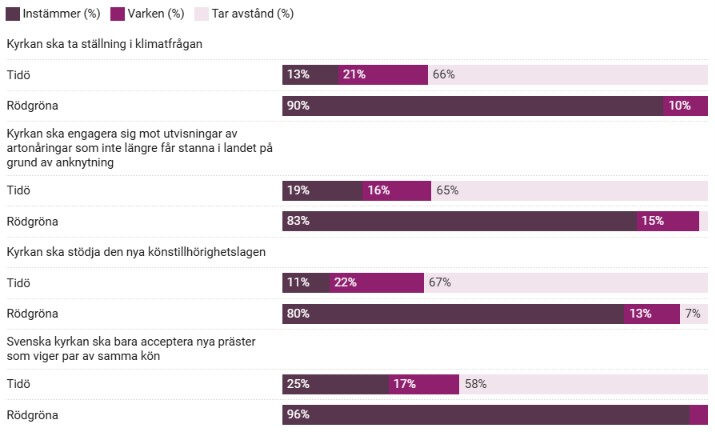
At the same time, while the vast majority of the Red-Greens believe the church is not political, they still think it should take a stand on several political issues:
Once Seen as a Conservative Force
Among Tidö bloc members, only 40 percent feel their political values are welcome, and 65 percent disagree that they feel more at home in the church. Here, only 15 percent believe that the Church of Sweden is independent of party politics.
According to Magnus Hagevi, Professor of Political Science at Linnaeus University, the Church of Sweden in the early 20th century was perceived as a conservative political force, and the emerging labor movement felt opposed by priests and bishops.
– I believe that a large part of secularization in the early 20th century was due to the growing labor movement not perceiving the Church of Sweden as representing them, he tells Kyrkans tidning.
READ ALSO: Christians Find a Home in the Orthodox Church: “The Church of Sweden Feels Less Christian”