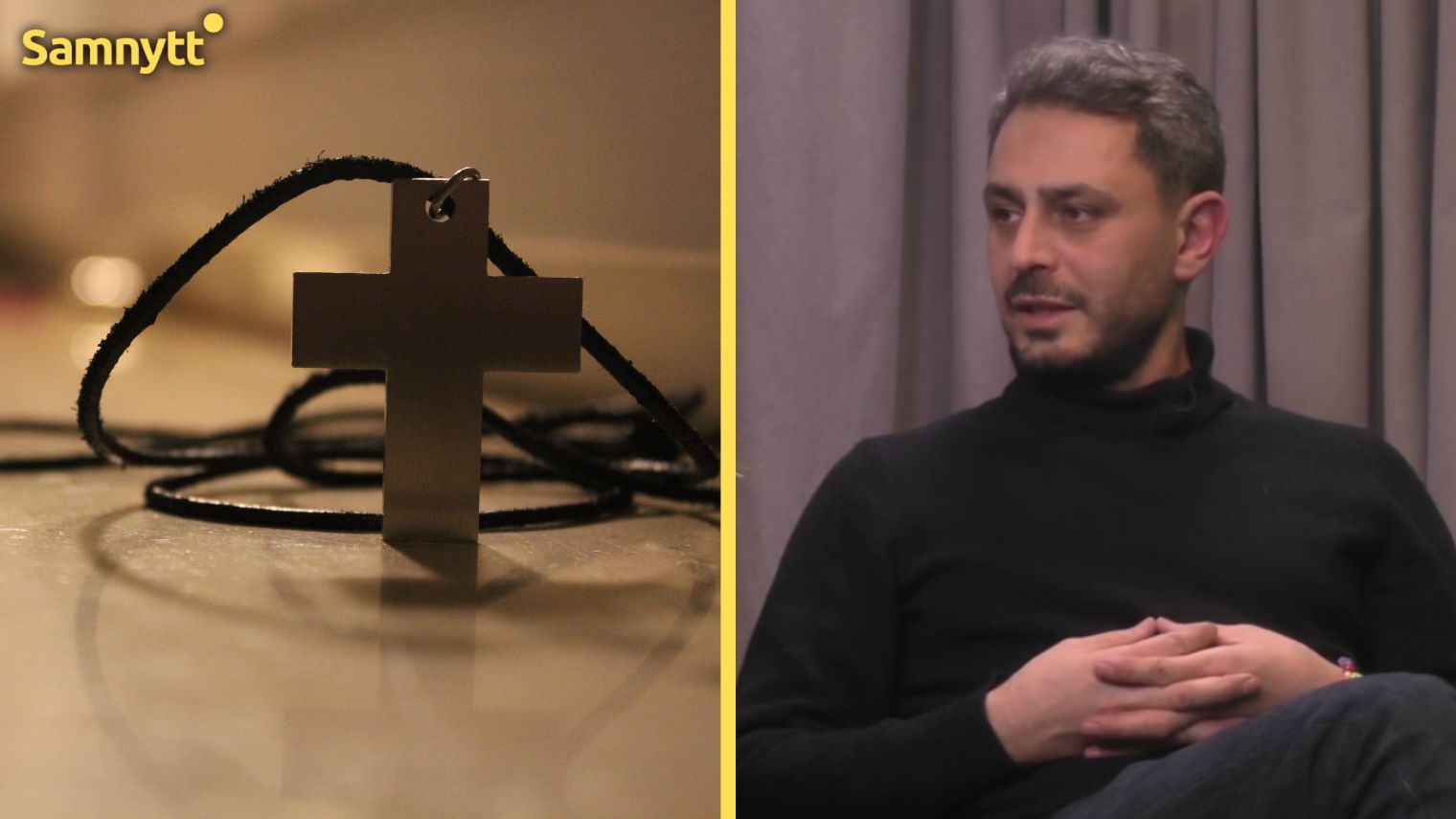
Researcher Devin Rexvid wants to see a much broader ban on religious symbols in schools and preschools than what has so far been discussed in Swedish politics. Instead of targeting only Muslim garments, he advocates for a general ban on all visible religious symbols for employees in tax-funded operations.
Rexvid, who researches honor-related oppression and violence at Stockholm University, argues that a ban covering only Islamic symbols risks becoming discriminatory.
“I have never believed in a ban on only Islamic symbols,” he tells Forskning & Framsteg.
At the same time, his research has identified connections between staff wearing veils and honor-related norms in preschools. In a 2024 report, he describes how interviews with Swedish preschool staff include examples of situations where religious norms have influenced operations.
READ ALSO: Sweden Democrats: Ban Veils in Public Spaces
Among other things, there are “examples where a veiled colleague signals with her body language to a girl that she should put her veil back on when it has come off or prevents a girl from having physical contact with male staff during play.”
According to interviewees, female staff members who wear the veil can also serve as role models in a way that puts pressure on some girls from Muslim families. Rexvid therefore believes that the state should adopt a more consistently secular stance.
Protect Children from One-Sided Influence
He not only wants to ban religious symbols but also political, philosophical, and ideological symbols among staff in public service. In support of his position, he refers to a 2001 European Court of Human Rights decision, where the court accepted that Switzerland banned primary school teachers from wearing the veil, citing that young children are particularly impressionable.
“So we should note that the Swedish curriculum states that children should be protected from one-sided influence.”
Rexvid, who himself grew up in Iran under the country’s theocratic regime, believes Sweden’s increased religious diversity has brought state neutrality toward religion into sharper focus. He regrets that the trend has moved toward greater public visibility of religion and argues that Sweden has, for the most part, prioritized religious freedom over other democratic principles, such as equality.

According to Rexvid, public service is based on the principle of neutrality and displaying religious symbols can thus create mistrust.
He also highlights a reasoning used by France’s former president Nicolas Sarkozy during the debate on a veil ban in French schools. He said that when he enters a mosque, he takes off his shoes out of respect for Muslims’ faith and argued that the French school is the state’s living room, and here our values apply.
Lacks Credibility
At the same time, Rexvid criticizes the Swedish political debate about bans on veils and niqabs. He believes that the parties most actively pushing the issue lack credibility.
“Of course it matters who is raising these issues. For me, the Christian Democrats and Sweden Democrats lack credibility, not only on issues of niqab and veil, but also on equality and secularism in general. They are two deeply value-conservative parties. At the other end are cultural relativists and Islamists who want to excuse the oppressors. But there is very little interest in those directly affected.”
Veil Ban
The Sweden Democrats have pushed proposals to ban full-face veils, such as niqab and burka, in public spaces. Their arguments have mainly concerned security, integration, and the idea that covering one’s face in public life is problematic in encounters with authorities and in society at large.
The proposal has been criticized for potentially being far-reaching and legally controversial with regard to freedom of religion.
Several similar rules already exist in Europe. In 2011, France introduced a ban on face-covering clothing in all public spaces, and countries such as Denmark, Belgium, the Netherlands, Austria, and Switzerland have various forms of bans or restrictions, often in public buildings or certain locations.
In several Muslim countries, the rules are different. In countries like Iran and Afghanistan, full-face or mandatory veiling is instead enforced by the state, while, for example, Tunisia has introduced restrictions on the niqab in some public contexts citing security.