Péter Magyar will be Hungary’s next prime minister following Sunday’s parliamentary election, where his party Tisza emerged victorious. This is no minor victory—the party has secured what is known as a supermajority in parliament, opening the door for extensive and sweeping reforms in a country that has been governed by Viktor Orbán and Fidesz for 16 years. Previously, this door had kept :censored:6:cdd6bbaa89:ist networks with mass immigration and left-liberalism off Hungary’s agenda.
With almost all votes counted in Hungary, it’s clear that the EU-friendly Tisza party received over 50 percent of the votes and 138 mandates in parliament—a clear majority in Hungary’s 199-seat legislature. The result also means the party surpasses the threshold for a so-called supermajority, which requires at least 133 seats.
The incumbent national-conservative Fidesz party, led by Prime Minister Viktor Orbán, garnered about 38 percent of the votes and 55 seats. Orbán conceded defeat on election night, even before all votes were tallied.
“I have congratulated the winning party,” said Viktor Orbán, who has often been portrayed by left-liberal media as an authoritarian leader unwilling to respect an election result.
Hungary, List vote, 98.3% counted:
National parliament election
TISZA-EPP: 53.5% (-0.2)
Fidesz/KDNP-PfE: 37.9% (+0.1)
MH-ESN: 5.9%
DK-S&D: 1.2%
MKKP→G/EFA: 0.8%+/- vs. 95.9% counted
➤ https://t.co/nONdLs4JDG pic.twitter.com/fOA6UaWsus
— Europe Elects (@EuropeElects) April 12, 2026
Throughout the campaign, the opposition under Magyar and Tisza positioned themselves as clearly pro-EU and emphasized the need to restore relations with the European Union.
The campaign focused primarily on domestic political issues, with corruption, the economy, inflation, and the functioning of the rule of law highlighted as central problems. Healthcare and general public services were also seen as major issues for voters during the campaign, according to opinion polls.
The party has also expressed support for continued European cooperation regarding Ukraine and a more unified approach to supporting Ukraine’s defense.
Péter Magyar declared victory in a speech to his supporters, calling the result historic. On Sunday evening, Magyar told his voters that Orbán had called to congratulate him on the victory.
“We have taken back our country,” he said, continuing:
“We have received an unprecedented mandate.”
Watch Péter Magyar’s victory speech:
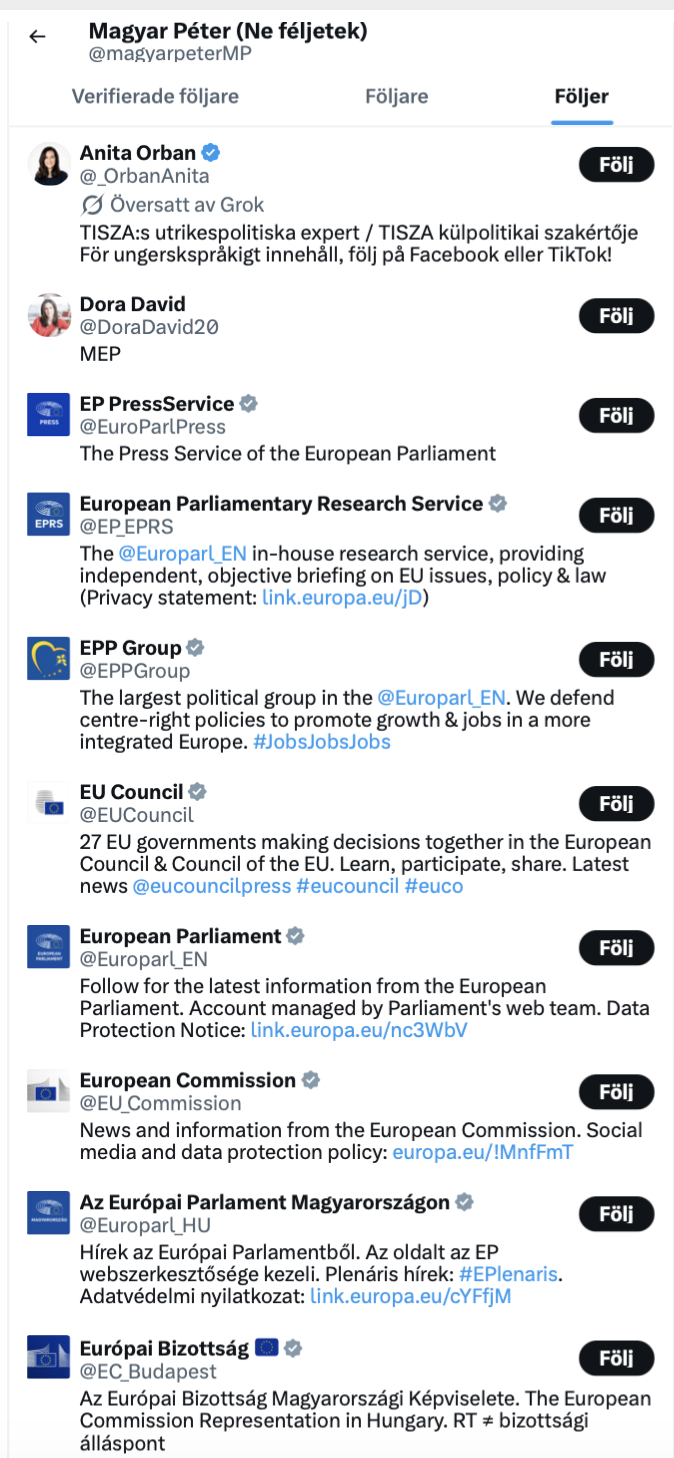
No one could have missed Péter Magyar’s EU-friendly stance, further underlined by his social media following: out of the ten accounts he follows, eight are connected to various EU-related fields.
Left-Liberal Cheering Section
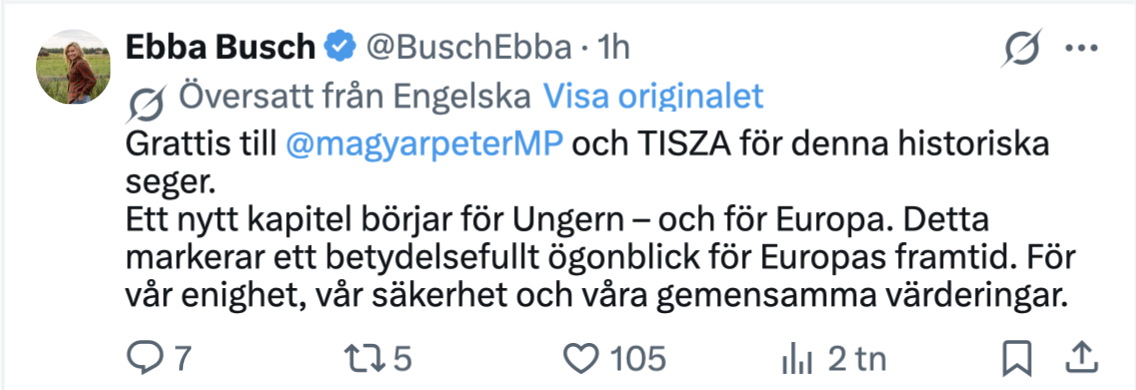
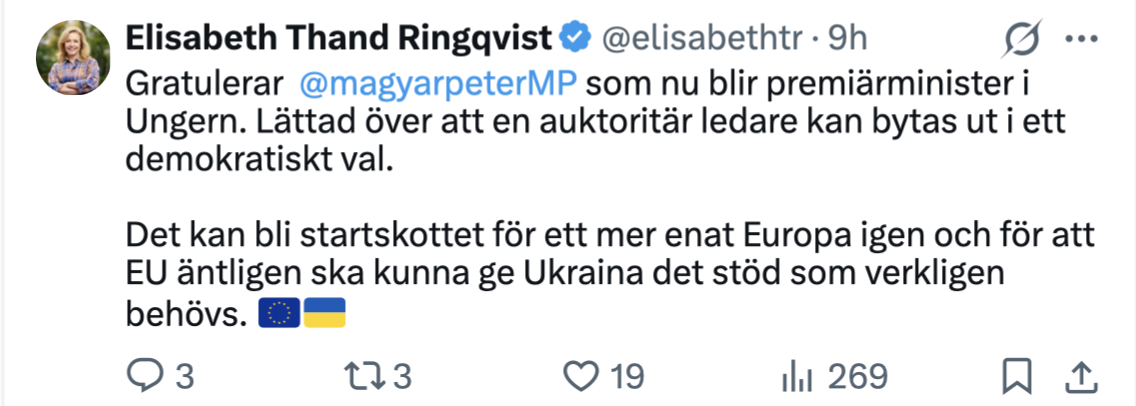
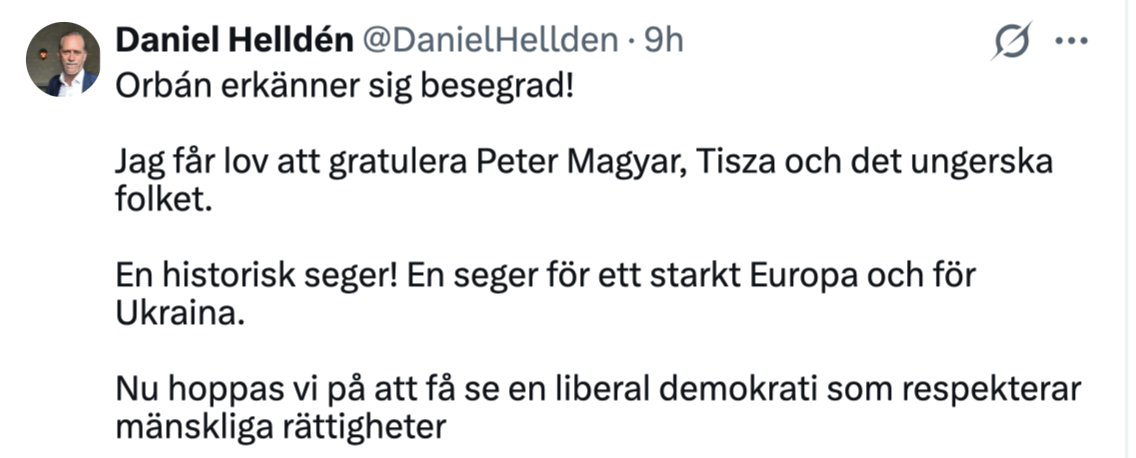
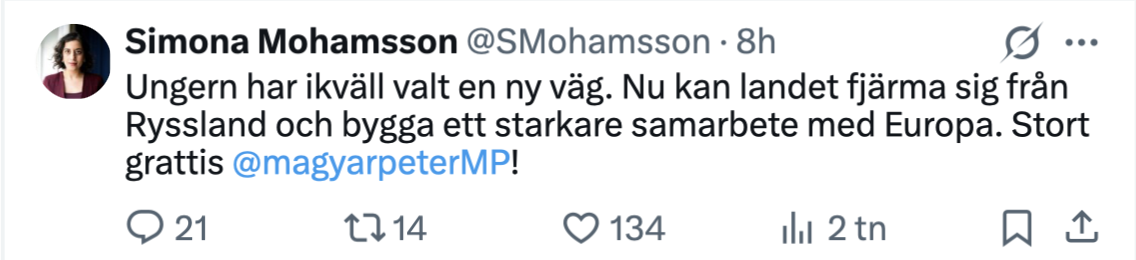
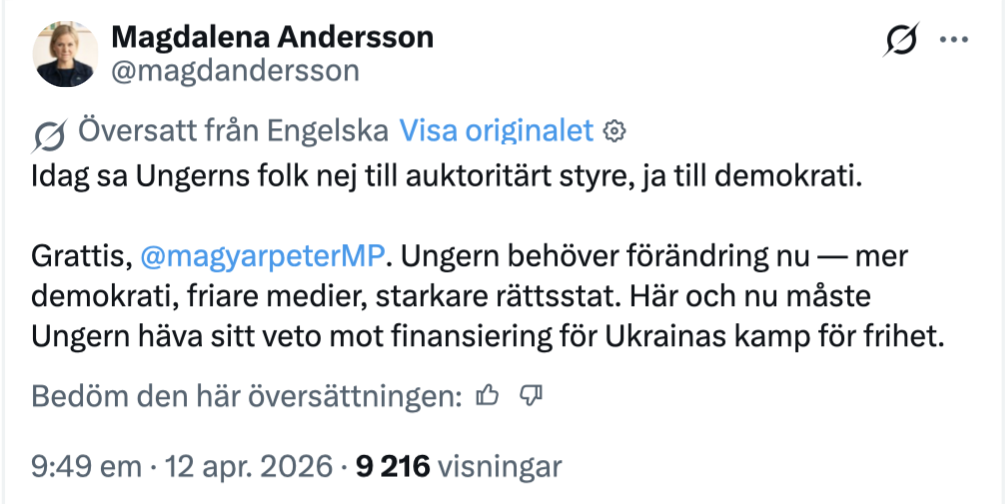
Reactions from the more EU-friendly and left-liberal quarters came swiftly after the election result. In Sweden and across Europe, coordinated posts were published celebrating Hungary now being seen as part of Europe and “our shared values”.
The phrasing can almost be interpreted as if European democracy is only considered legitimate when it aligns with the idea of so-called liberal democracy.
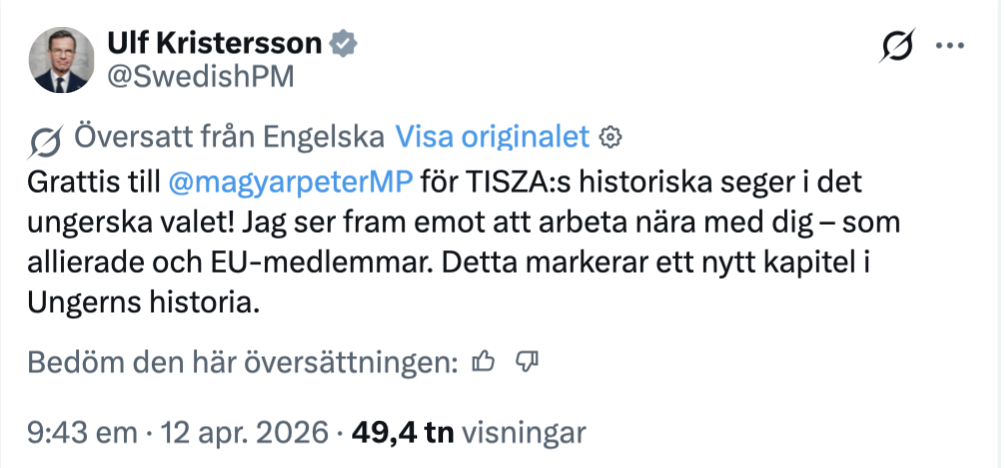
According to Swedish Prime Minister Ulf Kristersson (Moderates), the election victory marks a new chapter in Hungary’s history, expressing hopes for close cooperation within the EU and the alliance.
Social Democratic leader Magdalena Andersson also commented on the election, saying that Hungarians had rejected authoritarian tendencies in favor of democratic values.
Top EU Bureaucrat Had Her Favorite Candidate
When Viktor Orbán was defeated on Sunday evening, Ursula von der Leyen posted a celebratory message, writing that “Europe’s heart beats in Hungary” and that the country, which under Orbán had been highly critical of Brussels’ policies, is now “on its European path.”
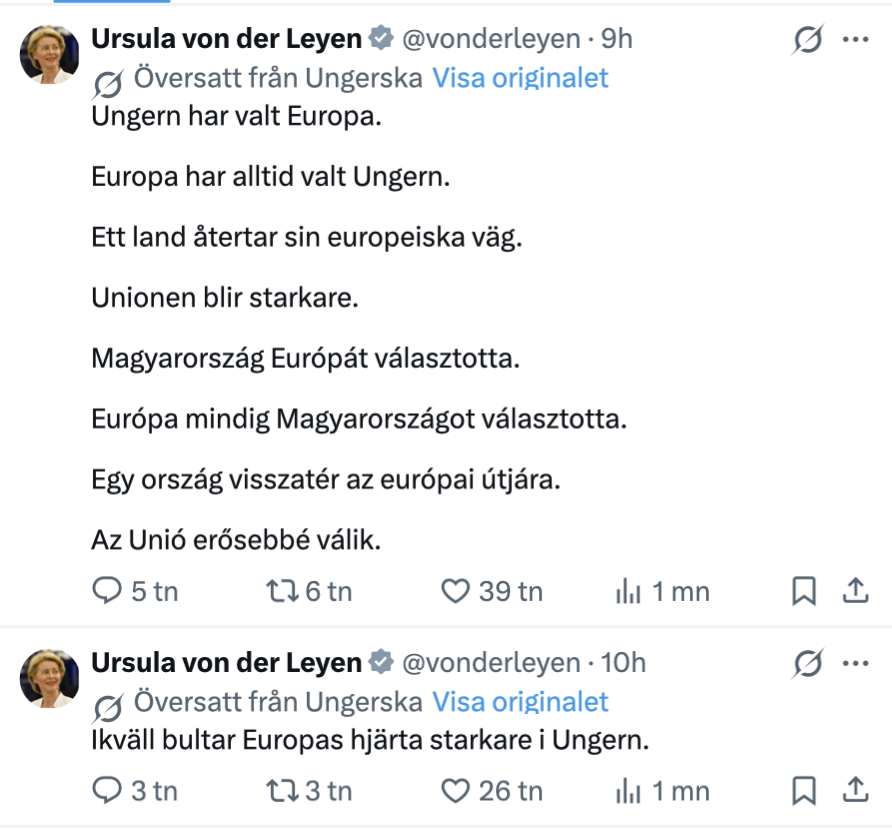
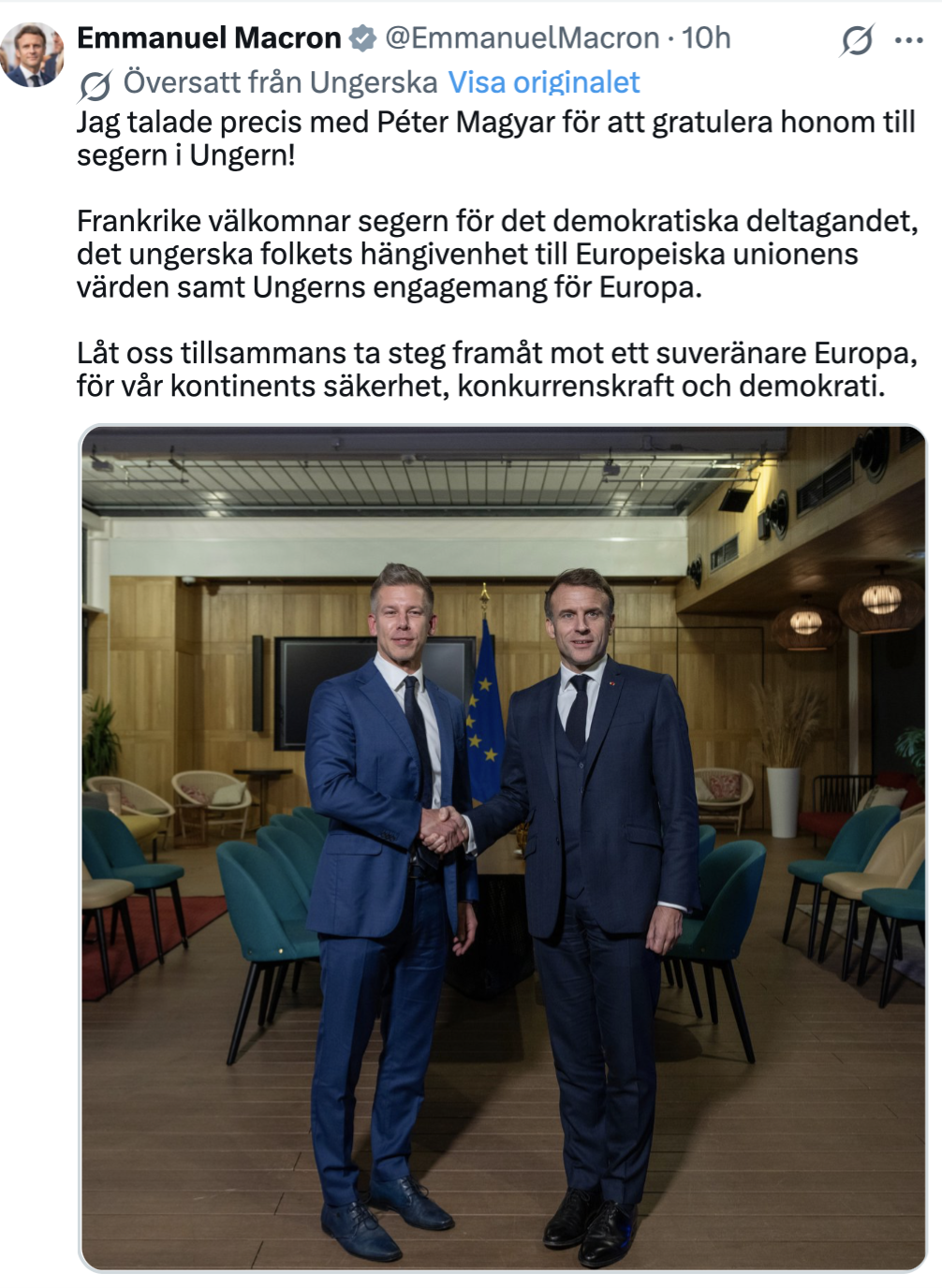
Macron: “France Welcomes the Victory”
In a post from French President Emmanuel Macron, he emphasizes that France “welcomes the victory.”
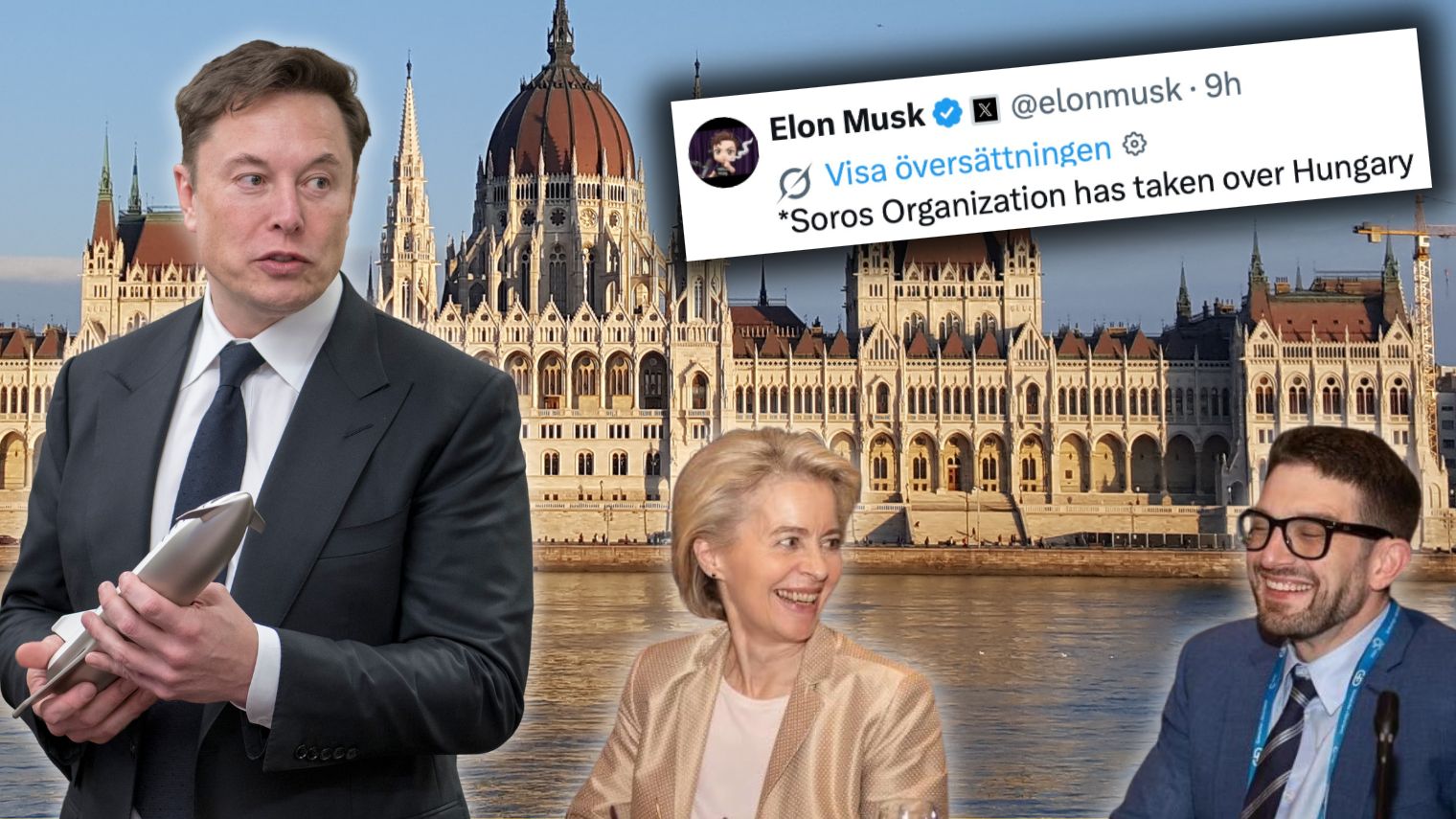
Elon Musk: “Soros Has Taken Over Hungary”
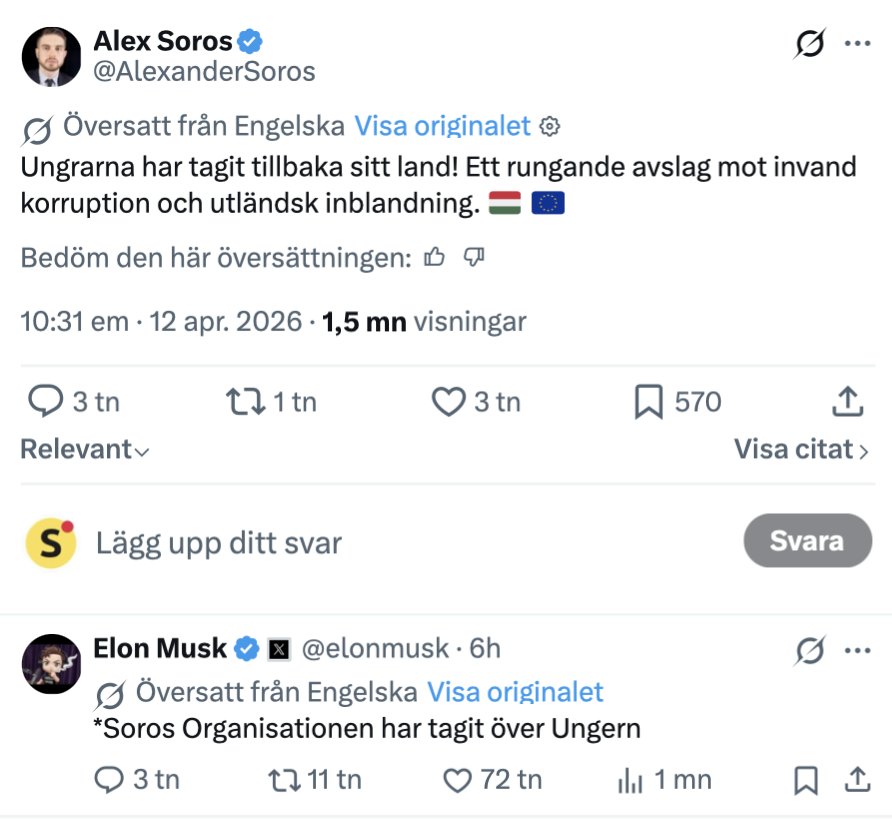
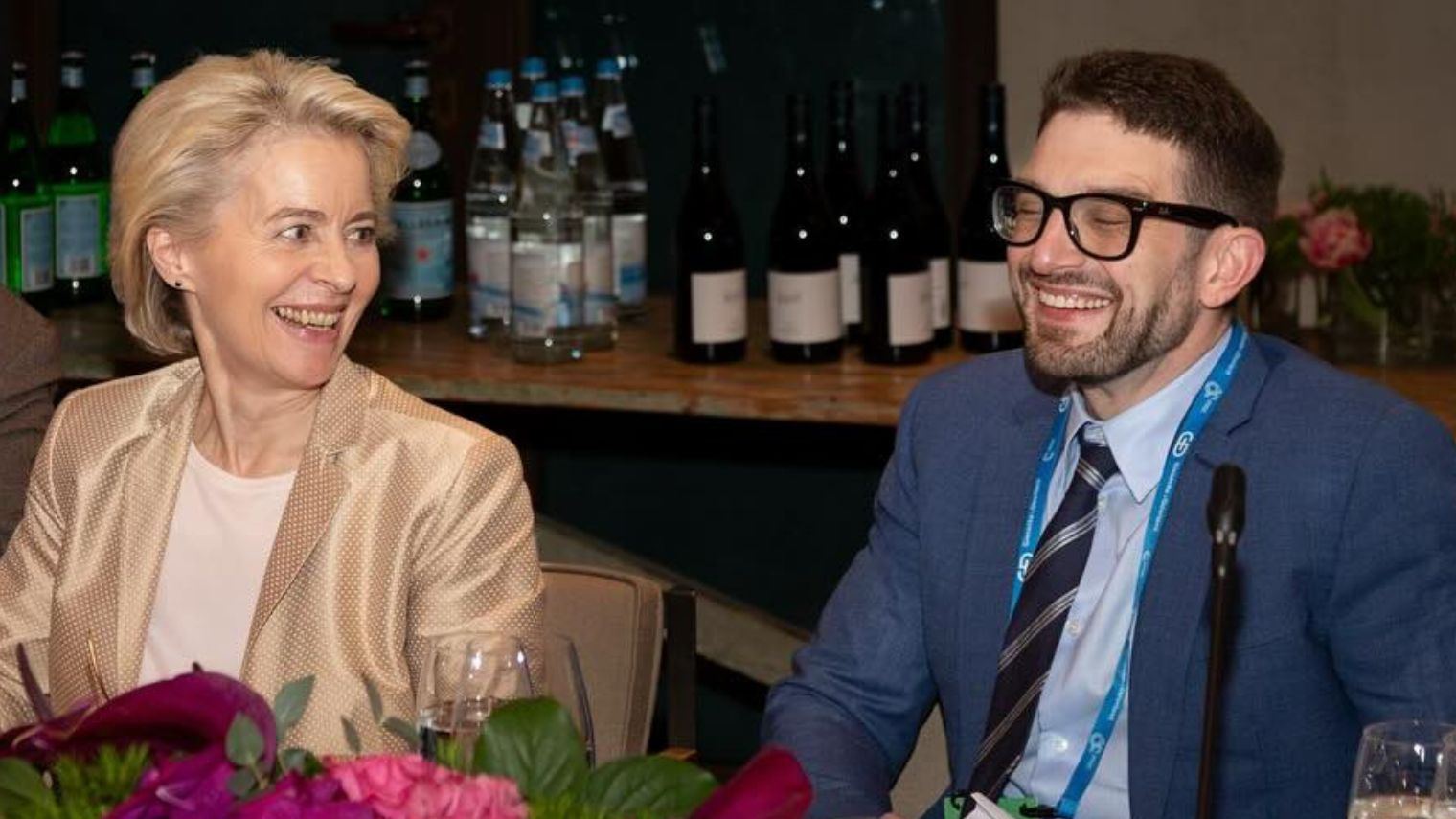
The world’s wealthiest man, Tesla billionaire Elon Musk, commented on the Hungarian election result. He did so in a reply to a statement from Alex Soros, son of the controversial businessman George Soros and chairman of the pro-migration Open Society Foundations, which critics say has supported migration to Europe, and who celebrated by saying “the Hungarians have taken back their country.”
According to Elon Musk, however, it’s not the Hungarians who have taken back the country. Instead, Musk claims it is the pro-migration and left-liberal Soros organization that has taken over Hungary.
Orbán Banned Soros
What makes it especially interesting that Alex Soros—the head of the Open Society network—is celebrating the victory is that under Viktor Orbán’s government, Hungary in 2018 passed the so-called “Stop Soros” package, a set of laws targeting organizations seen as supporting or facilitating illegal immigration.
The laws introduced stricter rules for how civil society organizations, so-called NGOs, could operate in matters related to migration and asylum. Critics argued that in effect, the laws could limit the ability to provide legal and humanitarian support to asylum seekers.
Fidesz and Viktor Orbán’s government, however, justified the laws as intended to protect Hungary’s borders and migration policy, and to counter what they described as foreign influence networks seeking to impact the country’s domestic policy and societal structure.
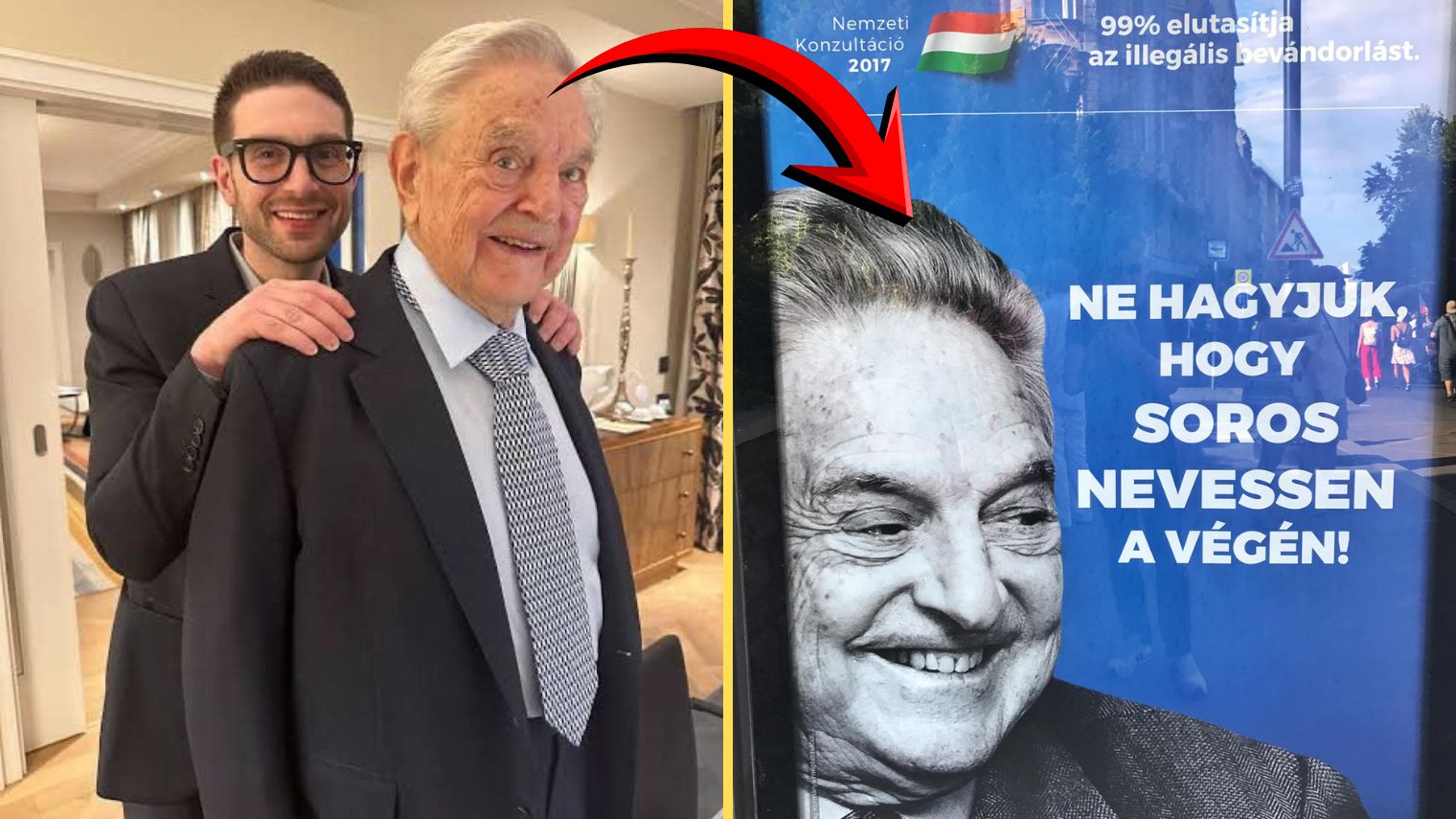
This was often linked in debate to networks around George Soros’s Open Society Foundations—which are now run by his son Alex Soros. The measures faced strong criticism from the EU, which argued that parts of the legislation could conflict with Union law, particularly regarding freedom of association, asylum rights, and legal certainty.
The EU Commission therefore launched an infringement procedure against Hungary and referred parts of the case to the EU Court of Justice. In subsequent judgments, the EU Court has repeatedly found that Hungarian rules concerning migration have not been compatible with EU law, resulting in demands for changes and continued criticism of how the laws have been designed and enforced.
This, in turn, has been one of the reasons Hungary has faced extensive media campaigns and left-liberal criticism, with Orbán’s government accused of undermining the rule of law and democratic institutions. At the same time, Orbán has argued that several of these measures are intended to protect the country from foreign influence networks and organizations.
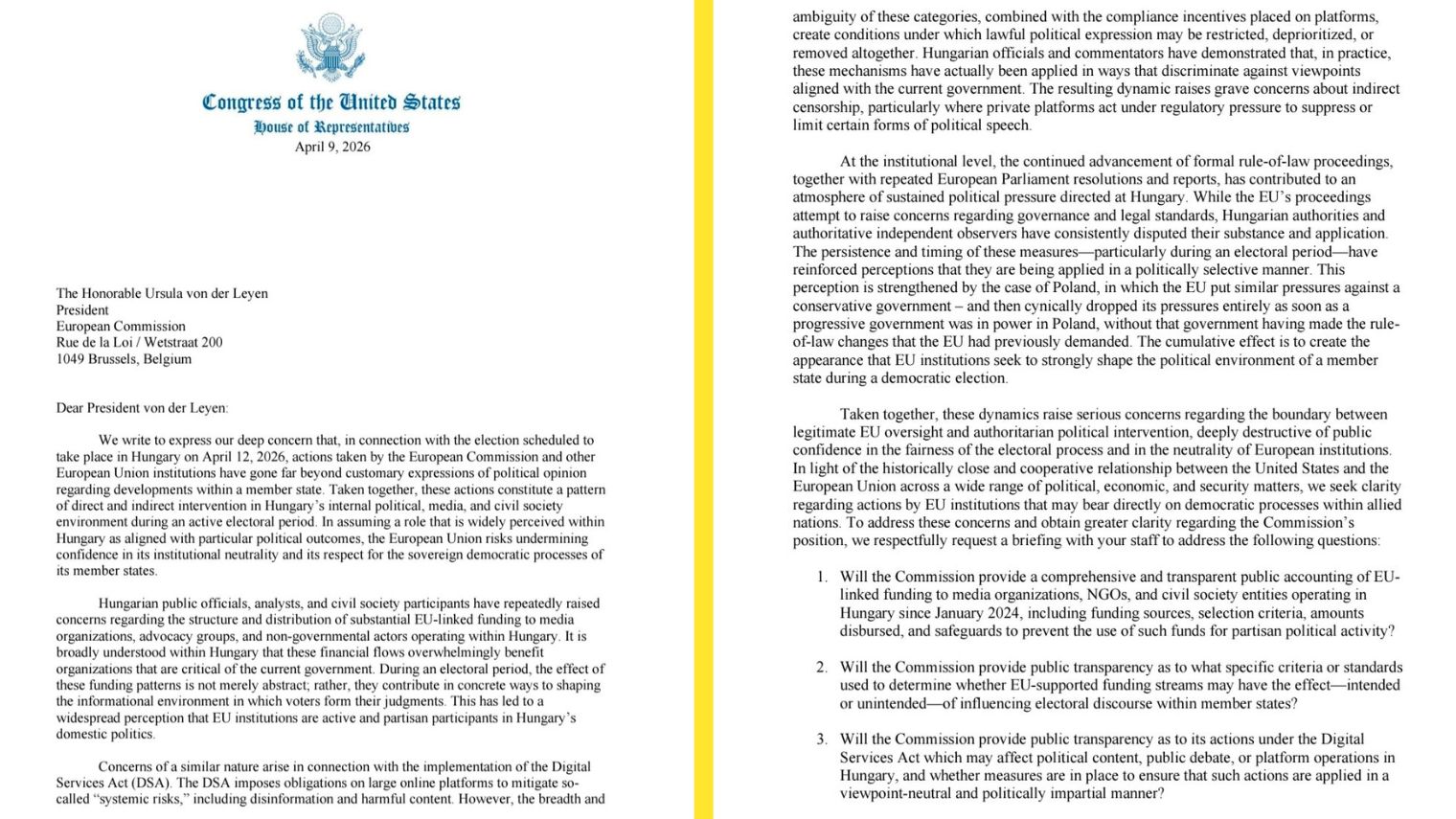
Republican members of the U.S. Congress have sent a letter to European Commission President Ursula von der Leyen criticizing Brussels for interfering in Hungary’s elections and political processes. They warn that the EU’s funding of civil society organizations, implementation of digital regulations such as the Digital Services Act (DSA), and new content monitoring systems could undermine trust in both elections and institutions.
The letter also questions transparency regarding EU support to NGOs. According to Hungarian MEP Csaba Dömötör, representing Orbán’s party, this concerns about 37,000 agreements the EU has made with such organizations, with a total value of €17 billion between 2019 and 2023.
The US lawmakers link this to a broader criticism of the EU’s treatment of Hungary, including frozen funds and recurring political conflicts.
Soros Wants Ukraine in the EU
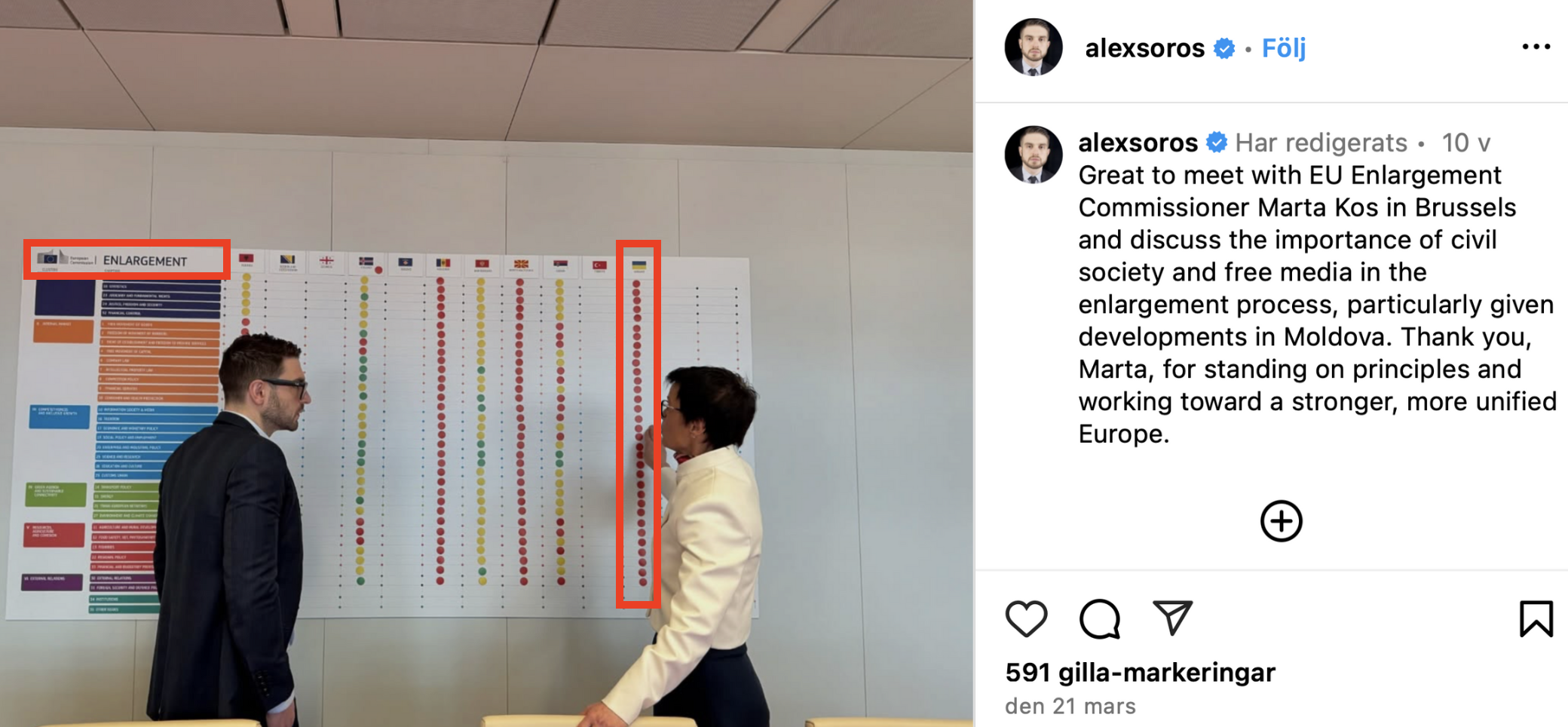
Alex Soros, now head of the Open Society Foundations after his father George Soros, is also a strong advocate for Ukraine’s EU membership—even during the ongoing war and despite several assessments that the country does not yet meet all the requirements for membership. This is now seen as possible as the Hungarian government’s resistance diminishes.
READ ALSO: Orbán: EU should invest €1.7 trillion in Ukraine
Viktor Orbán, by contrast, has been one of the strongest opponents of a rapid EU accession for Ukraine. He has insisted it will not happen, warning that membership could drag the EU into the war and have huge consequences and arguing that the country does not yet meet the accession criteria. With Hungary’s new political situation, this resistance is now described as gone.
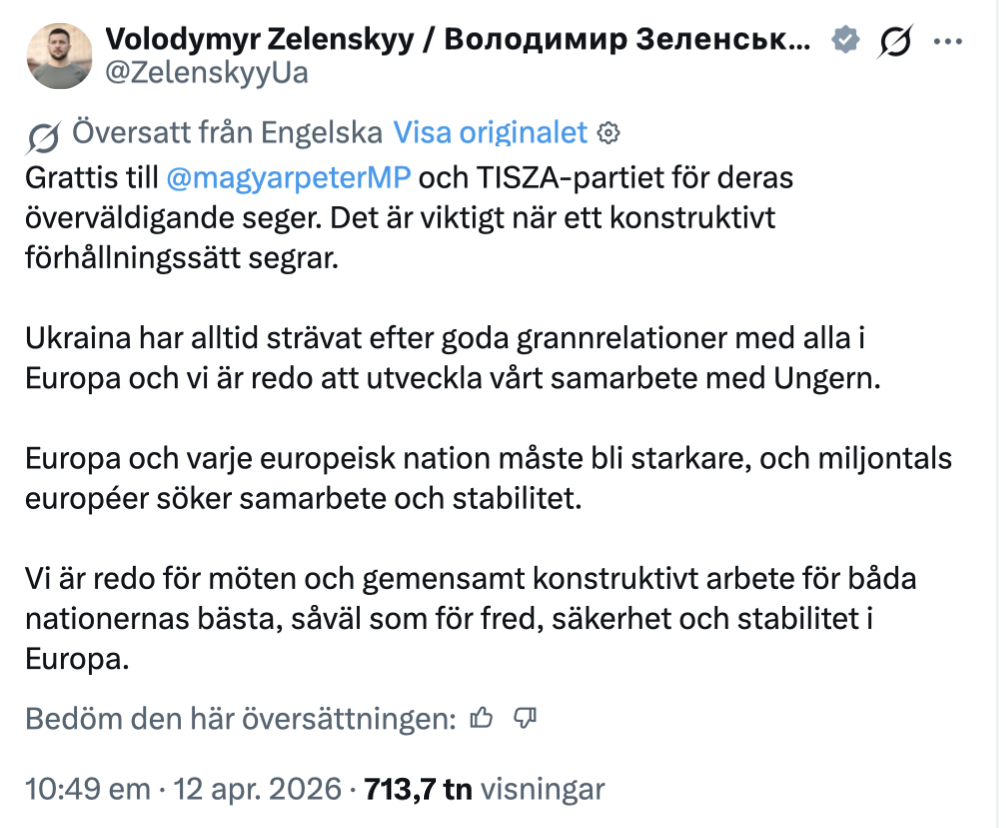
Volodymyr Zelenskyy, who can now count on less resistance in the EU after Orbán’s defeat, has expressed his appreciation of the election result on social media. He writes that Ukraine is already “ready for meetings.”
READ ALSO: Zelenskyy: Will send the military on Orbán if he blocks EU aid
A major upcoming decision concerns the giant aid package, nearly 1,000 billion kronor, which the EU has promised but was suddenly paused earlier this spring after the oil flow between Russia and Hungary was cut, with Orbán demanding resumed oil before approving the aid.
What Is Needed to Unlock EU Funds?
Péter Magyar is described as conservative and, by some, as even more critical of immigration than Viktor Orbán. This may be a matter of political positioning in a fundamentally conservative Hungary, where such a profile can be important to broaden voter base and challenge the established ruling party.
In practice, however, Magyar appears clearly pro-EU and more liberal in orientation, which has contributed to his ability to rally support from an unusually broad group of voters—from conservatives and liberals to greens and leftists.
READ ALSO: Green Party top Alice Bah Kuhnke: Orbán is a “dictator”—do we want Hungary to turn into Russia?
To gain access to the hundreds of billions of euros in EU grants currently withheld in protest of Hungary’s political development, Magyar’s path forward will likely be marked by a more collaborative line toward Brussels and greater compliance with EU demands and policies.
Do you appreciate Samnytt’s straightforward journalism?
Hundreds of thousands read Samnytt every week—yet only 1 in 100 contribute. Help us continue delivering investigations and in-depth reporting that reveal more of reality.
Without your support, there is no Samnytt.
Support us by becoming a subscriber and help enable independent journalism that continues to scrutinize society.
123 083 33 50
Swish any amount
Thank you for reading and supporting Samnytt