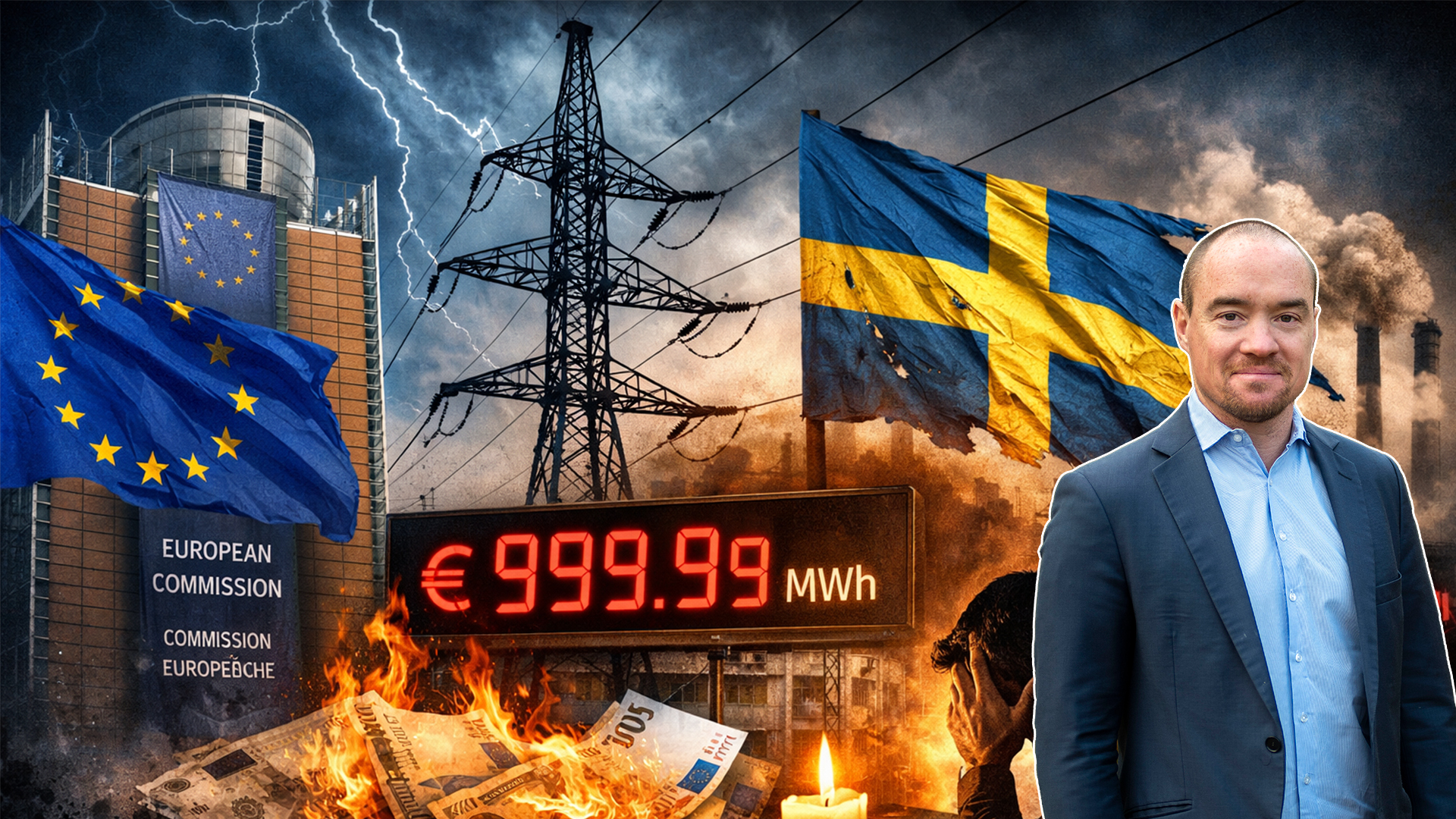
EDITORIAL • The Swedish electricity system is once again under attack. It has been for almost 30 years now, unfortunately from both internal forces—mainly the Social Democrats—and external ones, from the EU. Right now, we see Sweden and its authorities allowing themselves to be pressured by EU structures that threaten to make electricity prices more expensive and unpredictable.
The first bizarre thing is that our own authority, the Energy Market Inspectorate, is threatening another Swedish authority, Svenska kraftnät, with a fine because Sweden has not joined the EU’s new balancing platform, MARI. This kind of self-destructive behavior is rare, but shows just how brainwashed many of our civil servants have become.
Joining this system could further contribute to turning an already unstable system into total chaos. As is well known, the Swedish power grid used to be very stable, but as the Social Democrats have dismantled our electricity system—shutting down nuclear power and building out weather-dependent energy—that is now just a memory.
READ MORE: “Higher and More Unpredictable Electricity Prices” with New Transmission Model
Extreme Imbalance Prices
The EU has long been determined to create an integrated electricity market across the union. In theory, this is supposed to provide more stable prices and greater flexibility. In practice, the reforms—on paper intended to “provide the foundation for lower costs and more stable prices”—have instead led to greater volatility and increasing costs as member states have not had equal opportunities to adapt.
In the Nordic region, we’ve seen how the introduction of the flow-based model and new balancing systems has resulted in extreme imbalance prices and soaring costs in southern Sweden—something now at risk of being exacerbated through the EU’s MARI platform. It’s remarkable that a reform meant to “increase consumer protection” may actually increase the risk of exponentially rising electricity costs for both industries and ordinary households.
What Sweden ought to do is stand up for its own interests. Instead, we see political passivity that is almost tantamount to capitulation in the face of Brussels’ decision-making machinery. Or, for that matter, Swedish authorities attacking their own country.
ALSO READ: Ekeroth: “SD Saved Diesel Prices – Now the Grid Fees Must Be Saved”
This is happening at the same time as other countries in the union are struggling with their own problems—not least criticism of the EU’s emissions trading system (EU ETS), which has contributed to price volatility and unpredictability in electricity production, something Poland and other countries have openly voiced.
It is as shocking as it is unfortunate that Swedish decision-makers and authorities allow EU ambitions to trump the financial interests of Swedish consumers and businesses. When energy policy is centralized in Brussels rather than tailored to unique Nordic conditions, we risk greater instability, higher costs, and an industrial economy that is no longer competitive.
It is high time for Sweden to stop acting as the EU’s obedient extension in energy policy and instead reclaim the control needed for a stable and affordable electricity system.