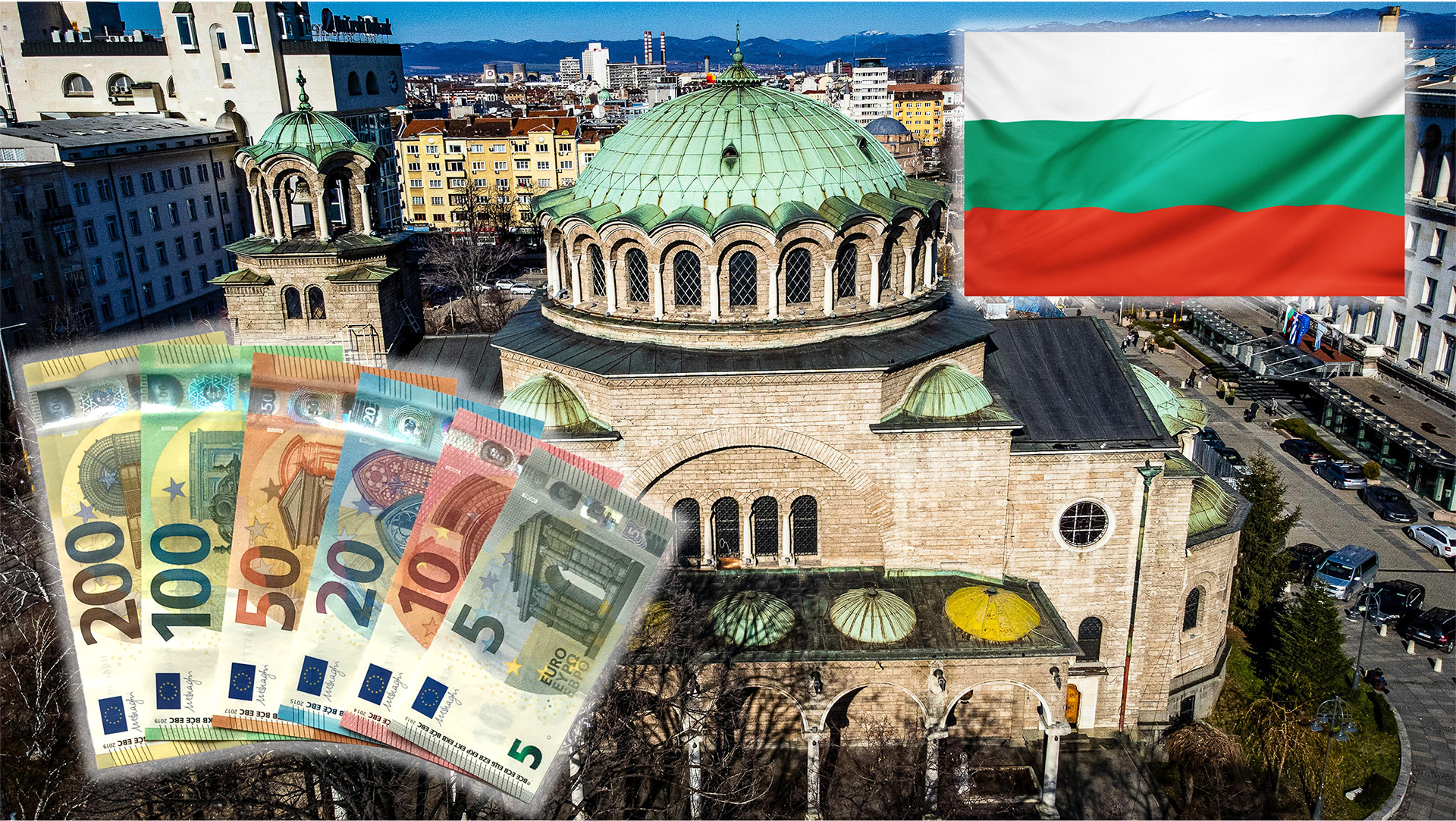
On New Year’s Day, Bulgaria took the step into the euro cooperation and becomes the 21st country to adopt the EU’s common currency. The decision marks the culmination of a process that has lasted for decades and which the government in Sofia has long pushed for to deepen the country’s economic integration with Western Europe. At the same time, the transition is taking place against a backdrop of clear public resistance.
In preparation for the currency change, prices and bank accounts have been labeled in both euros and the outgoing currency lev, at the fixed rate of 0.51 euros per lev. Bank deposits are converted automatically. During a transition period of about a month, the lev will still be usable for payments, but change will be given in euros. After that, the lev is expected to quickly disappear from circulation.
Old banknotes and coins can be exchanged free of charge until June 30 at banks, post offices, and the Bulgarian central bank, and thereafter without a time limit at the central bank.
Membership means that Bulgaria becomes part of the eurozone—a larger economic area with a common currency and shared monetary policy. For private individuals, this means, among other things, easier travel and price comparisons within the euro area. For companies trading with other euro countries, exchange costs disappear, which according to Bulgaria’s central bank amounts to savings of about one billion lev per year.
At the same time, the euro means that the country formally relinquishes certain economic policy tools, such as the ability to set its own interest rates or devalue the currency. In practice, however, Bulgaria has already had a fixed exchange rate to the euro for a long time.
Noticeable resistance
Bulgaria committed to introducing the euro already at its EU accession in 2007. All member states are in principle expected to do so, with the exception of Denmark, which has a formal opt-out, and Sweden, which after a referendum has chosen to postpone the issue. Countries like the Czech Republic, Hungary, Poland, and Romania have not yet taken the necessary steps for eurozone membership.
To introduce the euro, a country must meet the EU’s requirements for a stable exchange rate, low inflation, and limited budget deficits and national debt. After review by the EU Commission and the European Central Bank, the final decision is made by EU leaders.
However, resistance in Bulgaria is evident. A Eurobarometer survey from March showed that 53 percent of those surveyed were against adopting the euro, while 45 percent were in favor. A later poll in the fall showed similar numbers. The concerns are mainly about the risk of rising prices and the loss of the national currency as a symbol.
Dimitar Keranov of the German Marshall Fund in Berlin believes that the resistance is not primarily ideological.
– It is more about economic concerns and generally low institutional trust, not about ideological resistance to the euro or Bulgaria’s European integration, said Keranov.
Uncertainty
Some argue that experiences from previous euro adoptions show that the inflationary impact tends to be limited. European Central Bank President Christine Lagarde has said that the effect has previously been between 0.2 and 0.4 percentage points and has quickly faded.
– Before the introduction, uncertainty is natural, said Lagarde. But when households and businesses start using the new currency in their daily lives—and see that a credible central bank safeguards price stability—then confidence grows, Lagarde claims.
According to ECB economists, public opinion also tends to swing after adoption, on average by eleven percentage points in favor of the euro. At the same time, economists point out that some price increases may be perceived as new even though they were previously planned but only become apparent during the currency change.