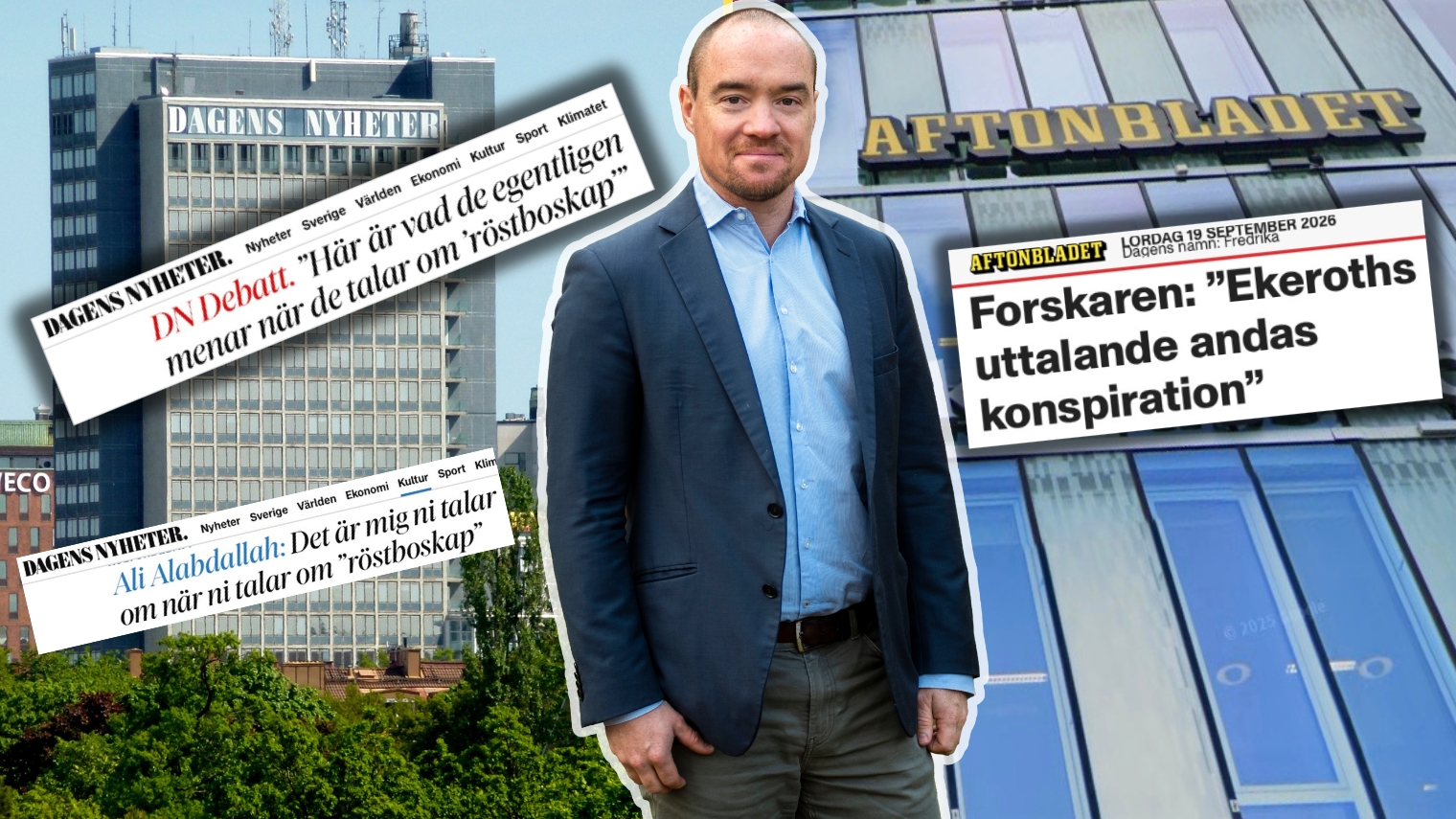
After Ekeroth’s interview on Swedish Radio, where he pointed to demographic changes as a major reason for the Tidö parties’ election loss, outrage in the establishment has been heated. In both Aftonbladet and DN, commentators have been allowed to attack Ekeroth and his statements, but when Ekeroth requested to respond to the accusations, both newspapers denied him this opportunity.
In Aftonbladet two days ago, space was given to researcher Christer Mattsson, linked to the Social Democrats and Expo, where he criticized Ekeroth’s statement about how demographics affected this year’s election.
READ MORE: Expo researcher on Ekeroth’s claim that immigrant votes decided the election: ‘Conspiracy’
When Ekeroth wanted to respond to the article with an opinion piece, Aftonbladet contacted him and instead asked for a news interview.
Hello and thank you for the text.
Since Ekeroth is responding to criticism he received in a news article, it is reasonable that he should also do so in a news article. A reporter is happy to call now during the morning.
Do you have a number he can use?
Kind regards,
Kristofer Forssblad Olsson
Aftonbladet Debate
So an interview was scheduled for Thursday. However, Ekeroth asked the journalist to conduct the interview via Zoom, an online tool for both audio and video calls. But this was refused by the journalist in question, Nora Fernstedt:


Instead, when Ekeroth called via phone 6 minutes after the first SMS went unanswered—within the 40-minute window he had previously announced and Fernstedt had accepted—he received no answer:

After Ekeroth attempted to reach Fernstedt, he sent a final SMS informing her he had tried to reach her via regular phone.
“Seems scared”
Ekeroth believes that Aftonbladet’s reluctance to use Zoom was more about not wanting to be recorded than the Zoom platform itself.
– Zoom works as a phone call too, without video, if you want to avoid video, and the participant doesn’t even have to download any program but can use it via their web browser. So it probably has to do with them being afraid that I would record the interview. Of course, you can do that anyway, but I would have needed to make other arrangements to do so without Zoom, he tells Samnytt.
READ MORE: SR tries to school Ekeroth about immigrant votes: ‘You know nothing about that’
He believes they probably changed their minds about letting him speak.
– It’s a bit odd, to say the least, since it was shortly after the SMS exchange and within the period I’d said I was available. They’re probably just using this as an excuse not to allow me to respond, despite the attack on me by the Social Democrat-linked “researcher,” Ekeroth claims.
You can read Ekeroth’s opinion piece, which was rejected by Aftonbladet, in full at the end of this article.
DN denies right of reply
Dagens Nyheter also refused to let Ekeroth respond to an opinion piece they themselves published. This time it was “Ali Alabdallah” who in DN was given the headline “You’re talking about me when you talk about ‘voting cattle’.”
SEE ALSO: Ekeroth’s warning about demographics gets unexpected support from left-wing researcher
Ekeroth also submitted a response here, but DN’s Jacob Lundström replied as follows by email:
Hello Oliver,
Thank you for your email! Is there any inaccuracy in the Kent Ekeroth quote, as Ali Alabdallah presents it in his text? If not, we decline to publish your reply.
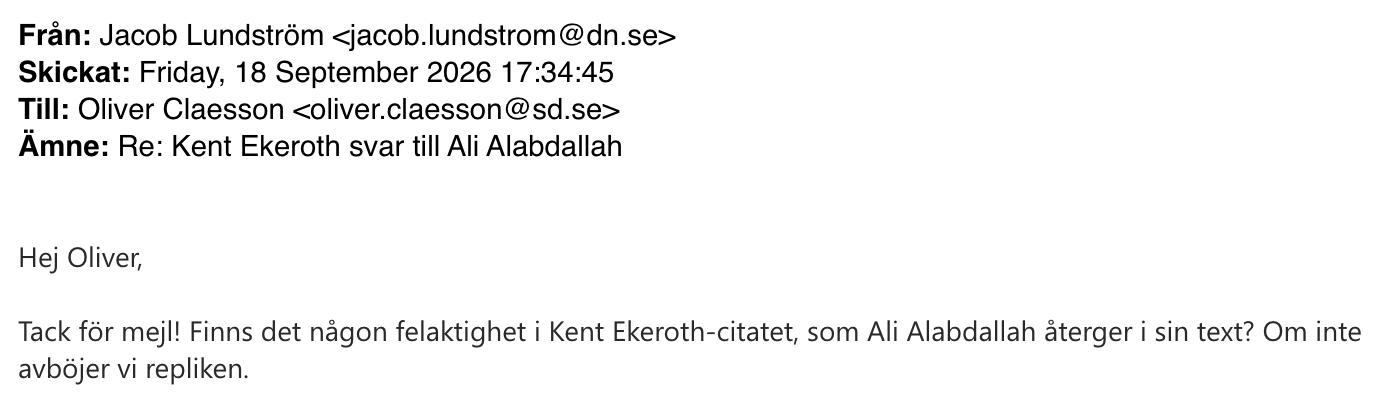
Ekeroth then responded somewhat sarcastically, demanding an explanation for why DN deviates from normal editorial practices where a person has the right to respond to attacks published by the newspaper.
He writes an opinion piece about me – in what world should I not be allowed to reply to that? […] It’s clearly a departure from usual journalistic principles… How on earth do you justify a rejection?
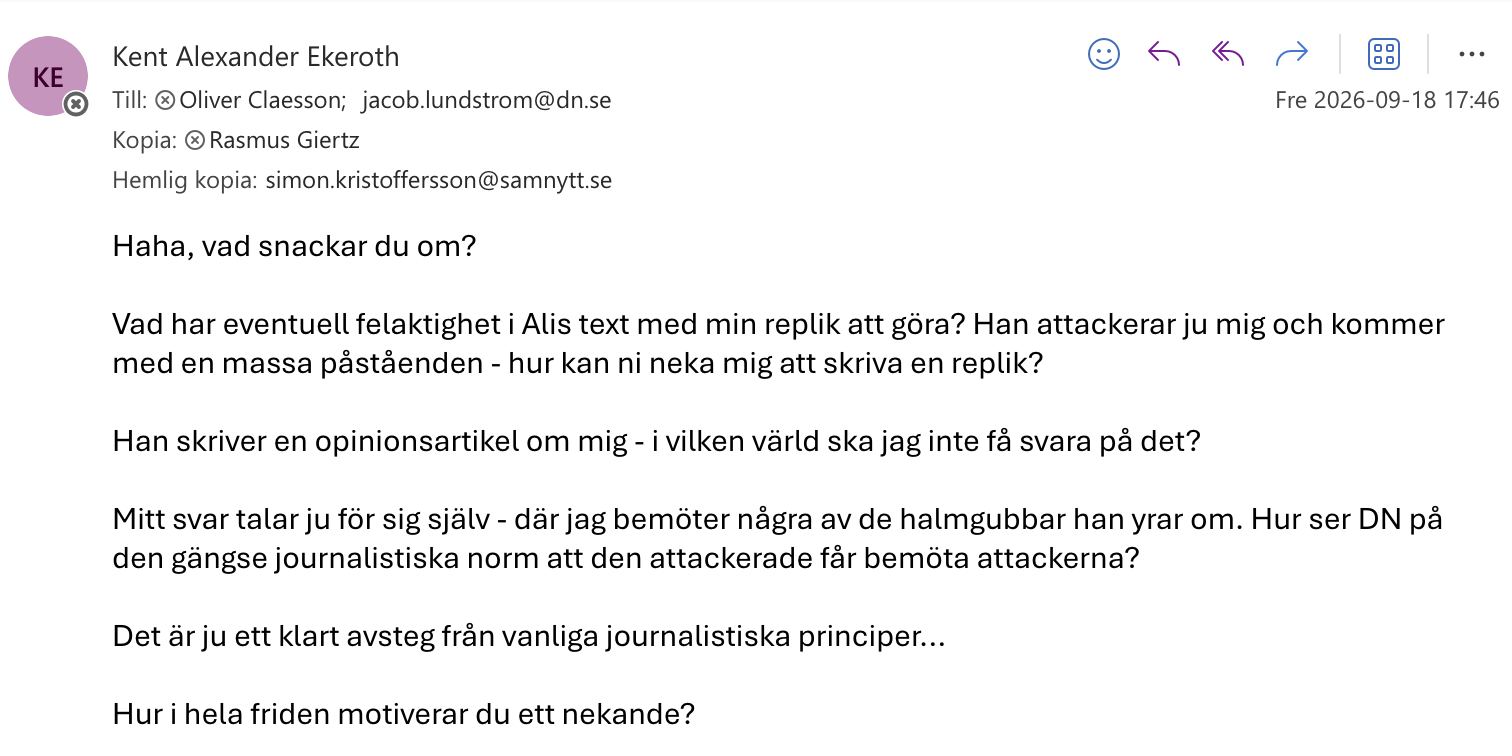
Ekeroth tells Samnytt that the media’s agenda becomes extremely clear.
– Two of Sweden’s biggest newspapers publish two attacks on me and then ‘ghost’ me when I demand a right of reply. DN simply denies me a reply and lets this “Ali” have free rein, and Aftonbladet does something similar when the Social Democrat “researcher” is given plenty of space.
SEE ALSO: Kent Ekeroth (SD) reported to police for ‘thought crime’
– It’s never been clearer that press ethics, which they pretend to care so much about, don’t matter to them at all. It’s all just propaganda for them. It’s downright embarrassing that they stop responding.
You can read both of Ekeroth’s replies to the respective newspapers below.
The rejected opinion piece to Mattsson in Aftonbladet:
Aftonbladet allows researcher Christer Mattsson to describe my statements about the impact of immigration on election outcomes as something ‘reeking of conspiracy.’ The problem is that he argues against something other than what I actually say.
Mattsson is gladly presented as a neutral researcher, but his background is relevant. He has undertaken tasks for the Social Democrats, written for Expo, and has long directed harsh criticism at the Sweden Democrats. Readers should know he is not a politically disengaged observer.
But let’s start with the obvious: immigrants are not a homogeneous group. A highly educated Japanese engineer, a Polish construction worker, and an unskilled migrant from the Middle East are not the same thing — culturally, socioeconomically, or politically.
The Sweden Democrats’ immigration policy is not based on the idea that all immigration is the same. Sweden benefits from skilled labor and people who work, support themselves, learn Swedish, and become a functioning part of society. This is altogether different from a migration policy that has created widespread exclusion, dependency, crime, and cultural conflicts.
It is above all immigration from the Middle East and Africa that has been problematic from an assimilation point of view. This, of course, does not mean every individual from there is a problem. Politics must be able to discuss groups and averages without pretending that a statement applies to every individual.
The same applies to the electorate. Research from Delmi shows that people with foreign backgrounds do not all vote the same, but also that as a group, they are more likely to vote for the Social Democrats and Left Party than people without a foreign background.
Two things, then, can be true at the same time: immigrant groups differ greatly, and extensive migration changes the composition of the electorate over time, and thus the country’s political conditions.
It is mathematics.
If a population group grows significantly and has a distinctly different political distribution than the rest of the population, it will, over time, affect election results. No secret plan is required for this.
That is why the reflexive cry of ‘conspiracy theory’ is so intellectually inadequate.
Mattsson himself admits in Aftonbladet that Sweden’s demographics have changed and that it’s legitimate to discuss how different groups vote. His objection is that migration policies were not made by ‘a small elite in secret to replace the people.’
But that does not address my point. Political decisions have consequences regardless of what motives the decision-makers had.
That demographics is also about power is hardly a right-wing fantasy. In 2017, Recep Tayyip Erdoğan urged Turks in Europe to have five children and said: ‘You are Europe’s future.’ This is a clear example of awareness of the significance of demographics.
You may think that Sweden’s large-scale immigration has been good and welcome its demographic and political effects. But then you should say so.
What you reasonably cannot do is first change the composition of the population through political decisions, then note that different groups vote differently – and then call the person who points out the consequence a conspiracy theorist.
Sweden has changed demographically. That also changes Sweden politically.
It is not a conspiracy theory, but a direct consequence.
And that consequence has been, and risks continuing to be, deeply destructive for Sweden.
It is sad that the migration issue has dropped on Swedes’ political agenda. Then as now, it is one of Sweden’s great fateful issues.
He talks about increased mobilization in immigrant-dense areas. About associations, civil society, and religious communities urging people to vote. About candidates with migration backgrounds in the streets and on social media. About the Left Party’s Arabic campaign ‘Al-Yasar aw al-Matar’—the left or the airport. About citizenship, religion, and deportations no longer being abstract, but able to make the vote a matter of life and death.
Some want to call this legitimate democratic mobilization, but then you cannot at the same time pretend it is incomprehensible—or ‘racializing’—that demographics and the make-up of the electorate are discussed after an extremely tight election.
Alabdallah writes that the words cut deep because ‘voting cattle from abroad’ refers to people like him: citizen, taxpayer, parent, voter. Okay? It’s still a group whose votes now weigh heavily when the election is on a knife edge.
He then takes the metaphor literally. To call people voting cattle would be to deny them autonomy, since cattle have no political will. But it is a political term, not a zoological classification. It’s about as reasonable as getting upset over a ‘spearhead for change’ and pretending the conversation is about spearing people on a stick. You may find the word harsh, but you should focus on what it means: that large groups are mobilized as a voting mass along family, ethnicity, religion, and campaigning in languages other than Swedish.
The group is not homogeneous, he repeats. Of course not. No serious analysis claims every individual votes identically. The relevant thing is differences at the group level. Those exist. That’s why the left campaigns in Arabic. That’s why voter turnout is highlighted there.
It’s not just me saying this. Hassan Khan of the Vision Party—targeting the same voters as Nyans, i.e., Muslims—describes in a Facebook post after local elections exactly the same thing. Many vote chiefly based on ethnic or cultural affinity; policy plays a smaller role. Hundreds took ballots outside polling stations after being told who to vote for. Candidates from different parties helped each other purely because of shared ethnicity. The red-greens know this and exploit it. Personal familiarity and ethnic representation trump policy—in addition to positions of Muslim organizations and mosques.
It’s not ‘racializing language.’ It’s an insider describing how the votes are gathered.
Alabdallah has lived here for thirteen years, became a citizen, works and pays taxes. Legally, he is Swedish. That’s not the same as the country’s direction being shifted by people who arrived late, with other notions of nation, culture, religion, gender, free speech, and what the state is for.
Then comes the most revealing passage where he wonders why it’s a problem if new citizens vote and instead claims you ‘should win their trust.’
It’s a problem for one reason. Foreign people with foreign ideas take the country in a direction Swedes, left on their own, would not have chosen. Citizenship should be proof you are or have become Swedish, but since it’s been handed out extremely easily, sometimes even by caseworkers who don’t even have Swedish citizenship themselves (!), over the past decades it now means something else. That a caseworker thirteen years ago stamped Alabdallah as a citizen does not give him a moral right to overrule the population that was here before.
‘Win their trust’ is also the perpetual shift. First, the electorate is changed through immigration and rapid citizenship distribution. Then the original population must adapt policy until it suits the new. Otherwise you’re undemocratic.
The interesting part is not the outrage over a word. It is that Alabdallah—and now the Vision Party—describe the ethnic and religious mobilization this debate is about. The question is what consequences a generous migration and citizenship policy will have for who governs Sweden.
You can reach different conclusions. The question does not disappear just because every statistical argument is reduced to someone denying certain individuals their free will.
When I talk about voting cattle from abroad, I am not talking about a man and his tax receipt. I am talking about a demographic shift that is already evident outside the polling stations. Alabdallah has described it. Hassan Khan has confirmed it. They just dislike the name.
Continues with material that cannot be responded to
It doesn’t stop there. While Dagens Nyheter refuses Ekeroth the right to reply, the paper continues to publish new opinion pieces on Friday that criticize him.
This time, researchers from the renowned Stockholm School of Economics wade into the political debate, advancing arguments in which Ekeroth is portrayed as anti-democratic, under the headline: ‘Here is what they really mean when they talk about voting cattle’.
It’s easy to get stuck on the coarse and dehumanizing language. But the problem is larger than that. The statements reveal an anti-democratic logic in which certain citizens’ votes are seen as less legitimate than others’.
When Swedish citizens are described as ‘voting cattle’ because they vote for the opposition, it exposes a worldview that regards certain citizens as less Swedish, less credible, and therefore less valuable than others.
In a democracy, voting rights are not a trust that you can lose by voting the ‘wrong’ way. It is not conditional on surname, religion or origin – it applies to all citizens. Anything else is an assault on the very idea of democracy.
Kent Ekeroth?
SHOW YOUR SUPPORT – BECOME A SUBSCRIBER
OR DONATE VIA SWISH
123 083 33 50