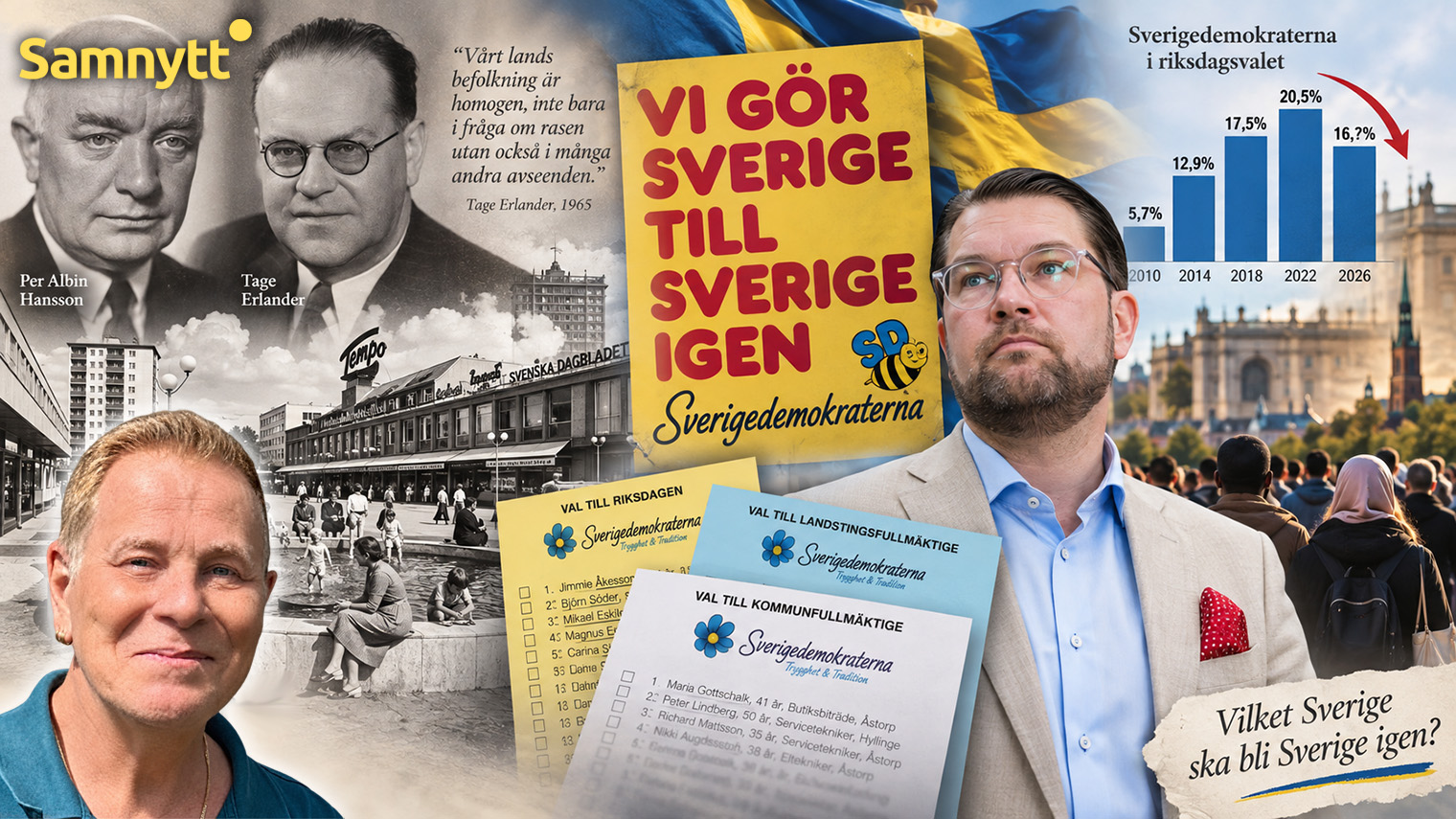
EDITORIAL • The Sweden Democrats campaigned on the promise to “make Sweden Sweden again.” After an election in which the party clearly lost ground, it is worth pausing to consider those words. Do they understand which Sweden needs to come back? And that returning there does not involve only reducing immigration – that the promise requires something much more comprehensive?
The election is over. With the 200,000 citizenships granted during the parliamentary term, Tidö handed the election victory to the red-green bloc, and for the Sweden Democrats, the result was a cold shower. The party, which had previously set one record after another, went clearly backward this time, more than any other party actually and the only one within Tidö.
If one wants to be harsh, it can be said that it’s the Sweden Democrats’ fault the government fell, for not ensuring they retained or grew their voters, for not pulling their weight, serving instead as an anchor for Tidö. One can also blame the Center Party’s betrayal of the bourgeoisie—a market-liberal party that doesn’t really belong on the red-green side, wanting to both have and eat the cake, drawing red lines against other parties on that side and only politically united with them in their hatred of the Sweden Democrats.
There are numerous conceivable explanations for why SD imploded—dissatisfied voters who stayed home, went to AfS or ÖP, returned to M and KD, or strategically voted for L. But from a broader perspective, SD’s election result offers reason to revisit perhaps the party’s overarching message issued to voters on its campaign posters: “We make Sweden Sweden again”.
When the Sweden Democrats launched the campaign, communications chief Joakim Wallerstein explained: “Sweden should feel the way it once did.” The party also gave the phrase more concrete political content.
Sweden was to become “safe, free, and Swedish again.” Asylum intake would be kept to the lowest possible level, remigration promoted, Swedish values upheld, citizenship requirements toughened, and the Swedish language strengthened.
Jimmie Åkesson has expressed the vision in similar terms. At the party’s national congress in 2025, he spoke about a Sweden where people who have immigrated and chosen to become part of the country can live together with Swedes with very old roots, united in a cohesive society.
An Insufficient Answer
At least that offers an answer to what SD means, but hardly one that fully covers the promise on the posters. Nor is it the answer that I and many from my generation attach to those words. When I hear “Sweden again” and “as Sweden once felt,” my thoughts go much further back. To the Sweden where I was born in 1958 and was a child in the 1960s.
Not because everything was better then. It wasn’t. In many respects, Sweden is richer, freer, more comfortable, and technically more advanced today. But much has also regressed compared to then, such as social care, health care, and schools. And demographically, it was a completely different country—not just according to me, but also supported by objective facts, undoubtedly a better country.
And a party that has dusted off and cited even Per Albin Hansson, who died 12 years before I was born, and Tage Erlander, who was Sweden’s prime minister during my first ten years of life, must expect that it is the Sweden of that era, in terms of migration, security, and sentiment, that many assume is being referred to.
Today, Sweden has several million inhabitants who are either born outside the Western world or have two parents who are. A not unreasonable estimate is that at least half of these are not assimilated into Swedish society. A large proportion of them are not, even after living in Sweden for decades.
If Sweden is to be made Sweden again, these must be faced with an ultimatum: either you adapt fully or you leave the country. The Sweden Democrats’ “open Swedishness” is, in principle, not a bad thing—it should exist for the migrant who truly wants to become Swedish from the inside out, to feel Swedish and be perceived as Swedish—linguistically, culturally, religiously/secularly, and in terms of values.
But for the large majority of non-Western migrants, Åkesson’s speech at the national congress is as realistic as Jehovah’s Witness pamphlets where small children and lambs lie beside lions. To make Sweden Sweden again thus requires that a million people leave Sweden in an orderly retreat.
The hundred-plus who have received remigration grants is a drop in the ocean, a grain of sand in the desert. The circa 700 people per year that the commission has forecasted likewise. On the order of 100,000 people per year for a decade is what’s required if Sweden is to be made Sweden again within a reasonable period.
This must be done regardless of residence status, citizenship, or what domestic and international actors interpret as possible, or compatible with conventions, human rights, and so forth. The population exchange must not just be slowed, not just stopped. It must be reversed. And it can be done if one has a sufficiently firm grip and courage. And in an orderly manner, provided we don’t wait until “the Swedish state” approaches failed state status and we’re on the brink of civil war.
Anything else might make Sweden a bit better than it is today but is nowhere near making Sweden Sweden again. But the Sweden Democrats don’t write “We’ll make Sweden a little better” on their campaign posters—they make much bigger promises. Let’s take a look at what Sweden actually was like when it was still Sweden.
Sweden 1958
When I lay in my cradle in Sweden’s first so-called ABC city, Vällingby in western Greater Stockholm, our country had about 7.4 million inhabitants. Roughly 300,000 were born abroad, about four percent of the population. The overwhelming majority of them came from our Nordic neighbors, Germany, and other nearby European countries.
Immigration from Africa, Asia, and South America was virtually negligible. People born outside Europe and North America made up less than one-tenth of a percent of the population. The number of people with a Muslim background was estimated at between 500 and 1,000 in the entire country.
This was the Sweden that Prime Minister Tage Erlander described in 1965, noting: “We Swedes live in an infinitely happier situation. Our country’s population is homogeneous, not only in terms of race but also in many other respects.” This quote appears in the early program of the Sweden Democrats.
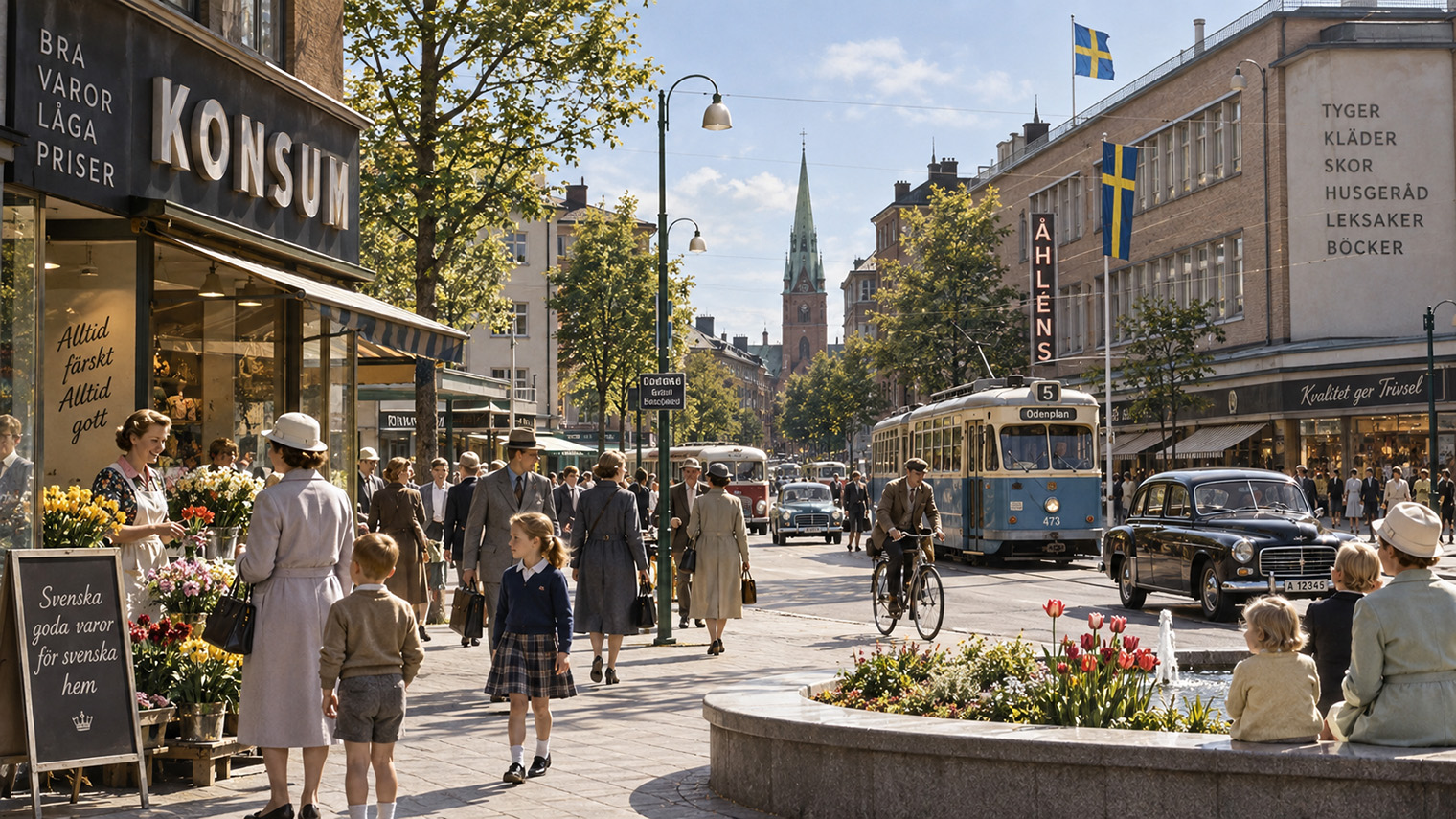
The word “race” sounds foreign in today’s political language, but to generically label it racist is a more recent phenomenon and quite unique to Sweden. Erlander’s point was primarily societal. He was comparing Sweden to the USA, where ethnic tensions and racial conflicts created problems that Sweden had no counterpart to.
But now we are there too. With Koran riots, mass demonstrations for Hamas, and constant us-versus-them thinking from large migrant groups—ungrateful accusations of racism and discrimination when not given everything for free, and something they themselves call a “war against the Swedes.”
The Swedish welfare state was built in a society with an exceptionally homogeneous population. This was seen as a prerequisite for democracy, harmony, and a solidaristically financed welfare system—not because we looked genetically alike, but because we shared the same culture, values, and history.
Sweden Begins to Change—but Marginally
During my first decade on earth, that development started to change direction. Sweden needed labor for an expanding industry. In the postwar era, workers had mainly been recruited from the Nordic countries and Southern Europe—Italy was an important early source. In the 1960s, Swedish firms and agencies looked further afield, including to Yugoslavia and Turkey.
The difference between 1958 and 1968 is measurable. The number of foreign-born increased from around 300,000 to about 480,000. Those born in Asia and Africa went from fewer than 1,500 to about 12,000.
But proportions matter. Even in 1968, the non-European population made up a tiny part of Sweden. The bulk of immigration was still Nordic, especially Finnish, as well as Yugoslavian. In all essentials, Sweden in 1968 was still Sweden.
The year I turned 10 and got used to riding my bike on the right-hand side of the road, Olof Palme took the helm from Tage Erlander, and much would soon change at accelerating pace.
Not All the Social Democrats’ Fault
At the same time, it’s worth remembering that the history of migration policy is less party-line neat than current debate sometimes implies. The roles in the immigration game have changed several times.
In the 1960s, the LO union was a strong force for restricting free labor immigration. The unions feared wage dumping and pressured the Social Democratic government to tighten the rules. From 1967, employment and housing were, in principle, required before entry, while labor market needs had to be assessed.
In 1989, it was Ingvar Carlsson’s Social Democratic government which, through the so-called Lucia Decision, sharply tightened asylum policy. Two years later, the bourgeois government reversed the decision.
Later, the roles changed again. The Alliance government liberalized labor immigration in 2008, and Fredrik Reinfeldt’s government in 2011 struck a migration policy deal with the Green Party.
The (presumably outgoing) Prime Minister Ulf Kristersson began his career in the Moderate Party’s youth wing as extremely pro-immigration, much more so than the senior party. He retained this stance for the most part as one of Reinfeldt’s fast followers. Today he sounds different.
Anyone wishing to write an honest history must therefore abandon the comfortable belief that one side of politics always opened the borders and the other always wanted to close them. The pendulum has swung.
Sweden and Germany Chose Different Paths
A difference in policy is worth mentioning in such a migration-historical look back. Sweden and West Germany both faced a need for foreign labor. West Germany built its system around “Gastarbeiter”—guest workers expected to work for a limited time and then return home. They usually lived in temporary housing near workplaces. Family members had to stay behind.
Sweden chose another model. Here, migrant workers received the same wages, union rights, and social benefits as Swedish workers. They were offered regular apartments, not only for the workers themselves but for the entire family.
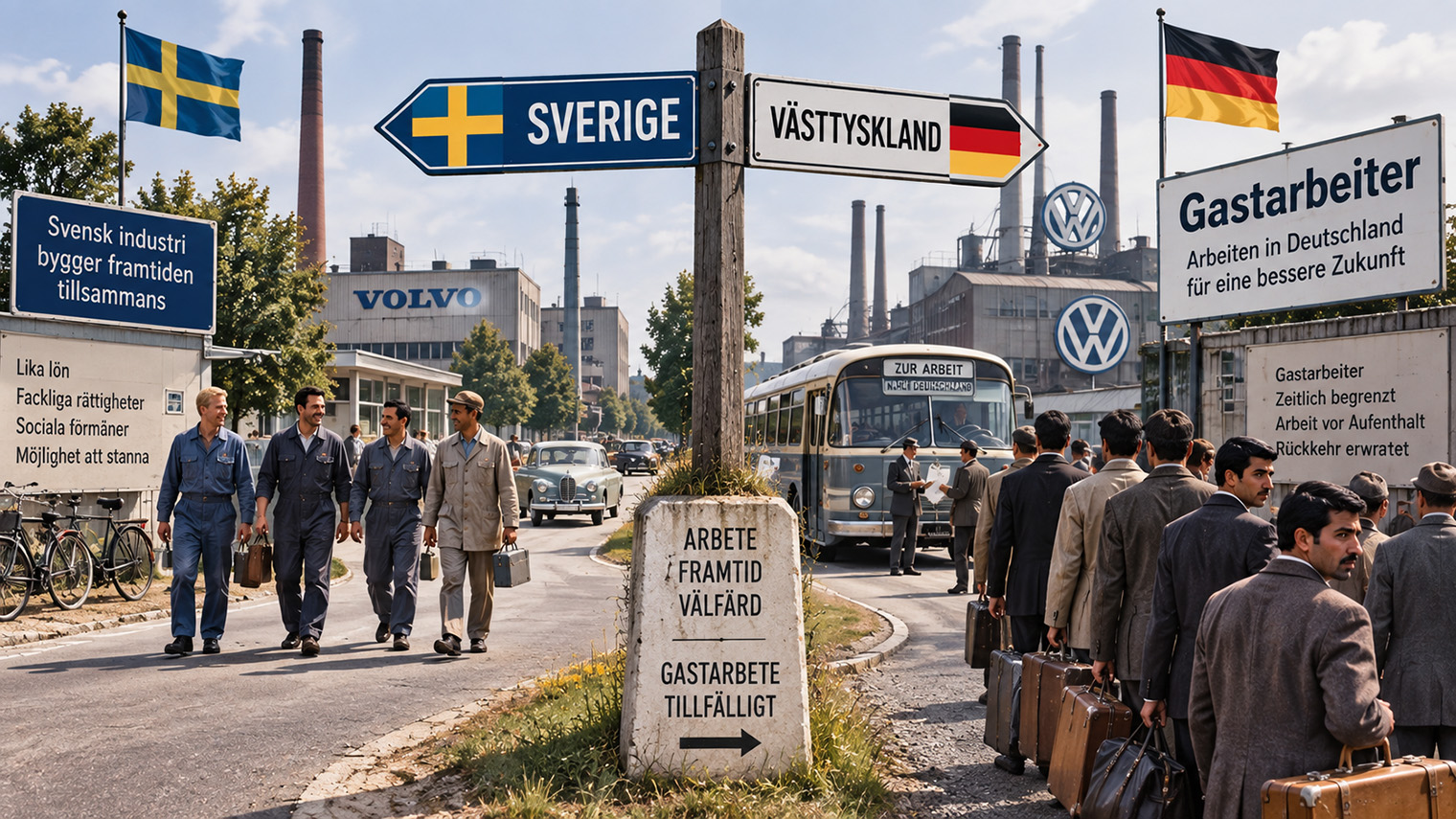
In some respects, this was decent and reasonable. But it also meant that a temporary labor need quickly became permanent immigration through settling and family reunification.
This was one of many policy choices that blurred the distinction between temporary and permanent immigration, and the boundary toward regular immigration—and eventually changed Sweden demographically in a dramatic way.
Then came asylum immigration, family reunification, and further policy choices. What started as a need for hands at Swedish industrial machines developed over the past half-century into something else entirely.
Immigration became increasingly less necessary for Sweden, increasingly costly, more culturally, religiously, and value-wise divergent, and—above all—far, far larger.
Slowing Down Is Not Reversing
Migration policy has tightened substantially during the parliamentary term, at least by Swedish standards. Immigration has declined from previously high levels, but hardly to what, from a helicopter perspective, could be called low.
The 200,000 citizenships granted—8 out of 10 to people from non-Western countries and the main reason Tidö lost to the red-greens—must also be criticized, together with the Center Party’s changing sides, of course.
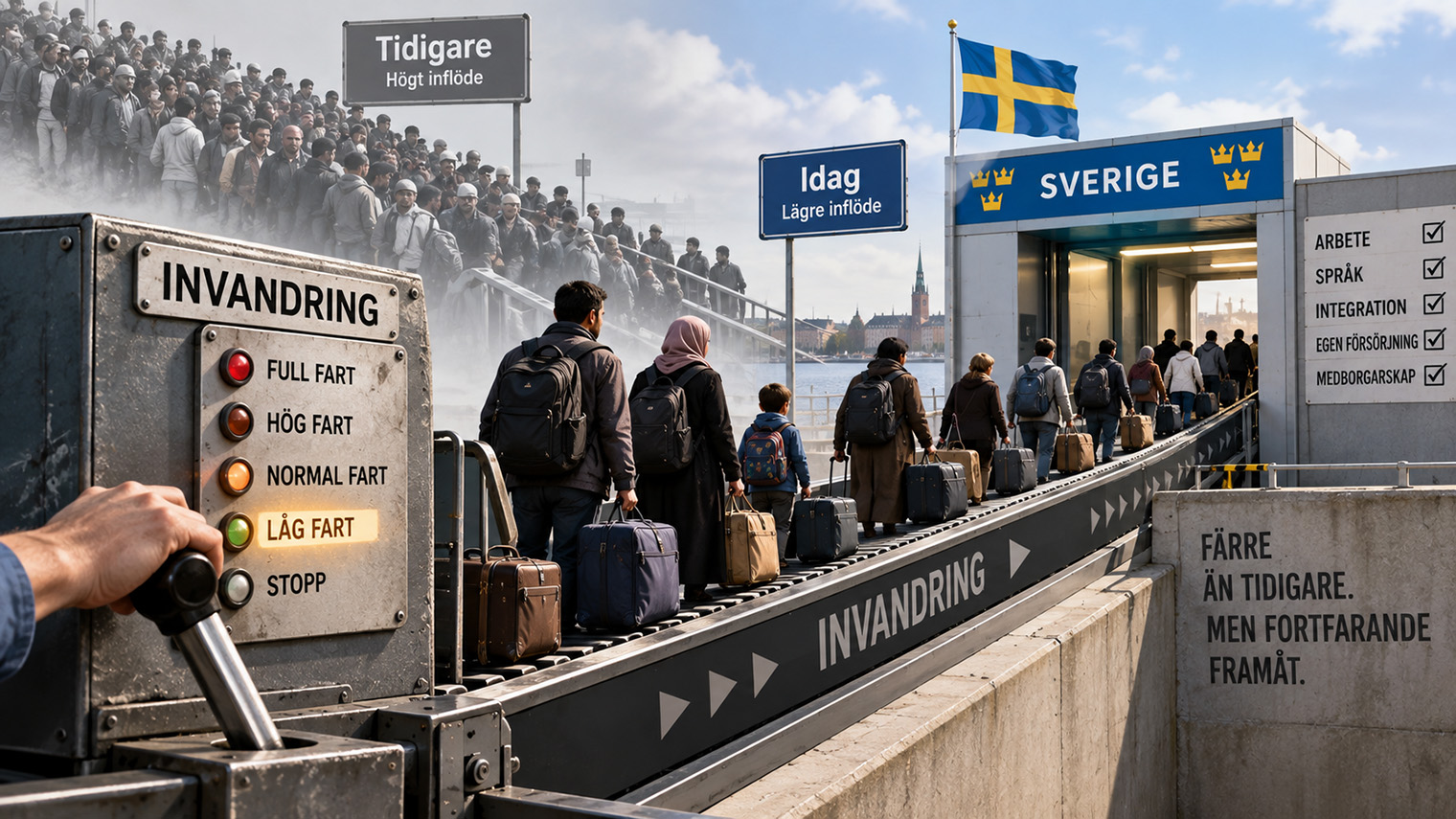
SD has undoubtedly been a central political driving force behind moving migration issues as far as they have gone. But reduced immigration is not the same as a demographic return to making Sweden what it once was, 1958 or 1968, when the country still belonged to the Swedes.
Citizen, Integrated, or Swedish?
Law and identity are not the same thing. Citizenship, integration, and assimilation are not the same thing. Issuing a passport is a purely administrative government decision. Integration means functioning in society. Assimilation goes further—language, norms, identity, and belonging change over time so that origins matter less and less after several generations.
Only the latter comes close to making Sweden Sweden again. But, as already noted, it is a naive dream to reach that goal for a million people living in ethnic enclaves that more resemble their former homelands than Sweden.
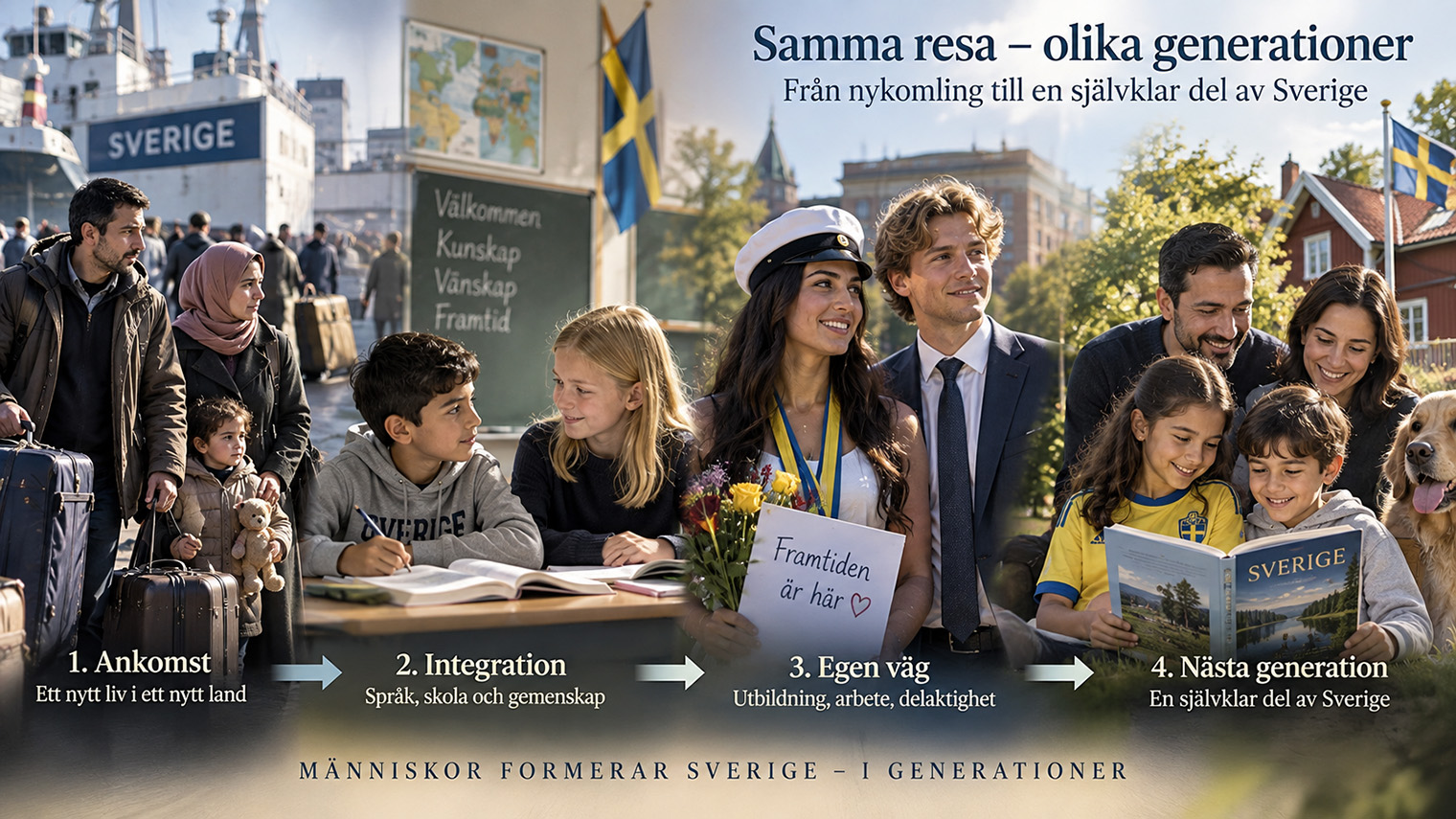
Moreover, it takes a very long time. Time we don’t have. Time we who want our Sweden back should not have to wait. Especially not for our generation, which may have only a decade and a half left to live. I want to see my Sweden restored before I kick the bucket.
Research Knows Which Sweden Swedes Want
It is not a Sweden where no one can have foreign roots. But it is a Sweden where very few do, and even fewer from countries outside the Western world. It is a Sweden where those who come here do everything to become Swedish and nothing to challenge Swedishness.
If I had to put a number on it, it’s a Sweden where at least nine out of ten, or better yet 19 out of 20, have a Swedish background spanning generations, or have been so deeply assimilated over generations that both they themselves and those around them unambiguously perceive them as Swedes.
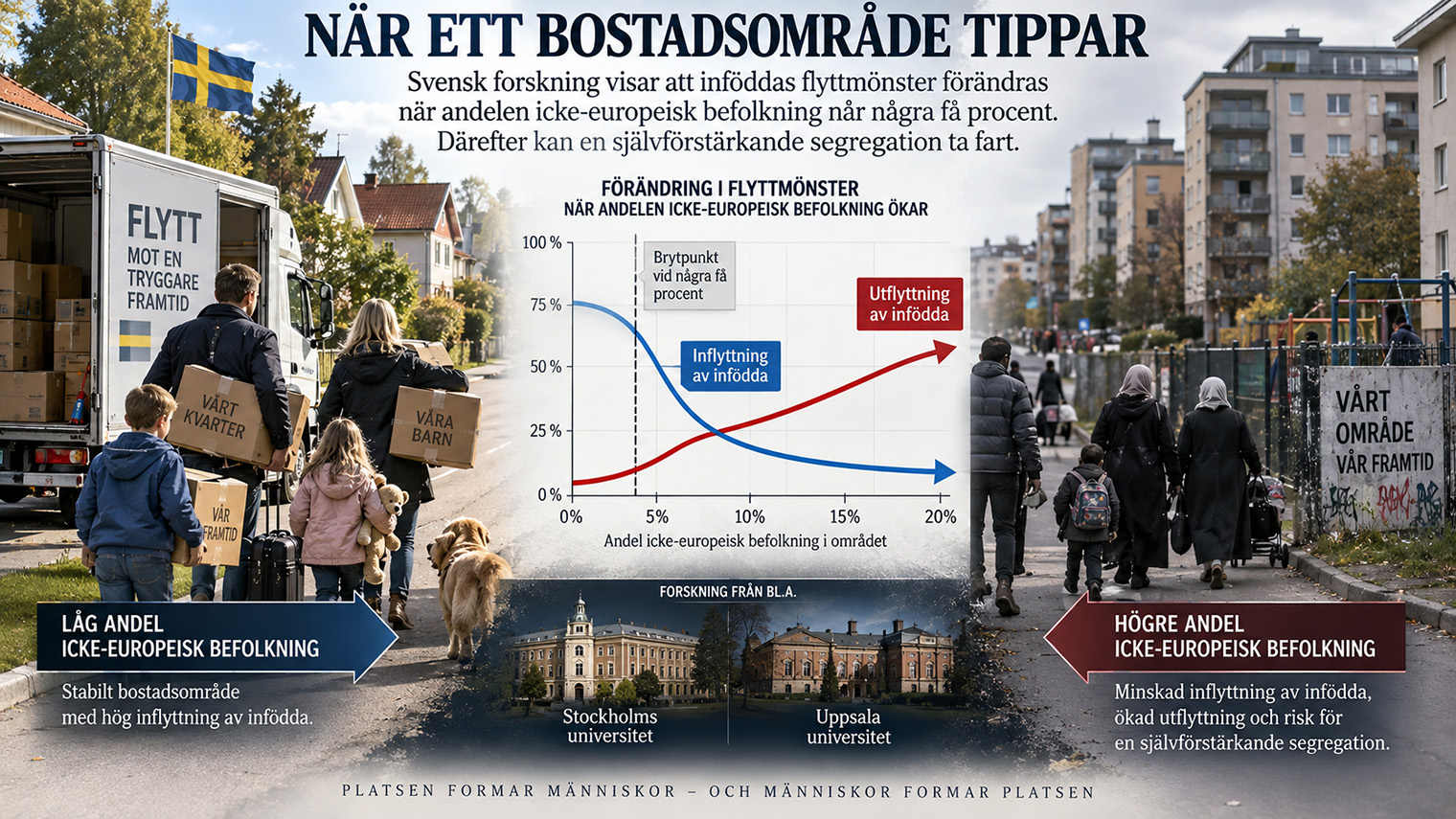
This is not a number plucked from thin air, but one backed by research from, among others, Stockholm and Uppsala universities. Breakpoints have been identified at just a few percent of non-European immigrants in a residential area. When such thresholds are exceeded, the moving patterns of native Swedes change: they move out or engage in “white flight,” and Swedes are less likely to move in. The result is a self-reinforcing development toward increased segregation.
Achieving that goal, and doing so within a foreseeable time, is my interpretation of the meaning of the message “We make Sweden Sweden again.” I’m not claiming the Sweden Democrats have set precisely this demographic goal and this timeline. But it can’t stray too far or the promise will appear false or Orwellian.
GP’s usually readable editorialist Håkan Boström writes in his post-election analysis of SD’s decline that the party now needs to get rid of its “far-right” politics, not draw the conclusion that it needs to be “radicalized” further. The advice is to become a “more popular right-wing party” and design a policy suited to “a Sweden that looks different.”
What Boström is talking about is what all other parliamentary parties have done in various ways and to varying extents. The Left Party and, to a degree, the Greens and Social Democrats have adapted to a Sweden that looks different by having a not insignificant share of immigrant voters who praise Hamas and hate Israel and all other Jews.
On the other side, the Moderates, Christian Democrats, and to some extent Liberals have adapted to this different Sweden by both appeasing it, as the red-greens do, and standing in limited opposition, as SD does—but mainly only to the symptoms, the worst negative consequences, not the cause—that Sweden is no longer Sweden.
Sweden does not need another party that just puts band-aids on wounds. Sweden needs a party that wants to make Sweden Sweden again.
Was Sweden 1958–1968 Far-Right?
“There is no support among the Swedish people for massive remigration, ethno-nationalism, or bans on ordinary Muslim headscarves,” writes Boström. Maybe not yet. Political correctness, the opinion corridor, and the desire to be balanced are still deeply rooted. But the white flight phenomenon hints at something deeper and more honest in Swedes.
Many can still vote away the new Sweden with their feet, thinking provincially rather than nationally. As long as forced mixing is avoided in their own single-family house or co-op area, they’re satisfied. For a while. NIMBY. Until reality finally catches up. When it may be too late, past the tipping point, with no return.
Sweden needs a party that says all of Sweden should be Sweden, not just privileged neighborhoods for those who can buy their way out. A party that talks about how parts of Sweden that today are only Sweden on paper must be reclaimed before the rest of Sweden is also lost.
And one might counter that there was no support among the Swedish people for mass immigration, multiculturalism, or then-unusual Muslim headscarves either. We got them anyway, imposed from above by a political and media elite. There is no reason to just accept the situation, not to redo, make right, and make Sweden Sweden again.
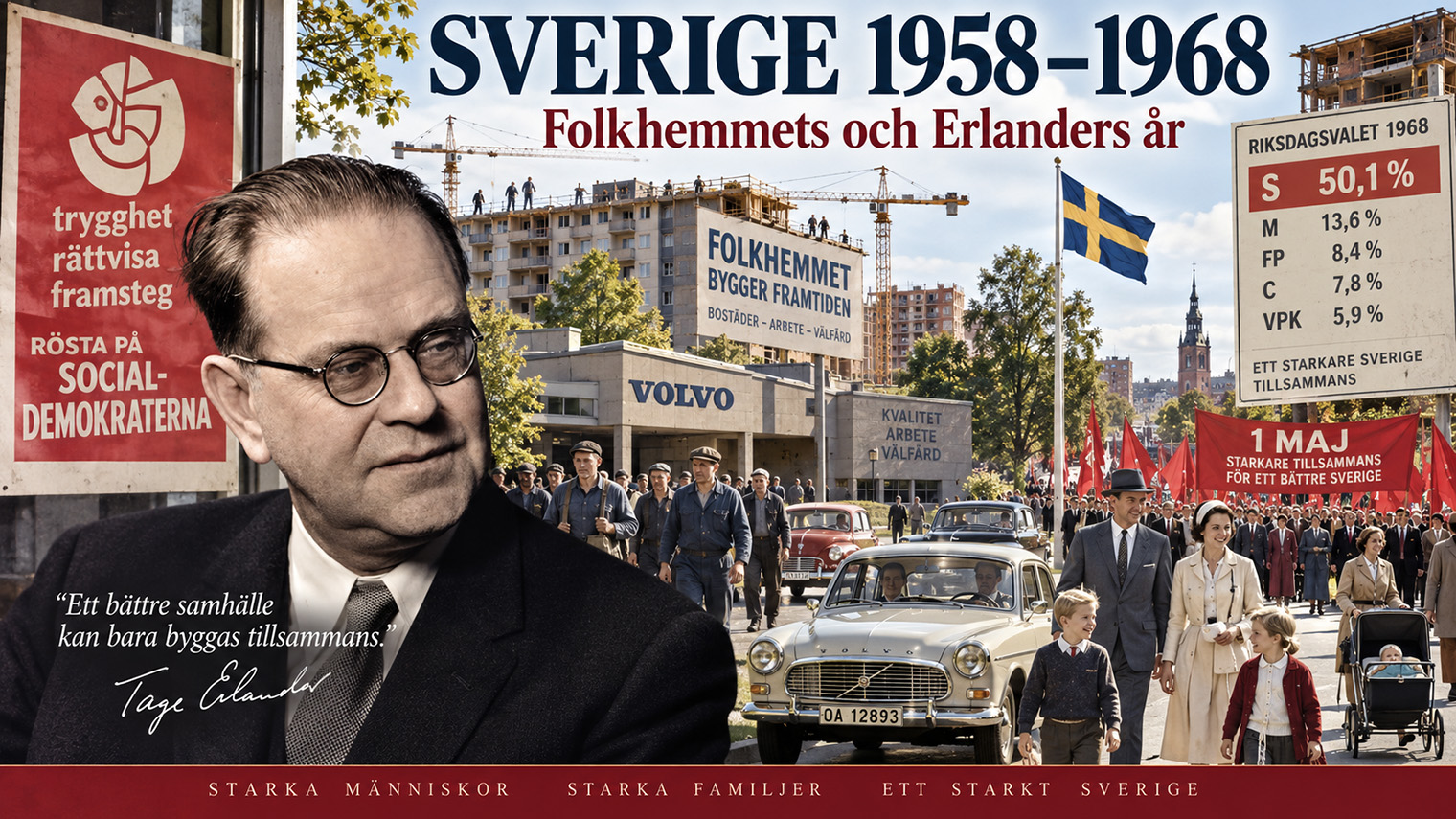
Massive remigration and ethno-nationalism are not far-right. They are about recognizing that Swedes, just like all other peoples, have a right to their country. Sweden 1958–1968 was as far from far-right as you can get and as social democratic as Sweden has ever been.
And there are no “ordinary” Muslim headscarves. The garment comes with a set of values that do not belong in Sweden—not just regarding gender equality but also views on democracy, freedom, Jews, sexual minorities, and much more. To embrace or even flirt with that oppressive attribute is not something a party should accept if it aspires to make Sweden Sweden again.
Not Everything Again
The Sweden Democrats’ promise obliges an actual demographic restoration toward a Sweden where people of multi-generational Swedish background once again make up the overwhelmingly dominant share of the population. That is something much more than just reduced immigration. That is Sweden 1958–1968.
There are other things from that era for which those of us who were there can also feel nostalgic—Volvo Amazon, Lennart Hyland on black and white TV, Beatles on vinyl, or my then-newly built Vällingby and the folkhemmet’s faith in the future that the area exuded, though the leveling of old Klara, which I remember well, was the downside of that same spirit.
I can think that life was simpler and more harmonious without Internet, social media, or smart phones. But all things considered, I would not want to be without the modern advances of technology and medicine. Sweden again does not mean everything again. Only what was better.
A society where the vast majority shared a common language, cultural references, and a self-evident sense of which country was theirs. Where deep ethnic, religious, and cultural divisions were not a dimension politics always had to address.
To Like, Reluctantly Accept, or Dare to Refuse
One can feel today’s multicultural Sweden is better. One can, as GP’s Håkan Boström does, feel that “a Sweden that looks different” is something you have to accept and swallow, whether you like it or not.
But you can also think that Sweden should go back to when Sweden was Sweden and nothing else. And it is important that there is a political party for those who believe so, a party that does not give in after a minor victory, a party that has been right about most things so far and will be proven right about even more if we become complacent now.
In Germany, the nation-friendly AfD recently got 44 percent in a state election. In several recent national polls, the party has polled around 30 percent—making it the largest party in Germany. At the same time, German social democracy has imploded. Since 2025, as the Christian Democrats and Social Democrats formed a grand coalition (the equivalent of the Moderates and Social Democrats forming a government in Sweden now), AfD has been the sole opposition. By 2026, support for the grand coalition has fallen to record lows, CDU punished heavily in state elections, while AfD continues to grow strongly.
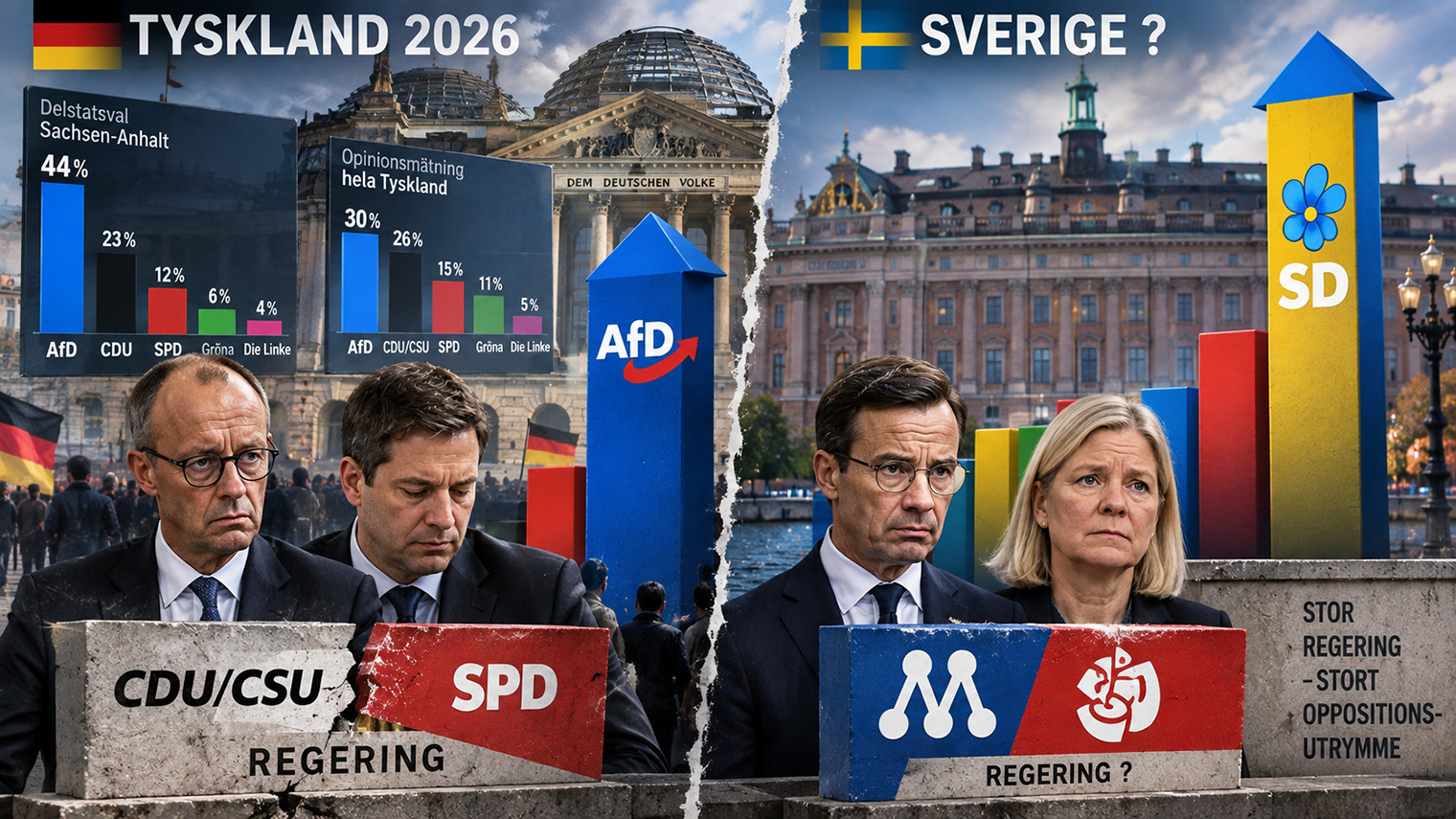
AfD in several respects has a sharper migration policy profile than SD in Sweden. This suggests that Åkesson’s party has not reached its full potential. Something has gone wrong, but it is hardly that they wanted too much Sweden in Sweden.
Perhaps SD hasn’t managed to awaken Swedes to the same extent that AfD awakened the Germans. Perhaps Swedes are harder to awaken than Germans, more marinated in oikophobia, humanitarian superpower obligations, and considering national pride as something shameful.
A post-election analysis is needed but not one that concludes the party should take GP-Boström’s advice to “find its role in the new Sweden.” If that’s the solution, they might as well take down the sign for the whole party as they now take down their election posters. An SD that does not seriously want to make Sweden Sweden again—the country I was born and grew up in—will not get my vote, in any case.
“This country is ours. It is given to us with its forests and rivers, its bluish mountains and its smiling valleys. It is given to us to cherish and protect, to love and defend.” – Torgny Segerstedt, publicist and anti-Nazi