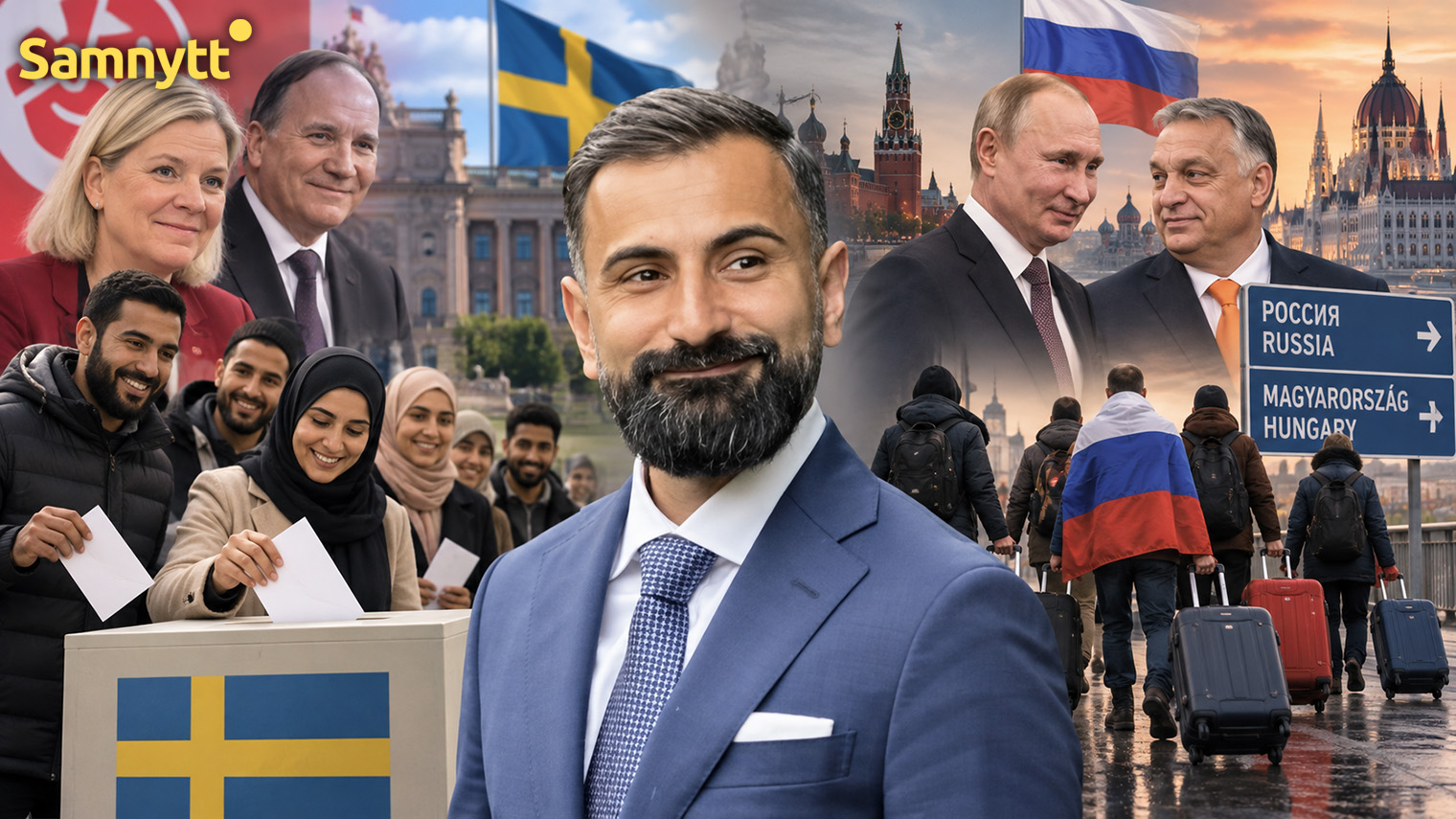
The debate over the impact of immigration on the red-green majority in the Swedish election outcome continues. After Kent Ekeroth was reported to the police for referring to “voting livestock from abroad,” former Moderate MP Hanif Bali is now joining the discussion. Through a thought experiment about Viktor Orbán’s Hungary, he questions why a temporary halt to new citizenships is regarded so differently depending on which country and which voters are involved.
Only a few tens of thousands of votes separated the two blocs after last Sunday’s parliamentary election, with the advantage going to the red-greens. Meanwhile, about 200,000 people have been granted Swedish citizenship since the Tidö government took office in autumn 2022. The combination has triggered a heated debate over what effect these new voters had on the election outcome.
SVT’s own review shows that voters with a non-European background vote much more frequently for the red-green parties. When SVT Verifierar tried to estimate how the new citizens might have voted, the calculation landed on a red-green lead of about 30,000–35,000 votes. That is roughly the same as the number of votes that actually forced the blue-yellow bloc to concede.
Bali: What if it had been Orbán?
The former Moderate MP and debater Hanif Bali is now entering the discussion with a thought experiment in which Sweden is replaced by Viktor Orbán’s Hungary.
“If Orban had lured Russian citizens with social benefits and given them the right to vote after just one parliamentary term, fully aware that 70% of them would vote for him or his coalition partners, we would probably have considered it problematic,” Bali writes on X.
He continues by stating that the opposition’s reaction in such a situation would probably have been regarded differently:
“In addition, we would have considered it entirely legitimate for the opposition to impose a moratorium on citizenships so that their new citizenship laws could take effect.”
Därtill hade vi tyckt att det varit fullt legitimt för oppositionen att införa ett moratorium för medborgarskap så deras nya medborgarskapslagar hinner träda i kraft.
Vad vi inte hade sagt är:
– Den ungerska oppositionen får väl bli bättre på att kampanja på ryska!!— Hanif Bali (@hanifbali) September 18, 2026
Bali concludes with a pointed comment on how he thinks the discussion would not have sounded:
“What we would not have said is:
– The Hungarian opposition just has to get better at campaigning in Russian!!”
Ekeroth reported to police after “voting livestock” comment
The background includes the much-discussed interview given by previous SD MP and current SD leader in Dalarna as well as Samnytt CEO Kent Ekeroth to P4 Dalarna after the election. Ekeroth pointed to “the immigrant vote” as an explanation for the Tidö bloc’s result and used the expression “voting livestock from abroad.”
When asked if it isn’t positive that Swedish citizens use their right to vote, he replied that, in his opinion, it is not good that Swedes “give up power in their own country.”
The comments have sparked strong reactions from the left. Political scientist Zeth Isaksson at Stockholm University described the phrase “voting livestock” as “a dehumanizing way to view a group of voters who are citizens like any other.” He also called the reasoning anti-democratic and emphasized the importance of high voter turnout.
Just nu leder vänstern med 10-20k röster. Tidö godkände 217 000 medborgare. Allt annat lika ger det MINST netto 46 000 röster till vänstern.
Så enkelt är det. https://t.co/I0QPowEt8N
— Kent Ekeroth (@kentekeroth) September 13, 2026
On Friday it became clear that Ekeroth had also been reported to the police for incitement against an ethnic group by a local politician from another party in western Sweden. A police report in itself does not mean that the statement is judged to be criminal. However, the term “voting livestock” is not new in political debate, and it is unclear which specific group the complainant refers to as having been targeted.
SVT calculated the impact of new citizens
At the same time, statistics show that the substantive issue behind the controversy is more complicated. Using data from the Swedish Migration Agency, SVT Verifierar has calculated that 64 percent of those who acquired Swedish citizenship since the Tidö government took office in October 2022 have non-European backgrounds. Six percent come from the rest of the Nordic region and 24 percent from other European countries.
SVT’s Valu election-day survey also shows that voters with non-European backgrounds voted for the red-greens to a much greater degree. SVT therefore applied the voting pattern from Valu to the different origin groups among the new citizens, assuming a 60 percent voter turnout. The result was an estimated advantage of about 35,000 votes for the red-greens.
However, this figure is an upper limit. About a quarter of the new citizens are estimated to have been minors on election day. When these are subtracted using available statistics, the estimated difference falls to about 30,000 votes. For comparison, 33,400 votes separated the blocs when SVT did its calculation on Wednesday.
The numbers are thus in the same order of magnitude as the margin between the blocs. But from there, it is not possible to draw the categorical conclusion that a moratorium on citizenships would have produced a different election result, though even SVT says the probability is high.
At the same time, the reasoning should also be seen in a longer-term perspective. Hundreds of thousands of citizenships with similar profiles have been granted over many parliamentary terms, which collectively could be assumed to benefit the red-greens. Ekeroth is not the first to warn that demographic changes in the long run may make it impossible for bourgeois and social conservative parties to win a parliamentary majority.
“It’s only a hypothesis, nothing that can be empirically verified at present,” economist Henrik Andersson at Uppsala University emphasizes in a comment to SVT.
Immigrant votes may have had less impact on the election outcome—or even more. Election researcher Henrik Ekengren Oscarsson points out that in such a tight vote as this, it is possible to identify several different voter groups as mathematically “decisive”—not only newly-minted citizens from the third world.
SD wanted to stop citizenships already in 2022
The issue of a temporary stop to new citizenships is also much older than the post-election debate. Already in November 2022, SD members Ludvig Aspling and Nima Gholam Ali Pour tabled a motion for a moratorium while awaiting the introduction of new and tougher citizenship rules. The proposal was rejected by the parliament.

The idea was also present within the Moderates. Already on October 5, 2022, before the new government had taken office, newly elected Moderate MP Fredrik Kärrholm proposed that a moratorium should be considered.
READ ALSO: Ekeroth: “Swedes must mobilize as MENA immigrants do”
He noted that the M, KD, L, and SD parties all wanted to tighten the requirements and pointed out that tens of thousands of citizenships had already been granted, while nearly 100,000 applications were being processed. However, no moratorium was ever introduced.
It was only on June 6 this year that the new tightened rules for Swedish citizenship came into effect. Among the changes are stricter residency and conduct requirements, as well as requirements for self-sufficiency and proficiency in Swedish language and knowledge of Swedish society. The rules were introduced without transitional provisions and therefore also apply to older applications that had not yet been decided.
Criticism even within SD
Ekeroth’s explanation for the election result is not shared by everyone within the Sweden Democrats. The party’s spokesperson for climate and environmental policy, Martin Kinnunen, has called the reasoning “defeatist” and pointed out that the difference between the blocs is small.
According to Kinnunen, the party should instead analyze why it failed to attract an additional 40,000–50,000 voters and mobilize better in other parts of the country. Party secretary Mattias Bäckström Johansson has also said that several aspects of SD’s election campaign need to be analyzed.
READ ALSO: Dagerlind: With population replacement policy, Sweden exemplifies the democratic paradox
The debate thus contains two somewhat different questions – partly how Ekeroth has described Swedish voters with immigrant backgrounds, and partly the more measurable question of how changes to the composition of the electorate may affect a very close election. It is in this latter discussion that Bali now places his Hungarian thought experiment to signal that the discussion likely would have looked different had it been about Hungary under Orbán rather than Sweden.