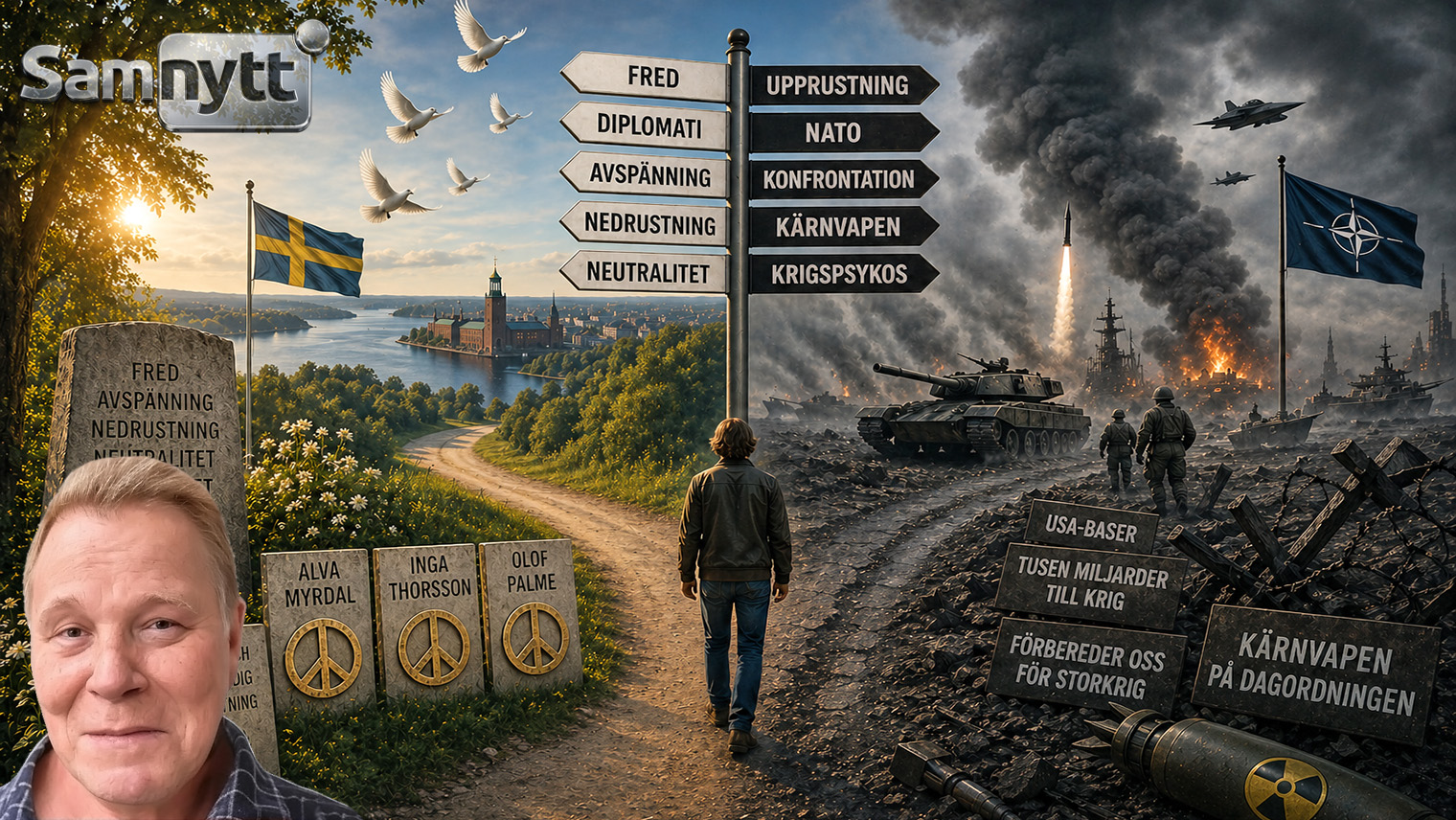
LEADER • In just a few short years, Swedish politics has undergone one of the biggest ideological shifts in modern times. A country that long built its international identity around non-alignment, disarmament, mediation, and opposition to nuclear weapons now speaks of military build-up, long-term confrontation, host nation agreements, base collaborations, and European nuclear umbrellas. The change has occurred so quickly that the speed itself should prompt reflection.
The old Sweden was not pacifist in the sense of being defenseless. During the Cold War, the country built a strong national defense. But security policy rested on two pillars – military capability and political restraint. Non-alignment aimed for neutrality in war. At the same time, Sweden tried to gain influence through diplomacy, UN work, and international disarmament.
Alva Myrdal became a :censored:6:cdd6bbaa89: symbol in the fight against nuclear weapons. Inga Thorsson pursued the same line. Olof Palme made Sweden an independent voice between the blocs. One may object to parts of this tradition, but it provided the country with a clear idea that the security of small states is also created through détente, international law, and a low level of conflict.
Russia’s Invasion of Ukraine Doesn’t Explain Everything
Today, things sound different. After Russia’s invasion of Ukraine, much has changed, and it would be dishonest to deny the significance of that event. A European country was attacked by its neighbor in violation of international law. This shook opinion across the continent, not least in Sweden. Many conclusions were rational – defense must be strengthened, preparedness improved, and old assumptions reconsidered.
SEE ALSO: SD opens up to Swedish nuclear weapons
But the invasion doesn’t explain everything. Sweden’s change of course began earlier. EU membership, participation in NATO exercises, operations in Afghanistan and Libya, the host nation agreement with NATO, and the gradual adaptation to Western security structures all pointed the way long before membership formally became reality. What happened in 2022 was thus not a total turnaround, but the culmination of a longer process.
The Previously Unthinkable Is Now Quickly Becoming Normalized
What is truly remarkable may not be that Sweden is rearming, but that almost no one is talking about peace anymore. The debate concerns percentages of GDP for defense, weapons systems, deterrence, and how long wars must continue. Far less often are diplomacy, European security order, arms control, or ways to reduce the risk of direct great-power conflict discussed.
When discussions arise about nuclear umbrellas or drawing closer to France’s nuclear capability, it becomes clear how quickly the previously unthinkable can be normalized. This does not mean that decision-makers wish for war. But it shows how crisis logic changes language and boundaries. What was considered extreme yesterday is now presented as pragmatic.
Military Billions – Austerity in Welfare
There is also an economic question here that deserves greater attention. When the security situation deteriorates, very large sums can be mobilized in a short time for military build-up. When healthcare needs resources, the railway needs maintenance, municipalities need support, or the energy system needs to be expanded, it is often said there is no room. Citizens are entitled to ask why some investments seem self-evident and others impossible.
SEE ALSO: Kristersson opens up to nuclear weapons in Sweden
This is not about choosing between defense and welfare, as if one automatically excluded the other. A country needs both. But one can discuss balance and proportions, and a society that single-mindedly only thinks about security in military terms risks missing the fact that resilience and total defense also include well-functioning institutions, education, cohesion, robust infrastructure, and trust.
The Voice of Peace Was Strongest When the Defense Was, Too
There is therefore a need for a more mature Swedish security debate than the one we see now. Sweden needs a credible defense of the model we had in the postwar period before it was dismantled. Russia’s aggression must be taken seriously. But every objection to militarization is not naivete, and every question about diplomacy is not complacency.
SEE ALSO: Strong support for nuclear weapons in Sweden
The Swedish peace tradition was not perfect and neutrality policy was at times cowardly. But it carried an insight that is now at risk of being lost – that lasting security is not only created through strength, but also by reducing the reasons for war. And the voice of peace in Sweden was in fact at its strongest when our military defense capability was too. That combination is missing today.
Sweden needs defense. But Sweden also needs to relearn how to talk about peace.