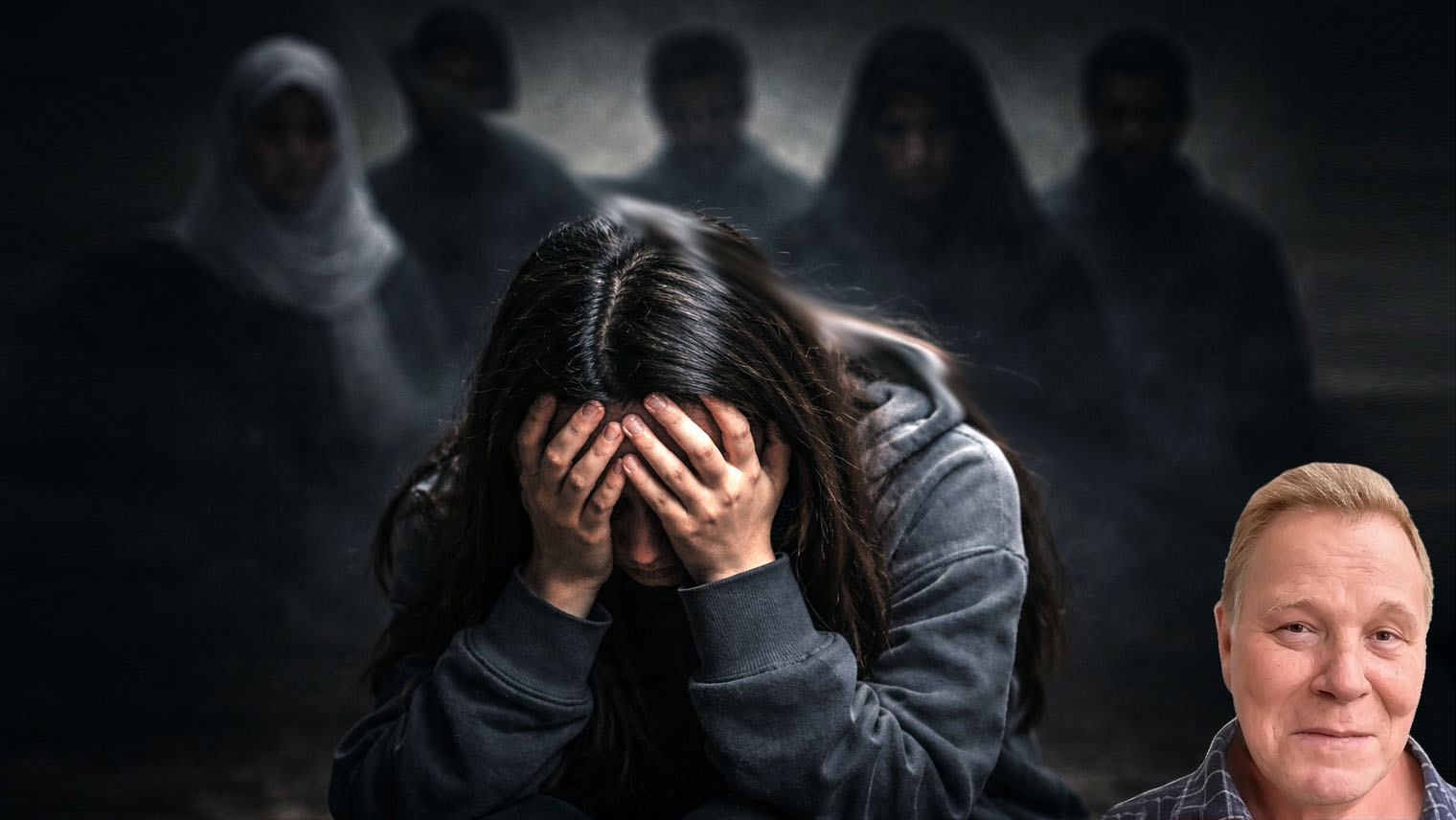
LEADER • A mother in Södertälje has been sentenced to prison for honor-based oppression after years of threats, violence, and control over her daughter. The verdict marks the third case in as many years in Sweden where honor oppression is the main criminal charge. At the same time, the government says up to 240,000 young people live under honor-related oppression. The gap between reality and rule of law should bring shame to every decision-maker.
The recent verdict against the honor-oppressing Iraqi mother in Södertälje is legally significant. It shows that the law against honor-based oppression can actually be enforced. But politically and morally, in its uniqueness, it’s also a monument to the state’s total failure.
SEE ALSO: Arab parents sentenced for honor-related oppression and violence against their daughter
Three verdicts in three years
Given that hundreds of thousands of children and young people are believed to live under honor codes that restrict their lives, bodies, and futures, the near complete lack of intervention by the legal system appears incomprehensible. Since June 1, 2022, honor oppression has been its own criminal classification. That in three and a half years, only three out of hundreds of thousands of perpetrators have been prosecuted, only three victims have received justice and liberation, is a damning indictment and an unprecedented scandal in modern Swedish legal history.
What other serious crime in Sweden—child abuse, sexual crimes, aggravated violations of integrity—would be tolerated with such overwhelming legal absence? We are talking about hundreds of thousands of children and young people, born in Sweden but deprived of the free upbringing that other Swedish children enjoy, and instead forced to live as if in their parents’ former homeland.
From Pela and Fadime to today — 25 years of paralysis
When Pela Atroshi was murdered in 1999 and Fadime Sahindal in 2002—one year after she had, to deaf ears, sounded the alarm about the problem in a speech to the Swedish parliament—honor-based violence became an undeniable concept that could no longer be swept aside and hidden. The cases shook Sweden and should have marked the beginning of a forceful, long-term effort. But not everyone wanted the uncomfortable truth to be scrutinized too closely, and some went out of their way to cast suspicion on it as fishing in murky waters.
But something did happen—for a short while: investigations, action plans, special coordinators, and much lip service about how terrible this was. But in practice, politicians—government after government—chose to treat the symptoms, not the structures. It was easier to talk about “individual tragedies” than about collectively sanctioned violence, religious and cultural norms, families and clans uniting against their own children.
Ideology before the freedom of children and young people
On the political left, there was long resistance even to using the term honor-based violence. Everything had to be classified under “men’s violence against women,” even though honor oppression is often directed at children and young people, exercised by both men and women, and is collectively rather than individually motivated and enforced.
The Södertälje case is a typical example: it is the mother who is most active in violence, threats, and control—with the father’s violence just one of several subordinate tools.
SEE ALSO: EXPOSED: Honor-killer in Västerås abused daughter – became Swedish citizen
The reason for denying these differences was supposedly anti-racist—immigrants should, and still shall, be portrayed at the group level as either culturally enriching for Sweden or as victims of racism and discrimination. Anything else risked fueling xenophobic sentiments.
Intellectually, it was a cynical dishonesty—and it is the honor-oppressed girls who have paid the price, in the worst cases with their lives, to hide the truth and uphold the left-liberal narrative and the polished facade of immigration policy’s effects.
The state of research: known, yet unclear
The government recently cited studies in an op-ed that suggest up to 240,000 young people in Sweden live under honor oppression. The figure is based on aggregated estimates from researchers and survey studies.
But the number may be even higher, the dark figure even larger. For a long time, research has suffered from a lack of systematic national mapping, fear of “singling out groups,” political anxiety about discussing culture, religion and norms, and reluctance to reveal failures and errors in their own social engineering.
The consequence has been a bizarre knowledge situation where everyone knows the problem is big—but no one has wanted to find out exactly how big or speak plainly about why. It is hard to imagine such a poor knowledge base in any other field where an estimated quarter of a million are currently victims of crime.
The government promises action—but where was the state before?
In September 2025, the government wrote that it is now “taking firm action” against honor oppression and placed the main responsibility on the Social Democrats, Left Party, and Green Party. The criticism is partly justified, but also a selective narrative with hints of historical revisionism.
Conservative governments have also conducted immigration policies that far exceeded Sweden’s integration capacity, accepted prolonged and accelerating ethnic segregation, and allowed parallel norm systems from migrants’ former home countries to take root and flourish in segregated areas.
Responsibility cannot be outsourced backward in time indefinitely. Honor oppression against young people is also just one in a long line of serious problems in the country’s million program suburbs where almost no Swedes now live, and which, as the demographic development has progressed, have been given new names like “vulnerable areas” or “exclusion areas”.
SEE ALSO: The wife wanted a divorce – murdered for honor by her husband and family
Here too, serious gang crime and antisocial behavior, violent Islamism and antisemitism, misogyny, intolerance of sexual minorities, anti-democratic values directed at freedom of speech and opinion, sky-high unemployment, and equally high dependency on benefits proliferate.
Not only Social Democrats, leftists and greens are to blame for this. It’s only facing and during the current parliamentary term that the three conservative coalition parties, under pressure from the Sweden Democrats, have begun to sober up regarding the immigration policy fiasco.
Honor oppression: a crime—but also a system
The biggest misconception in the debate is that honor oppression is treated as just another individual crime. In reality, it is a collective norm system, where family, clan, and sometimes whole communities participate, and those who break the norms risk social exclusion, threats, and violence—lethal in many cases.
Three verdicts relative to 240,000 victims is a logical result of a system that never truly wanted to confront the problem in depth. There’s no other explanation for such a monumental discrepancy.
Not a justice system—a betrayal
When the state says 240,000 young people live under honor oppression but only manages to prosecute three cases, it is not the rule of law that has triumphed or even tried to act. It is the oppression in the suburbs—which now only belong to Sweden on paper—that has triumphed, accompanied by cheers from countries like Iran, Afghanistan, and Iraq.
The current case in Södertälje shows what the law can do—but, as only the third of its kind, mainly what has not been done in 25 years. The right to grow up free from threats, violence, and collective control applies equally to everyone in Sweden—in law and in all conventions and legal documents Sweden has signed.
SEE ALSO: Burned to death for refusing the hijab – now Shahida’s father and brother are convicted
It is only in reality that it does not apply equally—not just for a handful but for 240,000 young people or more. It’s good that, at the end of its term, the Tidö government promises “forceful action” and a “paradigm shift” against this. But that’s not enough and deserves not only praise.
25 years too late, but better than nothing
It’s 25 years too late, and the government also cannot refrain from scoring political points by pointing fingers at others and absolving themselves of responsibility. But it’s at least something. However, there are no firm commitments to results or a concrete zero-vision.
With strong enough measures, honor oppression can and should become a shameful memory when the next parliamentary term ends. But, based on experience, one fears we’ll see another 25 years of the same empty, lofty talk and ineffective policies with fancy phrasing but lacking real toughness—and just as many deprived of the childhood and youth they are entitled to in Sweden.
In a forthcoming editorial, I will critically examine the research report from the National Center against Honor-Related Violence and Oppression (NCH) from last year, which is supposed to form the basis for this and future governments’ “forceful action” against honor oppression—stay tuned.