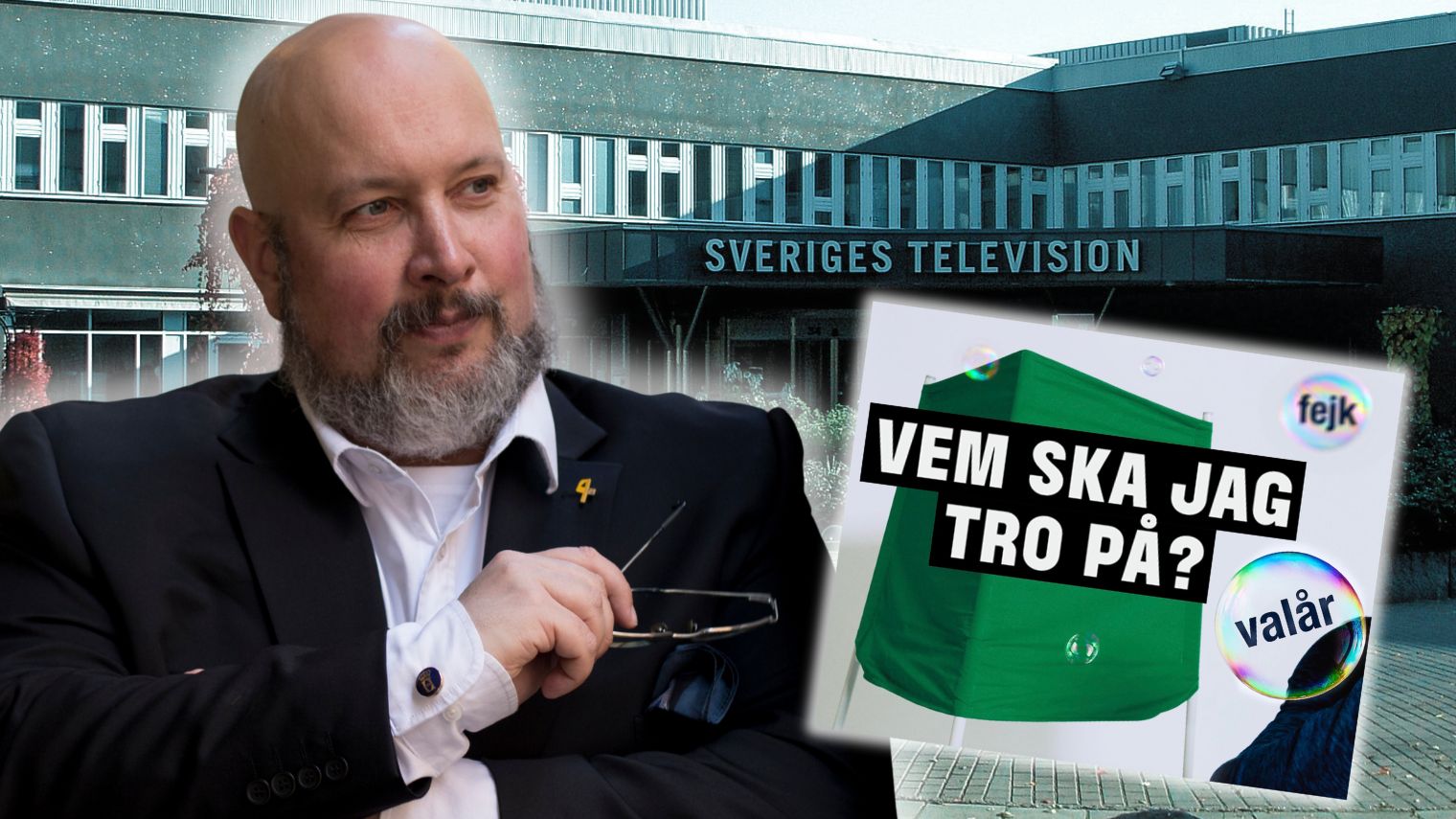
A new election initiative from the state media aims to guide viewers through questions about democracy, disinformation, and influence. Among the participants is the Centre Party debater and NATO lobbyist Patrik Oksanen, who often appears as a security expert in establishment media but whose theories often miss the mark once the pieces of the puzzle fall into place.
The series consists of four episodes addressing different aspects of the topic, from the media’s investigative role to how politics is increasingly packaged as content on social media. Throughout the series, the ambition is to provide a comprehensive view of both opportunities and risks in today’s media landscape—and to prepare viewers for an ever more complex election campaign.
How are our perceptions shaped ahead of an election in a time when news, opinions, and targeted messages are constantly competing for our attention? That question is central in the educational series titled “Who Should I Believe?”, where program leader Kodjo Akolor from Sveriges Radio guides viewers.
The series, which premieres on May 10th on UR Play and broadcasts on SVT2, starts with questions about democracy, disinformation, and what political influence looks like in the digital election campaign. The program consists of conversations with a broad range of voices from journalism, politics, and academia. This is stated in a press release.
The starting point is that the line between facts and opinions has become increasingly difficult to draw. Kodjo Akolor emphasizes the importance of source criticism in a media climate where information spreads quickly and often without a clear sender. The ambition is to give viewers the tools to assess what they encounter in their feeds themselves.
Left-Liberal Bias
The selection of participants in the initiative, which will air on the Educational Broadcasting Company (UR) and Swedish Television (SVT), raises questions about selection, perspective, and what kind of expertise is allowed room when viewers are to orient themselves in a complex information flow. Among the participants are Amanda Sokolnicki, Joakim Medin, Martin Schibbye, Ivar Arpi, and Erika Bjerström, as well as researcher Jesper Strömbäck. In the podcast format, there are also conversations with politicians like Ardalan Shekarabi and Hanif Bali about the role of social media and growing polarization.
At the same time, the line-up is dominated by profiles with a distinctly left-liberal starting point, with debater Ivar Arpi and former Moderate MP Hanif Bali standing out as the only more clearly dissenting voices among otherwise left-liberal and Sweden Democrats-critical profiles. Other political perspectives, such as those more aligned with the Sweden Democrats or generally national conservative, are completely absent.
Another focus is on new actors in the digital landscape. Through meetings with researchers like Marie Grusell and Yasmine Winberg, as well as social media personalities, the series explores how so-called “polfluencers”—opinion leaders on social media—influence public opinion in the country.
Rules and future challenges are also addressed. In discussions with Emanuel Karlsten and Olof Gränström, the potential impact of new EU regulations regarding political advertising on voters is discussed. Perspectives from young voters and psychological aspects of information influence are also integrated through meetings with, among others, Ebba Karlsson.
Confusing Geopolitical Profiles Become Experts
The series also highlights the international dimension of information influence. Ann Linde shares experiences of foreign influence attempts, while cybersecurity researcher Inga Trauthig describes how AI-generated content is becoming increasingly difficult to identify. Together with experts such as Patrik Oksanen and Charlotte Wagnsson, methods behind digital information operations are analyzed.
Ann Linde, who drew attention a few years ago when she wanted to finance influence campaigns abroad but take the planning via an encrypted channel, also concluded that the sabotage of Nordstream was a Russian attack—even though all suspects are Ukrainian citizens.
READ MORE: Ann Linde Fooled by Russian Trolls—Revealed to Want to Finance Influence Campaigns
On the same note, Oksanen has repeatedly been quick to conclude things based on his theories. But these analyses have later turned out to be completely wrong when courts in both Sweden and abroad have determined other causes. Then Oksanen has gone silent and changed the subject. Now both are experts in foreign influence and are to guide the Swedish public with knowledge.
ALSO READ: The Security Expert’s Russian Sabotage Theories in the Baltic Sea—Were Accidents
The episodes have the following titles:
Are the titles: Election Without Scrutiny?
When Politics Becomes Content
Hostile Countries and Our Democracy
Political Influence in My Feed