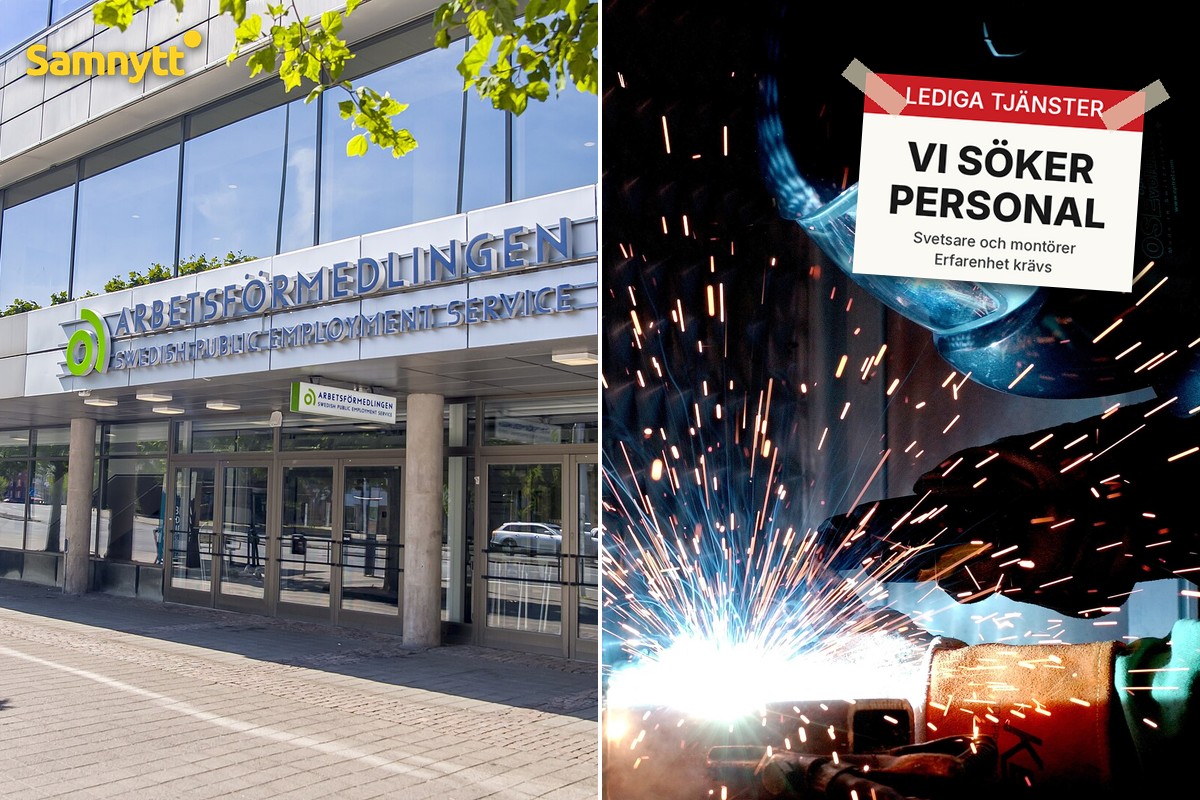
Sweden has hundreds of thousands of unemployed people, yet companies are simultaneously having major problems finding staff. According to the Confederation of Swedish Enterprise, seven out of ten companies find it difficult to recruit the right skills, and in a new report the organization is calling for comprehensive changes to the education system and labour market policy.
The Confederation of Swedish Enterprise presented a new report on Sweden’s skills supply on Friday. The organization describes the situation as a serious barrier to growth: companies need staff while large groups of people remain unemployed.
According to the organization, seven out of ten companies experience difficulties in finding employees with the right skills. The problems are mainly due to the fact that job seekers’ education and experience do not match employers’ needs.
This is happening at the same time that 349,398 people were registered as unemployed with the Swedish Public Employment Service at the end of August. This corresponded to 6.5 percent of the registered labour force. Of these, just over 149,000 had been unemployed for at least one year.
Unemployment has indeed decreased compared to the previous year, but the agency notes that matching problems persist and risk worsening as the economic climate improves.
One in four recruitment attempts fails
The problems are also evident in the Confederation of Swedish Enterprise’s recruitment survey published in March.
There, about two out of three surveyed companies that had tried to recruit stated they had difficulty finding the right skills. One in four recruitment attempts failed completely.
The most common reason was a lack of relevant work experience. According to the companies, this was followed by a lack of the right attitude and correct education.
READ ALSO: The government calls ‘Skåne’s’ unemployment absurd
The consequences are not limited to individual positions remaining unfilled. According to the survey, nine out of ten companies experiencing recruitment difficulties report that the problems negatively impact their operations.
Among other things, companies are forced to turn down assignments, postpone expansion, or handle increased costs. About one in three companies state that staff shortages have forced them to reduce or cancel activities.
The survey also shows that employers place high value on practical vocational skills. Upper secondary vocational education and post-secondary vocational training are particularly important for many companies, while university education plays a greater role in knowledge-intensive sectors.
Wants to reform the education system
In the new report, Growth Agenda for Skills Supply, the Confederation of Swedish Enterprise calls for reforms to make education better matched to labour market needs.
The organization wants, among other things, more young people to complete upper secondary school, more to choose vocational education, and for the vocational college sector to be expanded. Higher education and research should also, according to the report, be linked more closely to companies’ skills needs.
READ ALSO: Unemployment worsened by unemployable migrants
The Confederation of Swedish Enterprise also wants to make it easier for people to retrain and change professions during their working life. The matching of jobseekers and available jobs should be improved, while the organization wants to make it easier to recruit from abroad when the expertise is not available in Sweden.
The latter forms part of the organization’s proposed solution, despite large numbers of people already being outside the Swedish labour market.
The Swedish Public Employment Service confirms matching problems
The fact that companies’ recruitment difficulties exist in parallel with high unemployment is not just a conclusion from the employers’ organization.
In its labour market forecast from June, the Swedish Public Employment Service states that many registered unemployed lack the skills employers are seeking.
READ ALSO: KI: Lower asylum immigration would have resulted in lower unemployment
The agency especially points out the persistently high unemployment and the shortage of labour in some parts of the economy. According to the forecast, the number of registered unemployed is expected to average 349,000 in 2026 and 328,000 in 2027.
Even if the economy improves, the agency assesses that long-term unemployment will remain at a high level.
Almost three times higher unemployment among foreign-born
One key explanation for Sweden’s high unemployment rate is the significant differences between native-born and foreign-born people. According to Statistics Sweden (SCB), unemployment among native-born persons aged 20–66 was 5.0 percent in the second quarter of 2026, compared to 13.6 percent among foreign-born persons.
Unemployment was thus nearly three times higher in the latter group. Employment rates also differed significantly: 83.4 percent of the native-born had jobs, compared to 73.8 percent among the foreign-born.
The differences show that Sweden’s high unemployment is not evenly distributed across the population. Foreign-born have significantly more difficulty establishing themselves in the labour market, while employers report a lack of the right skills. This is about education, work experience, and language skills, but also about how well the labour market manages to make use of the workforce that already exists in the country.
READ ALSO: Unemployment is highest among these groups