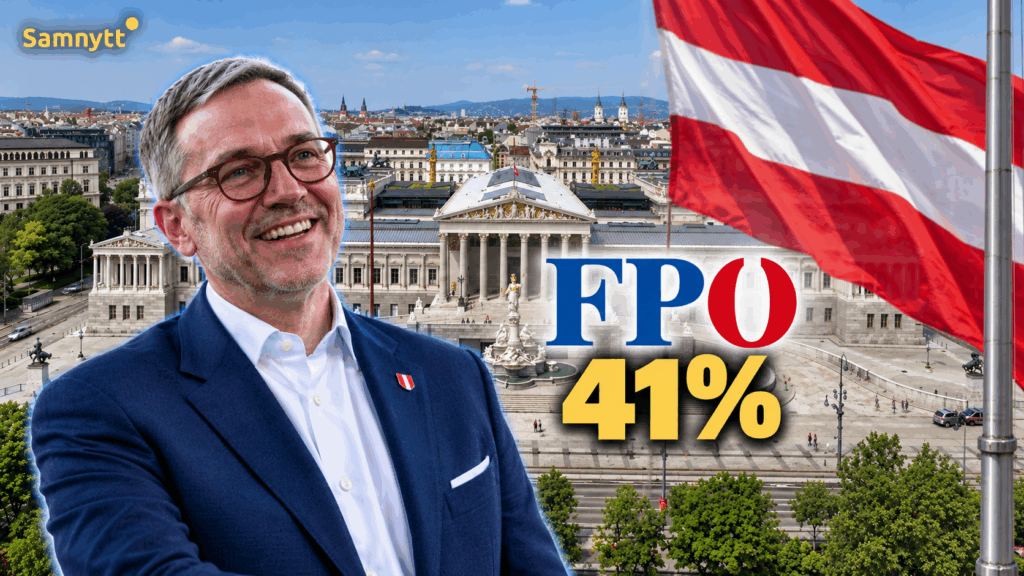
Austria’s national-conservative Freedom Party (FPÖ) reaches a record-high 41 percent in a new opinion poll, further cementing its position as the country’s by far largest party. At the same time, support for the incumbent government has plummeted to a level where the three coalition parties combined are now smaller than the FPÖ.
The FPÖ, led by Herbert Kickl, continues to strengthen its position in the country’s political landscape. In a fresh poll conducted by the Lazarsfeld Gesellschaft on behalf of the Austrian news site oe24, the party secures support from 41 percent of voters.
This is the first time FPÖ has crossed the 40 percent threshold in surveys by this institute, marking a rise of three percentage points compared to the previous week.
The result means the FPÖ now has more than twice as much support as the conservative Austrian People’s Party (ÖVP), which with its 20 percent comes in second. The Social Democratic SPÖ, traditionally one of Austria’s two major governing parties, lags far behind with only 14 percent.
The gap between FPÖ and the government parties has thus grown even wider, whereas Herbert Kickl’s party continues to attract voters despite being outside the government. Particularly notable is that FPÖ, at 41 percent, is now larger than all three coalition parties combined.
Austria has been governed since 2025 by a coalition of the conservative ÖVP, Social Democratic SPÖ, and liberal NEOS. Together, these parties achieve only 40 percent in the current survey, meaning the governing coalition for the first time comes in behind the FPÖ on its own in these polls.
Austria, Market-Lazersfeld poll:
FPÖ-PfE: 41% (+3)
ÖVP-EPP: 20%
SPÖ-S&D: 14% (-2)
GRÜNE-G/EFA: 12%
NEOS-RE: 6% (-2)
KPÖ-LEFT: 4%+/- vs. 29 September 2026 – 01 October 2026
Fieldwork: 05-06 October 2026
Sample size: 1,000➤ https://t.co/7wdXPVoSYN https://t.co/FBgPoFHelx
— Europe Elects (@EuropeElects) October 9, 2026
Strong dissatisfaction with the government
The weak position of the government parties is also reflected in how voters see the coalition’s performance. According to the poll, 54 percent say they are dissatisfied with the government, while only 20 percent believe it is doing a good job.
Chancellor Christian Stocker, who belongs to ÖVP and leads the three-party coalition formed after the last parliamentary election, thus faces a difficult public opinion climate where the governing bloc as a whole has less support than the largest opposition party.
For the Social Democrats, the trend is particularly troubling. SPÖ loses three percentage points in just a week, falling to 14 percent, which according to oe24 is the party’s lowest figure ever recorded in Lazarsfeld’s polling. The liberal coalition party NEOS also loses support and gets 6 percent in the survey.
Kickl far ahead – Babler last
The FPÖ’s strong poll performance is also evident in the question about whom voters would most like to see as Austria’s chancellor. Herbert Kickl is backed by 34 percent of respondents, placing him clearly ahead of all other candidates.
Incumbent Chancellor Christian Stocker gets only 13 percent. Even weaker are the numbers for Social Democratic leader Andreas Babler—only 5 percent of those surveyed would prefer him as chancellor.
READ ALSO: Austria toughens stance against political Islam – FPÖ demands total ban