
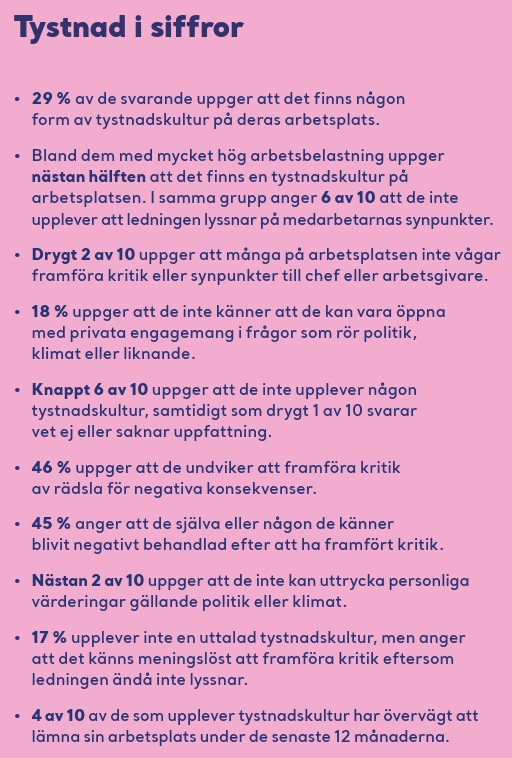
The work environment at several government workplaces appears to be anything but harmonious, according to a new report. Every second member of the ST Union avoids voicing criticism at work out of fear of negative consequences, and one in three experiences some form of culture of silence.
The ST report Silent State is based on responses from 22,000 union members in its workplace environment survey, covering multiple government employers. The State Institutions Board and the Swedish Prison and Probation Service rank the worst, with 56 and 51 percent of respondents respectively stating that a culture of silence prevails there.
The Swedish Migration Agency comes in third, followed by the Police and the National Agency for Special Needs Education and Schools. At the opposite end of the spectrum, agencies such as the Swedish Companies Registration Office and the Swedish Meteorological and Hydrological Institute report that only about ten percent feel there is a culture of silence.
READ ALSO: Chaos at the Social Democratic Women’s Association: “Palpitations and Nightmares”
“Unfortunately, we see that this is a widespread problem in many workplaces,” says Martina Cras, investigator at ST, to Publikt.
“It’s about leadership and how one receives criticism and feedback; you have to foster openness every day. But it’s also about workload.”
Democracy at Risk
According to Martina Cras, a culture of silence can lead to occupational health risks for individual employees, or worse — have broader effects on the government and democracy. She fears that expertise will be lost or that employees will not dare point out problems or wrongdoing at work.
The problems with a culture of silence are said to be greater at workplaces with high workloads.
The List
The State Institutions Board, 56 percent
Swedish Prison and Probation Service, 51 percent
Swedish Migration Agency, 37 percent
Police, 36 percent
National Agency for Special Needs Education and Schools, 36 percent
Government Offices, 35 percent
Sida, 35 percent
Swedish Maritime Administration, 34 percent
Swedavia, 32 percent
Swedish Social Insurance Agency, 31 percent
READ ALSO: Chaos at the Gender Equality Agency — staff feel discriminated against and insulted