
For many years, the debate surrounding labor immigration has focused on the needs of businesses for labor. But behind the government’s new compromise lies a much bigger conflict. Is Sweden primarily a nation and a welfare state – or a market where companies should be able to recruit workers from all over the world? In interviews with Samnytt, Hanif Bali and Ludvig Aspling (SD) present two perspectives on the same question. They agree that the old model has failed. But they don’t agree on what will happen next.
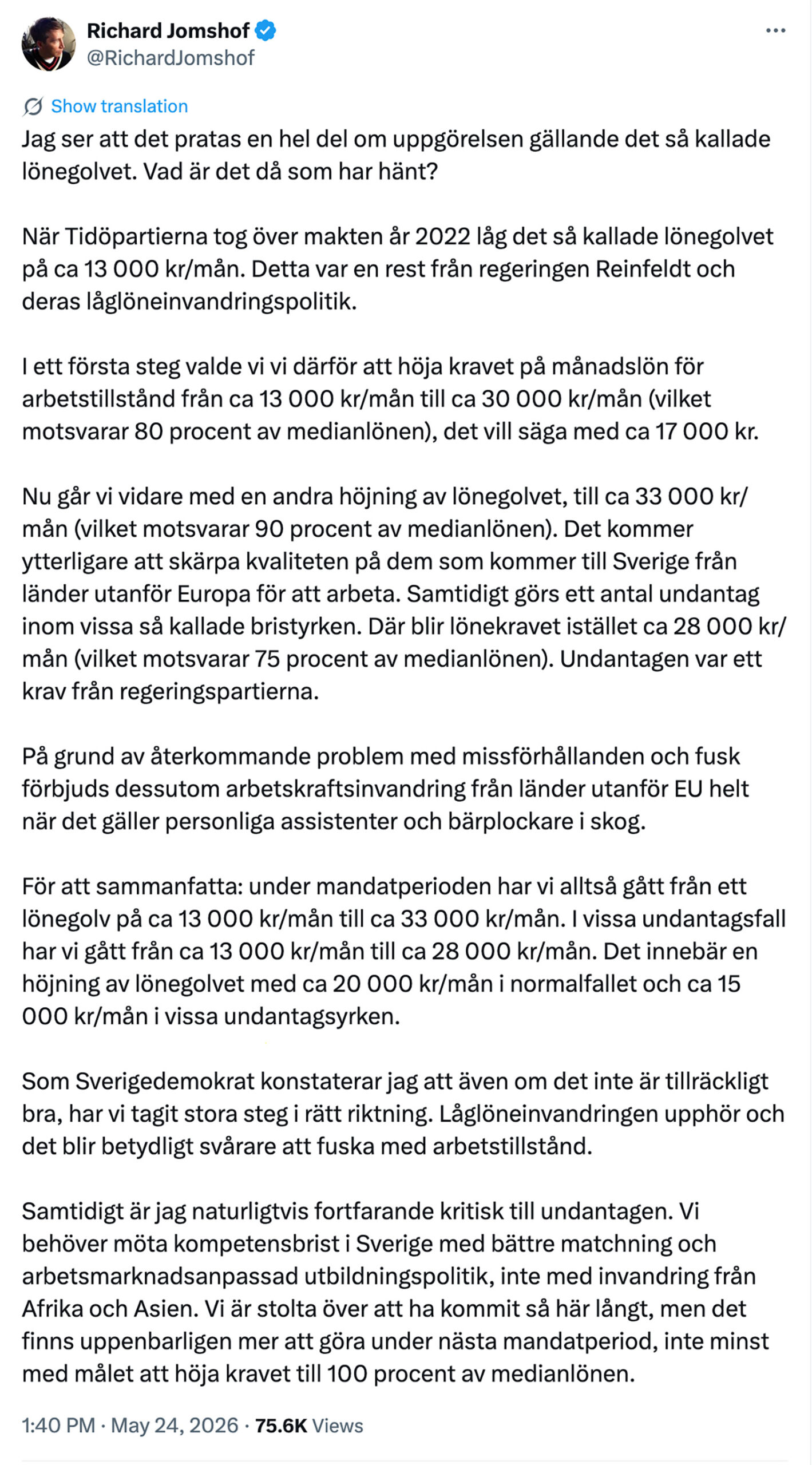
The government recently presented the next step in the reform of labor immigration. The main rule is that those applying for a work permit must have a salary corresponding to 90 percent of the median salary, which, after this year’s adjustment, is about 33,000 – 35,000 SEK per month.
At the same time, exceptions will be introduced for certain occupational groups deemed to be suffering from a skills shortage, including certain specialist professions in technology, life science, and other fields. For these roles, the limit is lower, at 75 percent of the median salary, which is about 27,000 SEK.
READ ALSO: Tidö government softens salary requirements for certain labor immigrants
The government presents the reform as a significant tightening compared to the previous system and claims that it will reduce abuse of labor immigration while still allowing Swedish companies to recruit talent not available on the domestic labor market.
What the government is doing now is eroding this whole principle by introducing entirely arbitrary boundaries.
Hanif Bali
But shortly after the announcement, X (formerly Twitter) and other social media platforms filled with criticism, not least from figures in the bourgeois and immigration-critical sphere. Critics argued that while the government is raising the salary floor, it is simultaneously opening new loopholes via these exceptions.
Questions were raised about who pushed for the special rules, why certain professions should be subject to lower requirements, and whether the reform risks recreating the very problems it was meant to solve. The debate quickly broadened to issues far beyond just salary levels.
But one of the sharpest critics comes from an unexpected angle. Former Moderate Member of Parliament Hanif Bali, who says he was involved in developing the median salary model upon which today’s requirements are based, believes the government now risks undermining the core idea of the reform.
Hanif Bali is a former Member of Parliament for the Moderate Party and has been one of the most prominent voices in Sweden’s migration and integration debate for the past two decades.
Born in Iran and raised in Sweden, he became known as an outspoken critic of both Swedish migration policy and the right’s approach to :censored:6:cdd6bbaa89:ization and labor immigration.
During his time in parliament, he worked, among other things, with migration and labor market issues and was among the Moderates who pushed early for stricter immigration policy.
According to Bali, the point of the median salary was to create a simple and clear principle where labor immigration should take place only at levels where the immigrant primarily becomes a net contributor to the welfare system.
By introducing exceptions for certain occupational groups, he believes the government opens the door to new divisions, special rules, and future loopholes.
– What the government is doing now is eroding this whole principle by introducing entirely arbitrary boundaries, he tells Samnytt.
For Bali, then, the conflict is not about the salary requirements being too high, but about the government in his view abandoning the model that was supposed to make the system simple, predictable, and resistant to political micromanagement.
The Exceptions
- Paramedics
- Childcare assistants
- Distribution electricians
- IT operations technicians
- Drivers of agricultural and forestry machinery
- Engineers and technicians within chemistry and chemical engineering
- Laboratory engineers
- Machine operators, meat and fish processing industry
- Network and systems technicians, among others
- Persons with a completed higher education of at least two semesters
- Forestry workers
- Slaughter and butchery workers, etc.
- Steel construction assemblers and heavy plate workers
- IT support technicians
- Welders and gas cutters
- System administrators
- Maintenance mechanics and machine repairers
- Assistant nurses, habilitation
- Assistant nurses, home care, home nursing and elderly care homes
- Assistant nurses, reception
- Assistant nurses, care and specialty departments
- Breeders and caretakers of farm animals
- Care aides
- Crop growers and animal breeders, mixed operations
- Other animal breeders and animal handlers
- Other operations technicians and process supervisors
- Other machine operators in the food industry, etc.
The World’s Most Liberal System
When the Alliance government opened up labor immigration in 2008, under Fredrik Reinfeldt, one of the most liberal systems in the world was created.
READ ALSO: Reinfeldt wants to maintain free labor immigration
The idea was that businesses should themselves decide what workforce they needed. The state should not interfere. However, the result was very different from what many had envisioned.
Wage dumping – that’s something the other government parties don’t mind much, in my opinion. They would have been happy to keep the system we had. // You notice that some people have absolutely no problem with a pretty extreme class society.
Ludvig Aspling (SD)
In the following years, criticism grew. Labor immigration appeared not only in qualified sectors but also in low-skilled jobs where wages were low and where labor was already available in Sweden.
At the same time, questions began to be asked about family reunification, the benefits system, and costs that ended up with the municipalities. When the Tidö parties took power, the salary requirement was sharply increased.
According to Ludvig Aspling (SD), the number of work permits has already dropped by more than half since the first restrictions were introduced.
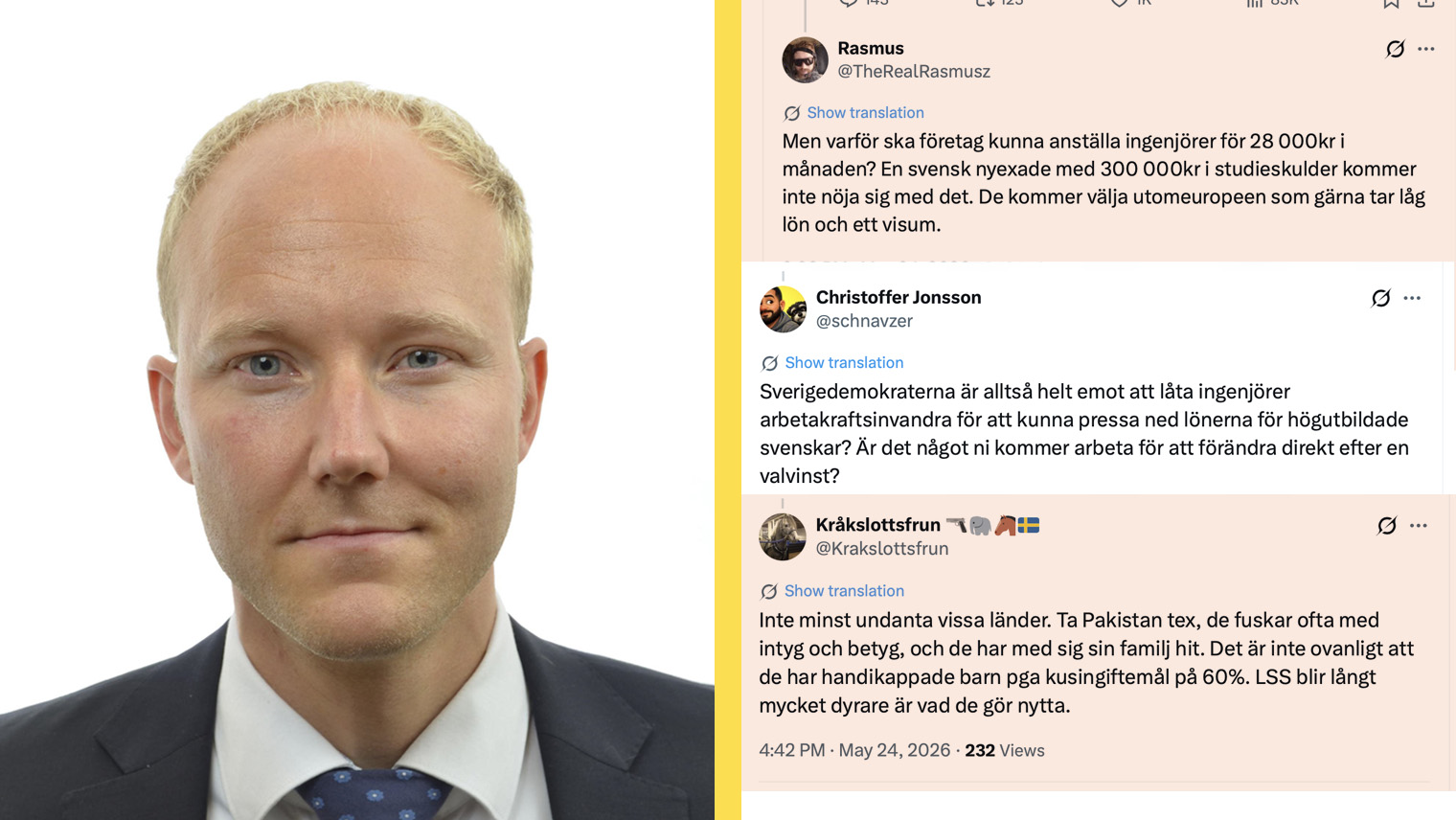
Ludvig Aspling is the Sweden Democrats’ migration policy spokesperson and a member of the Riksdag’s social insurance committee. Since the Tidö Agreement, he has been one of the party’s central representatives on questions of migration, labor immigration, citizenship, and integration.
For several years, Aspling has distinguished himself as an advocate for sharply reduced immigration and tougher rules on residence permits, and has played a key role in negotiations between SD and the government parties on new migration policy.
READ ALSO: SD and KD propose joint efforts to toughen labor immigration requirements
Aspling confirms that the Sweden Democrats actually did not want any exceptions at all, but that this is something pushed by their government partners.
– We actually don’t really think these exceptions are necessary. But it was extremely important for the other government parties, he says.
For SD, the compromise was about accepting the lesser of two evils.
Much of the current criticism is about wage dumping and the idea that incentives to raise wages in shortage occupations are undermined. Employers can hire workers at much lower salaries than the market would otherwise require. What do you say to this criticism?
– Wage dumping is something the other government parties don’t really mind, in my opinion. They would have liked to keep the system we used to have. He continues:
– We now have a significant tightening. Before we took over, the salary threshold was 13,000. Now it’s 35,000 for 90 percent of all employees and about 10 percent who fall under the cap. So to say we’re engaging in wage dumping isn’t fully correct, as we’ve more than doubled the salary requirement.
READ ALSO: EU and India in major trade deal – opens for massive immigration
You mean that without SD’s pressure, the old system would have continued?
– Yes, of course. Some people clearly have no problem with the idea of a rather extreme class society.
Aspling also admits that the risk of wage suppression is real.
Here is also where the clearest dividing line arises between Bali and Aspling. While Bali argues the government’s exceptions for certain shortage occupations risk undermining the entire median wage model, Aspling claims the critique partly comes from a misunderstanding.
According to the SD top, the exceptions do not concern the kind of low-skilled jobs Bali warned against, but a limited number of specialized professions where the government assesses there is a real skills shortage. Bali, however, is not convinced.
He questions why, for example, chemical engineers should be subject to lower salary requirements than other professions, and maintains the state is once again drawing arbitrary lines. According to him, the strength of the median salary model was precisely that it was based on a simple principle – if a company really needs certain expertise, it should also be prepared to pay a salary above the median.
When certain professions get special exceptions, Bali says, questions arise about which industries have influenced policy and why these, in particular, should have access to labor at lower cost.
Aspling, for his part, emphasizes that the reform, despite its exceptions, still marks a dramatic tightening compared to the previous system and that the Sweden Democrats would have preferred even fewer exceptions.
The Man Behind the Median Salary Model
Since leaving Parliament, Hanif Bali has continued to be an influential commentator, not least through social media, where he often combines economic, demographic, and cultural perspectives in his analyses of Swedish politics.
There is no point in having a Sweden that is better than the Swedes themselves – if it’s even possible to create. So what’s the point? Why should limited companies in Sweden be better than what Swedes themselves can partake in? Are the Swedes there for Sweden, or is Sweden there for the Swedes? That is the big conflict here.
Hanif Bali
Today he works in the IT sector but still regularly takes part in social debate. In his interview with Samnytt, Bali lays claim to something few outside the political sphere know.
READ ALSO: Bali: Demographics may make future right-wing governments impossible
He claims the very structure behind today’s salary requirements is based on a proposal he developed within the Moderates years ago.
The background was a growing realization that labor immigration in a welfare society does not work the same way as in a pure market economy.
– A person who comes to Sweden does not just get a job. Over time, family follows, along with schools, healthcare, pensions, and other areas of the welfare state.
Bali’s conclusion was that labor immigration must be tied to a level where the immigrant is primarily a net contributor to the system. The median salary became the natural dividing line.
– At what income level does one become a net contributor to the system, and at what level a net recipient? It’s roughly around the median salary, he says.
According to Bali, the point was to create a simple, transparent, and automated system – not to let authorities decide which jobs are prestigious enough or which companies should get exceptions.
This, he says, is why he reacts so strongly to the new compromise.
– What the government is doing now is eroding this whole principle by introducing entirely arbitrary boundaries.
A New Class Society Emerges
Both Bali and Aspling keep returning to the same theme – the emergence of a low-wage layer. Aspling describes how people are in practice forced to share small apartments and live under conditions few Swedes would accept. He believes parts of the bourgeoisie historically had no major objections to this development.
Bali instead uses the taxi industry as an example. He remembers a time when taxi drivers were often knowledgeable individuals who could support a family, buy a home, and build a stable life.
Then the industry changed. Technology lowered the entry threshold. Competition increased. Prices were squeezed. And, according to Bali, quality also dropped.
– It just got cheaper, shabbier, and cheaper, he says.
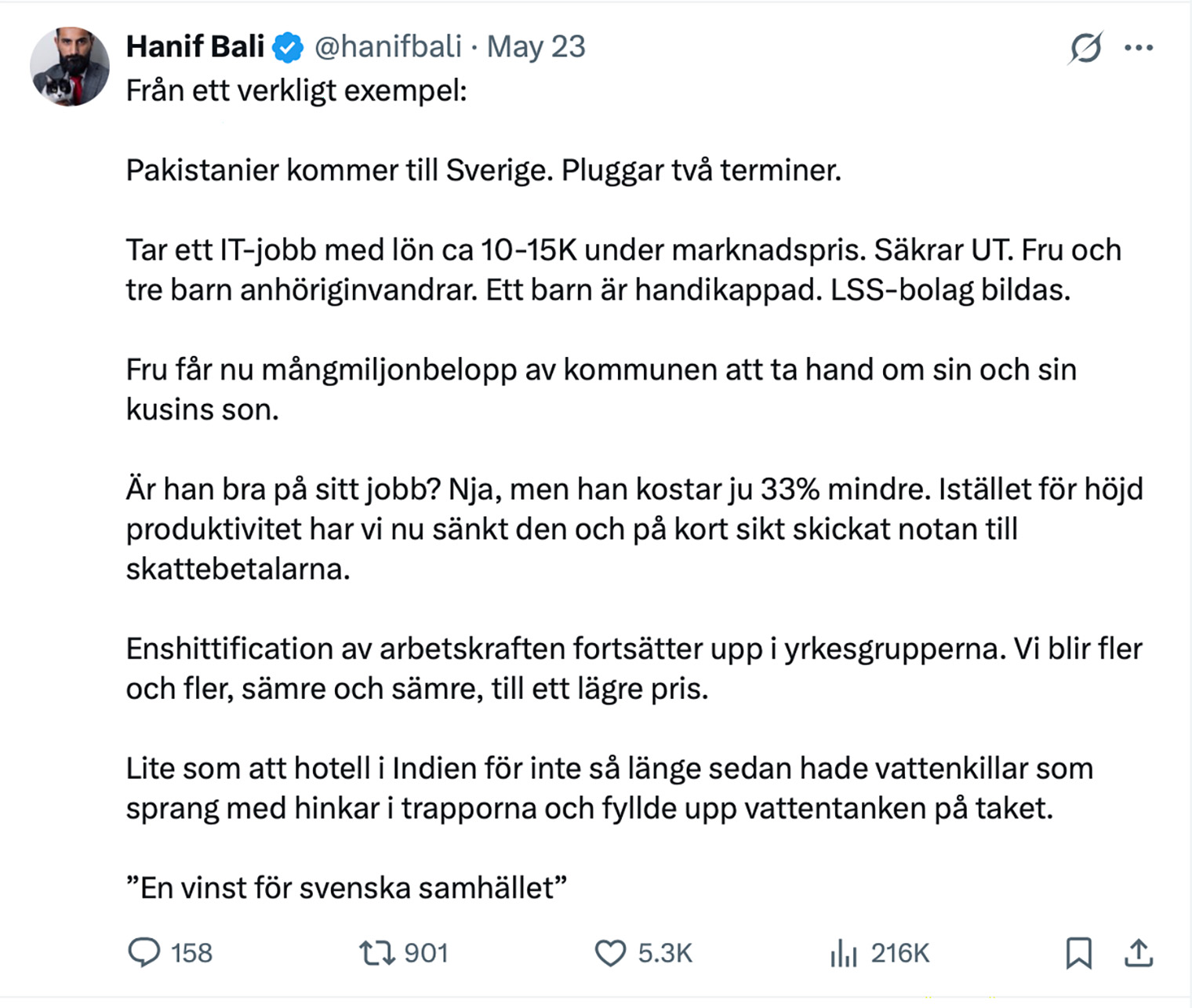
He describes the development as a kind of “enshittification” – a term used to describe how systems gradually deteriorate when all focus is put on price competition.
– It’s cheaper, there are many more, but it’s also worse.
In his view, the same risk is now affecting more parts of the labor market. More people. Lower costs. But also lower quality, worse conditions, and less incentive to invest in productivity.
Family Immigration – The Elephant in the Room
Another recurring question in both interviews is what happens after a work permit is granted. Bali sparked debate on X when describing a scenario where a person comes to Sweden via labor immigration, then brings their family, and finally gains access to extensive welfare benefits through relatives.
He admits it is difficult to know exactly how common this is, but argues it points to a real problem.
According to him, it is not enough to look at the individual’s employment. You must also consider the long-term consequences for the welfare state. On this point, he finds surprisingly little disagreement from Ludvig Aspling.
On the contrary, when Samnytt raises the criticism, the SD top responds:
– That risk absolutely exists. He continues:
– We are fully aware of this problem. The abuse here is enormous.
READ ALSO: EU in agreement with Bangladesh – opens for more immigration
Aspling also points out that the government is working on new maintenance requirements for family immigration and that some of the most problematic arrangements in personal assistance will now be stopped.
But again, Bali goes further. He argues the government is still leaving doors open for approaches that could, over time, lead to major costs for municipalities and the welfare system.
READ ALSO: Tidö government softens migration line and pauses “teen expulsions” after criticism
Is Sweden a Nation or a Market?
Ludvig Aspling claims that Tidö currently has no real concerns about what he describes as a pretty extreme class society, where there is a group working for far less than Swedes would be willing to work for. How do you comment on that?
– I don’t know exactly what he means, so I won’t draw conclusions. But this originally comes from the Moderate party program—the entire construction.
In the end, the discussion lands on issues that are much bigger than work permits, median salaries, and exempted jobs.
It’s about the view of Sweden. In recent decades, much of the economic debate has assumed that more people, more mobility, and a greater labor supply is fundamentally positive. We ask Hanif Bali:
You have often criticized how migration affects the social contract. Is there a point at which labor immigration ceases to be an economic issue and becomes a question of national cohesion?
– Yes, of course. There’s no point in having a Sweden that is better than the Swedes themselves—if that’s even possible to create. So what’s the point? Why should limited companies in Sweden be better than what the Swedes themselves can benefit from? Are the Swedes there for Sweden, or is Sweden there for the Swedes? That’s the big conflict here. He continues:
– Sweden exists for the Swedes. It’s not just a corporation. It’s a common construction created by Swedes to represent the interests of the Swedish people. Bali elaborates:
– It’s not in our interests to have 10 million extremely talented Chinese people here. They may be phenomenally skilled, but it is not in our interest. We cannot maintain a democracy that represents the interests of the Swedish people then.
READ ALSO: Migration Agency’s inside: Clans, Swedes in the minority, and a culture of silence
This is also where the real conflict line emerges. For businesses, labor immigration is often about skills supply and growth.
For Bali, it’s about national cohesion, the long-term sustainability of the welfare state, and preserving a high-trust society.
For Aspling, it’s about reducing low-wage immigration and regaining control over a system that has long been too generous.
But even though their paths diverge, both agree on one point – the old model of labor immigration at low wages has outlived its usefulness.
What remains to be decided is whether the government’s compromise is the start of a new, tighter system – or whether the exceptions are just the first step toward new loopholes.