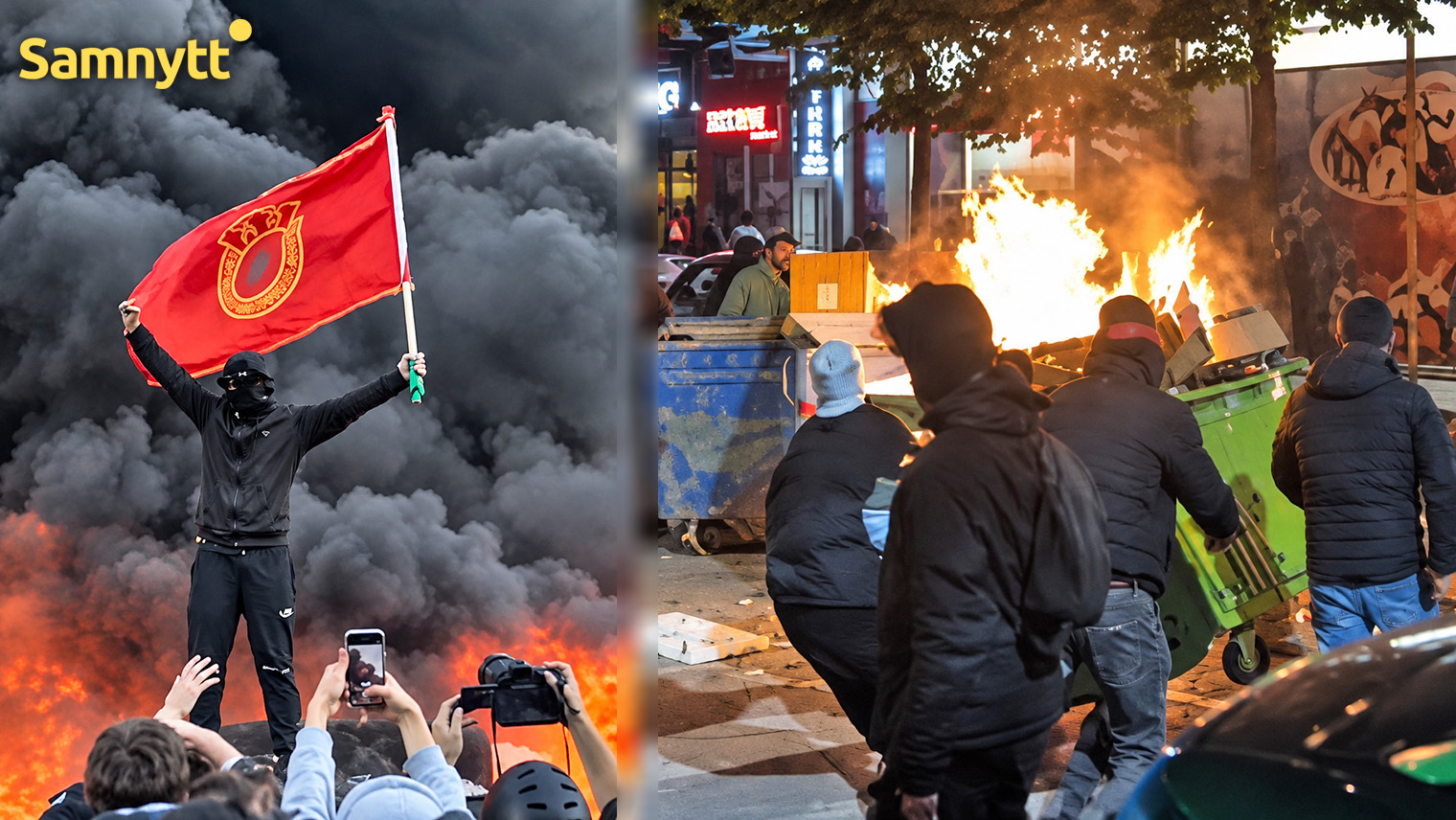
Tens of thousands of students demonstrated against corruption, high education costs, and the government in Albania. The protests have escalated into extensive violence where government buildings and banks have been set on fire and police officers attacked with stones. Meanwhile, discontent with Prime Minister Edi Rama is mounting, as he is accused of tolerating corruption within the country’s political elite. The unrest also raises questions about the political development in the country, which is a candidate for EU membership.
It turned violent on Wednesday when tens of thousands of protesters took to the streets in Albania’s capital Tirana to protest against the government and the situation at the country’s universities. What began as a protest over rising educational costs, insufficient financial support for students, and bleak future prospects developed into full-scale riots.
Protesters threw stones at the police, overturned garbage containers, and smashed shop fronts. The Ministry of Education’s building was set on fire, as were two banks, including a branch of Raiffeisen Bank. Police responded with water cannons and tear gas to disperse the crowds. According to authorities, at least 23 police officers and six other people were injured. A total of 35 people were arrested in connection with the violence.
Corruption Fuels Discontent
The protests are rooted in growing dissatisfaction with Prime Minister Edi Rama and his government. Rama, who leads the Socialist Party with roots in the former communist dictatorship, won a fourth term in office last May but has since faced increasing criticism over suspected corruption and irregularities among high-ranking politicians and officials.
Corruption has long been a deep-seated societal problem in Albania, whose political institutions are still influenced by the legacy of decades of communist dictatorship as a Soviet satellite state, and the difficult transition to democracy and a market economy after the regime’s collapse in 1991 following the Soviet Union’s dissolution.
Student protests and riots continue for a third day in Albania
In Tirana, protesters are throwing stones, bricks and Molotov cocktails at government buildings. The ministries of finance and justice, the prime minister’s office, shopping malls and two banks have been damaged.
Students are protesting against high tuition fees, poor conditions in dormitories and a lack of jobs in their fields of study.
— NEXTA (@nexta_tv) October 15, 2026
Despite repeated reforms and efforts to combat corruption, significant problems persist with political influence over public institutions and suspicions of improper financial ties between those in power and business interests. However, the discontent is not directed solely at the government. Many protesters also do not consider the country’s established opposition politicians to be credible alternatives.
This summer, several peaceful protests were held against the government. One of the triggering factors was plans for an exclusive tourist resort along Albania’s south coast, a project linked to Jared Kushner, son-in-law of U.S. President Donald Trump. The project has become the subject of legal disputes and sparked criticism over the exploitation of valuable natural areas and the close relationship between political and economic power.
Open Support for Violence as a Political Method
Wednesday’s protests represent the most violent escalation yet of discontent with Rama. That some protesters no longer considered peaceful demonstrations sufficient was made clear by statements from participants who openly advocated a more confrontational struggle against the government.
“This is a revolution. We are tired of peaceful protests. We will not stop until Rama resigns,” said student Lora, who did not want to give her last name, as she threw stones at the police.
???????? Total chaos in Tirana on the second day of violent student protests. https://t.co/0M8fpUU2ku
— kos_data (@kos_data) October 14, 2026
Other demonstrators chanted slogans demanding the government’s resignation and accused the police of siding with criminals. However, even if the discontent over corruption and abuse of power is legitimate, violence against police officers, arson, and property destruction cannot be justified as political means of exerting pressure.
The student organizations behind the protests have emphasized that their demands primarily concern better conditions at universities, lower education costs, improved financial support, and greater opportunities for employment after graduation. According to Albanian media, the protests have also spread to the university towns of Elbasan and Shkodër.
The Government Condemns the Violence
Albania’s president Bajram Begaj has condemned the violence and called for calm.
“The constitution and the law must form the boundaries for everyone, with no exceptions,” the president stressed.
Deputy Prime Minister Albana Koçiu also strongly criticized the destruction and urged peaceful demonstrators to distance themselves from those using violence. In a Facebook post, she emphasized that the freedom to demonstrate is a fundamental democratic right, but it must not be used as a pretext to destroy the city or attack other people.
Police have meanwhile warned that anyone attacking officers, starting fires, or damaging property will be held individually responsible under current legislation.
EU Responds – Albania Wants to Join
The unrest comes at a sensitive time for Albania, which holds EU candidate status and is conducting accession negotiations with the union. The fight against corruption, the independence of the judiciary, and respect for democratic institutions are among the central issues Albania must address in order to become a member.
The recent violence illustrates two parallel problems – the lack of trust in the country’s political institutions, and the risk that political disagreements turn into violence and lawlessness.
The EU delegation in Tirana has expressed concern over the violent developments, but at the same time has raised allegations that police have used excessive force against protesters and journalists. The delegation has called for a swift investigation of these claims and urged all parties to help reduce tensions.
For Albania, the situation represents yet another challenge on the road to EU membership. Combating corruption and strengthening democracy is crucial for the country’s future, but it also presupposes that political conflicts are managed within the framework of the rule of law.