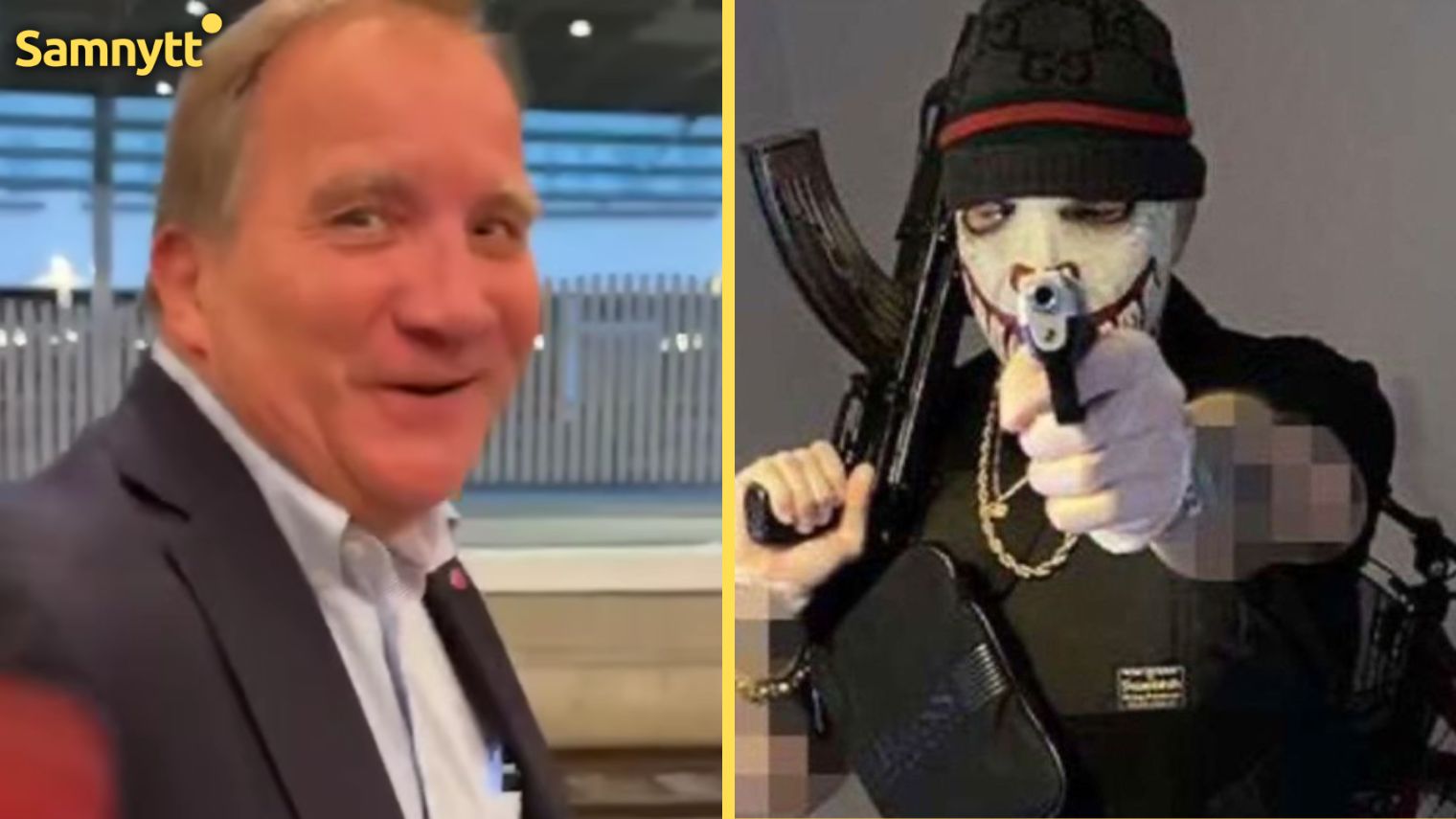
During Stefan Löfven’s time as prime minister, Sweden received almost a million migrants. There was never any upper limit since his Europe does not build walls, and the former Social Democratic leader did not foresee the consequences. When Löfven is now asked to comment on his time in power, he flees in panic.
Stefan Löfven made an unusual journey to the top of Swedish politics. From working as a welder and industrial worker, he moved on to the labor union movement and eventually became the Social Democrats’ party leader. His time as prime minister was marked by historically extensive immigration, growing gang-related crime, and an increasingly complicated parliamentary situation.
Löfven was born in 1957 in Stockholm and grew up in Sunnersta in Ångermanland. He trained as a welder and worked for many years in the industry. In a presentation of his professional background, he described how he worked as, among other things, a welder, sheet metal worker, forklift driver, and assembler.
The union career became his path into national politics. Löfven became chairman of IF Metall in 2006 and held the position until 2012. In January 2012, after Håkan Juholt’s resignation, he was elected as the leader of the Social Democrats. He was party leader from 2012 to 2021.
From Opposition to Rosenbad
When Löfven led the Social Democrats in the 2014 parliamentary election, the party became the largest but without its own majority. The Social Democrats formed a government together with the Green Party, and on October 3, 2014, Löfven became prime minister.
His first term was quickly dominated by the issue of migration. In the fall of 2015, the migration crisis reached its peak and Sweden received 163,000 asylum seekers during the year. In September the same year, Löfven gave his notorious speech at Medborgarplatsen in Stockholm.
The message was summed up in the words: “My Europe does not build walls.” Löfven argued that Europe should take joint responsibility for people fleeing and for a European system to distribute migrants between countries.
READ ALSO: Stefan Löfven resigns
The policy, however, changed later that autumn. Sweden introduced border controls and the government presented a series of restrictions on migration policy. This was a clear contrast to the rhetoric from September 2015.
Löfven later said that he did not regret the speech, arguing that the problem was that Europe’s countries had not taken joint responsibility.
Nearly a Million Immigrated
Statistics from SCB indicate the extent of immigration during the calendar years when Löfven was prime minister. Between 2014 and 2021, a total of 990,256 people immigrated to Sweden.
In 2014 the figure was 126,966 and in 2015 it increased to 134,240. In 2016, the peak was reached with 163,005 immigrants. The figures then dropped gradually: 144,489 in 2017, 132,602 in 2018, and 115,805 in 2019. During the pandemic, immigration fell to 82,518 in 2020 and 90,631 in 2021.
The figure 990,256 refers to the entire calendar years 2014–2021. Löfven was prime minister from October 3, 2014, to November 30, 2021, which means the figure also includes immigration during the months in 2014 and 2021 when he was not prime minister.
Government Crises and the January Agreement
After the 2018 election, Löfven’s path back to the prime minister post became significantly more difficult. It took 129 days to form a government. The result was the January Agreement between the Social Democrats, Green Party, Centre Party, and Liberals.
The government thereby had support from parties that were not themselves part of the government, at the same time as the Sweden Democrats had grown considerably. The parliamentary situation would come to mark Löfven’s second term.
In June 2021, Löfven was ousted in a historic vote of no confidence. He was, however, re-elected as prime minister on July 7 after new negotiations.
“We Didn’t See It Coming”
Parallel to the migration debate, the issue of severe crime grew ever more prominent on the political agenda. Shootings and explosions had become an increasing problem, and the government came under heavy criticism for not having foreseen the development.
In a noted interview on SVT’s Agenda in 2019, Löfven was asked why Sweden saw such a development of shootings and explosions. The prime minister replied: “We perhaps didn’t see it coming” and explained that Sweden previously had a different kind of lethal violence and had not really seen that even Sweden could experience such a development.
READ ALSO: VIDEO: Löfven SPEECHLESS when he is asked about the safety of Swedes
The statement later became one of the ones most associated with Löfven’s time as prime minister. Critics argued that the warning signs had been there for a long time and that the government should have acted earlier. The phrase also came to be used as a symbol for the criticism leveled at the government’s crime policy.
Löfven’s term as prime minister ended in autumn 2021. In August, he announced that he would leave the party leadership at the Social Democrats’ congress. In November, Magdalena Andersson was elected as the new party leader and Löfven then stepped down as prime minister. By then, he had been the Social Democrats’ leader for almost ten years and prime minister for just over seven years.
Refuses to Answer Questions
When journalist Christian Peterson, on behalf of Riks, tries to speak to Stefan Löfven about the consequences of his political career, Löfven flees without answering a single question:
READ ALSO: Löfven: Now I’m Leaving Facebook