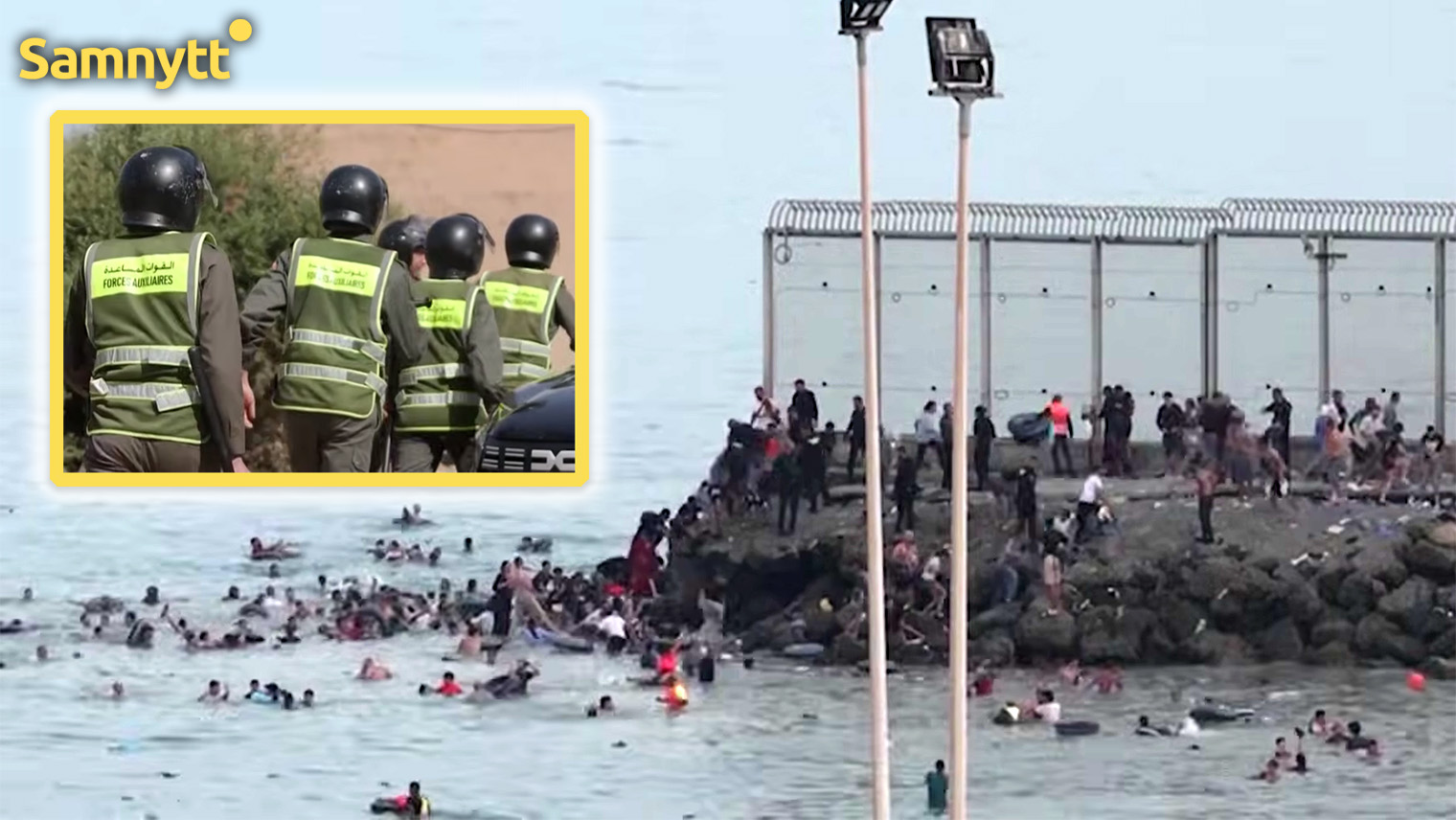
Highlight: Hundreds of people arrested. Almost all from sub-Saharan Africa.
Moroccan authorities have arrested hundreds of people who attempted to reach the Spanish enclave of Ceuta. The security operation comes just two weeks after around 72,000 people crossed the border in a dramatic mass crossing in which nearly one hundred people lost their lives.
On Saturday, Moroccan police detained at least 111 people in and around the coastal city of Fnideq, close to the border with the Spanish enclave Ceuta. According to information provided to Reuters, 109 of those arrested were from underdeveloped countries south of the Sahara, along with two Moroccan nationals.
Other sources suggest the operation may have been significantly larger. The Moroccan news site Le360 reported that a total of 294 people were apprehended. As of Saturday, no official figure had been definitively presented.
The operation was carried out following calls for a new mass illegal storming of the border on August 15, which had spread on social media. Earlier in the week, Moroccan authorities stated that they were monitoring the messages, which were described as of unknown origin, and warned that both organizers and participants could face prosecution.
Tear Gas and Roadblocks
In the days preceding the planned storming, security forces significantly increased their presence in northern Morocco. According to Spanish media, a large number of roadblocks were set up, patrol boats monitored the coast, and water cannons were positioned at the border.
Police also attempted to prevent illegal migrants from reaching the area. In cities such as Casablanca, Fez, and Kenitra, groups were stopped from boarding trains and buses heading north. Witnesses told Reuters that some of the migrants tried to avoid the controls by advancing along roads and mountain paths toward Fnideq.
On the hills a few kilometers from the border, Moroccan police used tear gas to disperse groups of migrants gathered there, according to the Spanish news agency EFE. Reuters later reported that hundreds of police officers, including riot police, were seen returning from the area. Around Melilla, Spain’s other enclave on the North African coast, a heightened security presence was also reported.
72,000 Crossed the Border
The backdrop is the exceptionally large illegal storming that took place on July 30 and in the following days. Around 72,000 people illegally crossed from Morocco into Ceuta, a Spanish city with a land border with Morocco and thus an external EU border.
The events led to political tension within the EU and once again put migration and the control of the Union’s external borders in focus. Most of those who entered Ceuta have reportedly since been returned to Morocco, but about 5,000 migrants were still in the enclave at the end of the week, according to Spanish Interior Minister Fernando Grande-Marlaska.
Spain Has Strengthened the Border
After the events at the end of July, Spain has also implemented extensive security measures. A barrier has been installed in the water to hinder illegal attempts to swim around the border fence, and over 500 additional police officers have been sent from mainland Spain. This brings the police presence in Ceuta to more than 1,600 officers.
READ ALSO: The migrant storming may put an end to the EU’s free movement: “Invasion”
Meanwhile, Spanish soldiers have guarded, among other things, food stores, and police have patrolled the city center. Grande-Marlaska has said that the reinforcements will remain for as long as needed to restore normality and prevent a repeat of the mass illegal incursion on July 30.

The Spanish government’s policy is also that those entering illegally should not be able to use Ceuta as a route onwards to mainland Spain or obtain legal status, except in special cases where individuals are considered extremely vulnerable. Those without the right to remain are, according to the government, to be returned to Morocco.
Journalists Ordered to Leave the Area
The Moroccan security operation has also raised questions about the ability to report from the border area. Both the Spanish news agency EFE and public broadcaster RTVE stated that their journalists were ordered by a representative of the Moroccan Interior Ministry to immediately leave Fnideq, without further explanation.
The heads of the two media companies protested the decision. RTVE chairman José Pablo López described the expulsion of the journalists as a serious obstacle to press freedom and the right to information.
“Don’t Try to Cross Now”
Among the migrants who have already succeeded in reaching Ceuta, there is an acute awareness of the risks. On Friday, Reuters met several young migrants on Tarajal Beach. One of them was 22-year-old Driss Sadik from Fez, who claimed he had swum for five hours to reach Ceuta. His message to others considering the same journey was to refrain. Another attempt, he said, would only bring more suffering.
READ ALSO: EU held a crisis meeting after Ceuta
Seventeen-year-old migrant Adil Jamil also described the situation as hopeless for many of those who had already crossed. At the same time, he gave an insight into how the large storming attempts can arise without any clear central organization – young men agree on a date, gather around Fnideq, and then try to cross together, hoping that their large numbers will improve their chances.
Saturday’s large-scale security operation seems, at least for the time being, to have prevented a new illegal crossing on the same scale as at the end of July. However, a greatly heightened security presence remains on both sides of the border.