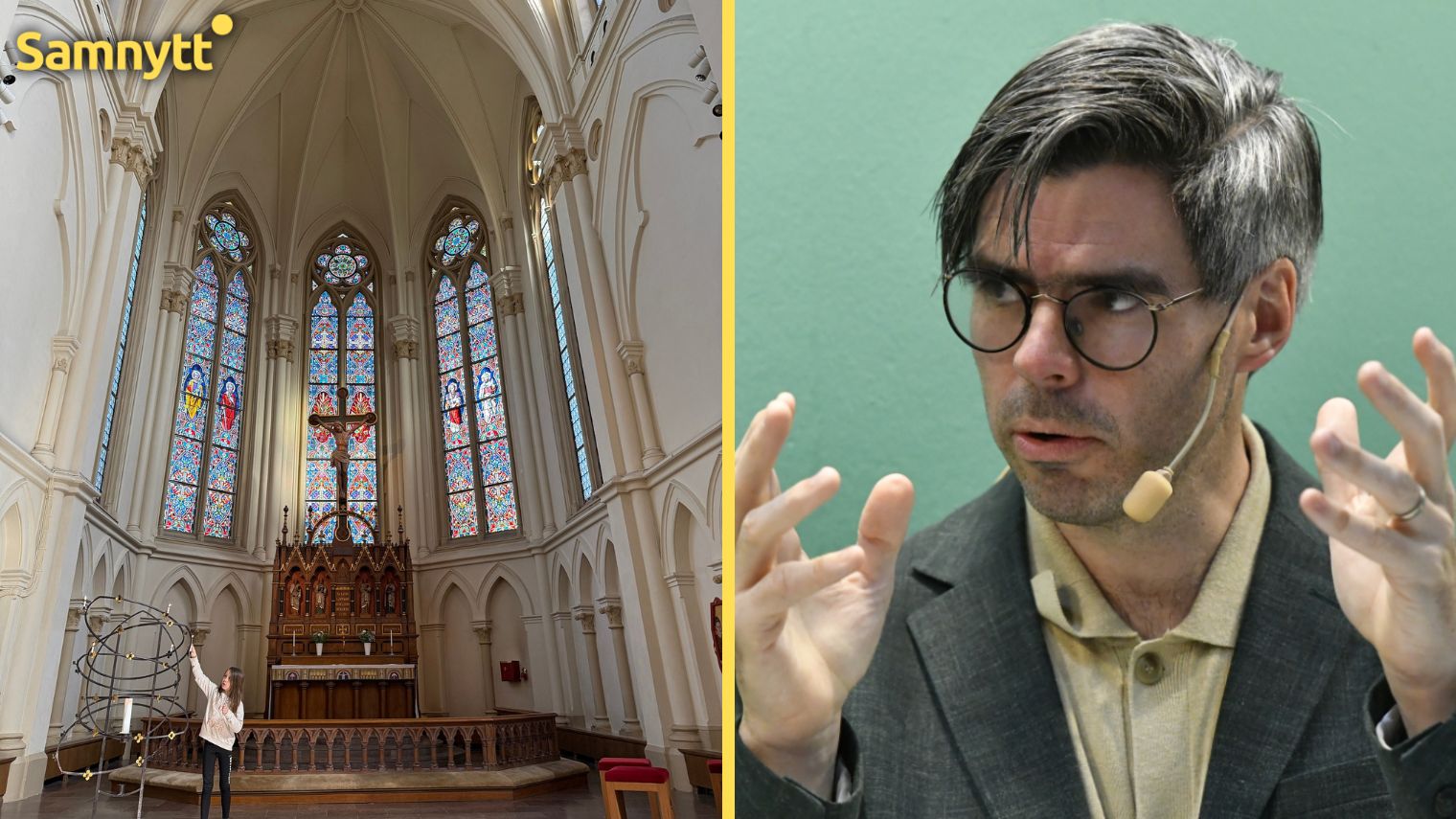
An inspirational day about migration and refugee rights was to be held at Skara Cathedral ahead of this autumn’s election, but after criticism that the event could be perceived as politically partisan, the Skara Diocese decided to cancel the day. The decision is now being criticized by one of the planned keynote speakers, professor and writer Joel Halldorf.
The event, titled “One Body – One Humanity,” was planned by the dioceses of Skara and Gothenburg and was scheduled to take place on August 30. The day was described as an “inspiration day ahead of the election.”
The program included, among other things, information on migration legislation and stories from the Restad Gård asylum accommodation. Among the participants were Skara’s bishop, Ulrica Fritzson, and Joel Halldorf, professor of church history and writer.
However, the planning sparked reactions within Skara Cathedral parish. Johan Hjertén, who recently became national chairman of Borgerlig kristen samverkan and is also chairman of the parish council, reacted mainly to the timing and the choice of Halldorf as a speaker.
READ ALSO: Christians find a home in the Orthodox Church: “The Church of Sweden feels less Christian”
“I and another person on the parish council reacted to the inclusion of Joel Halldorf, someone who is so outspoken against the Tidö parties, just two weeks before the election,” Hjertén told Kyrkans Tidning.
According to Hjertén, the diocese could have chosen another date for the event. He believes that migration is a particularly politically charged issue during an election and that Halldorf’s participation made it difficult to perceive the day as politically neutral. He also believes that Halldorf himself cannot be seen as a politically neutral person.
Frustrated
Halldorf received word before the summer that the inspiration day would be cancelled. He is critical of the decision and believes it reflects a broader change within the Church of Sweden.
“I was quite frustrated. It reflects a general trend where the Church of Sweden is afraid not to keep up with developments in society. Now that there is criticism of a generous migration policy and stronger elements of nationalism, I notice that the Church of Sweden wants to move in line with that movement,” he says.

At the same time, he opposes the idea that criticism of the government’s migration policy should automatically be considered left-wing and points out that right-wing parties have also historically held a more generous view of asylum policy.
When asked if there is a risk that the church’s involvement might be seen as supporting certain parties, Halldorf replies that the church must be able to highlight its experiences, and if people then draw political conclusions from that, “it’s up to them.”
Continued Support for Migrants
Skara Diocese has announced on its website that the day was cancelled because it was perceived as having a party-political dimension. Bishop Ulrica Fritzson emphasizes, however, that the topic of migration itself was not the issue.
“The program that had been planned was both important and relevant, but has unfortunately been linked to party-political opinion-making. And that is something we do not wish, nor should, participate in.”
Fritzson also rejects the idea that the decision means the Church of Sweden is backing away from its commitment to refugee rights.
At the same time, she draws a line between criticizing political decisions and trying to influence voters’ party choices. According to her, the church should be able to be critical of elected officials and highlight what it considers to be wrong—but not tell people how to vote.
The Gothenburg Diocese, which co-organized the event with Skara Diocese, also accepts the decision. Henrik Frykberg, diocesan officer for integration and interreligious dialogue, says the diocese respects that the day has been cancelled. At the same time, he regrets that these issues could not be discussed ahead of the election.
Who is Joel Halldorf?
Joel Halldorf is a professor of church history at Enskilda Högskolan Stockholm. He earned his PhD at Uppsala University in 2012, became an associate professor in church history in 2015, and professor in 2021. His research has covered revivalist movements, the relationship between religion and modern society, and the relationship between religion, politics, and democracy.
Halldorf is also a prominent opinion writer and commentator. He writes for the culture section of Expressen and frequently contributes to the Christian newspaper Dagen. Among other works, he has written the books Bokens folk, Gud: Jakten, and a noted biography of Pentecostal movement leader Lewi Pethrus.
In public debate, Halldorf has engaged in issues such as Christianity’s role in society, democracy, nationalism, and migration. He often argues for a Christian worldview in which the church should participate actively in public discourse.
At the same time, his political comments have made him a prominent voice in debates about the Sweden Democrats and the Tidö government’s policies. For example, Swedish Radio has described him as a church historian and Expressen writer during a debate on the Christian Democrats’ migration policy.
In 2026, Halldorf was nominated for the Stora Journalistpriset (“Great Journalism Award”) in the “Voice of the Year” category. The jury described him as someone who “with the zeal of an educator and the acuity of a professor” lifts the debate on ideas and the conversation about faith, ethics, and the contemporary era.
READ ALSO: Left Party politician wants to replace ‘he’ and ‘she’ with ‘hen’ in the Church of Sweden