Having a pet can be expensive in itself, but if your animal becomes ill or injured and needs care, the costs can add up to significant amounts. A new report confirms that prices have soared in recent years, and the Swedish Competition Authority has developed a plan on how to halt this trend.
In a new report, Sveland Pet Insurance has analyzed customer data from the past five years and reached a conclusion many pet owners have already noticed—the cost of veterinary care has increased significantly.
Previously, the Competition Authority presented a report with measures to improve price transparency within veterinary care, something Sveland Pet Insurance sees as a major step in the right direction to curb the price rally.
– The authority confirms that shortcomings in price information and comparability are so extensive that pet owners in practice lack the ability to make well-informed decisions, which in the long run threatens the security of pet ownership. To create true price transparency, clear and accessible price information is required, both digitally and in clinics, as well as national treatment guidelines to make care more uniform and comparable, says Linda Kreutz, CEO of Sveland Pet Insurance, and continues:
– These two measures are absolutely central to strengthening consumer protection and creating the predictability that pet owners in Sweden desperately need.
READ ALSO: Expensive Vet Care Gets Even Pricier
The Competition Authority highlights a historical passivity among insurance companies and presents four main measures in its investigation to strengthen consumers’ position and slow the price increase:
National treatment recommendations in veterinary care should be introduced
An industry agreement should be drawn up to improve price information on healthcare providers’ websites
Measures to improve price information for pet owners at clinics and animal hospitals
The scope of the Consumer Services Act should be expanded
Unhealthy Pricing
Over the five-year period, the cost per visit increased by a whopping 79 percent for cats, 51 percent for dogs, and 14 percent for horses. At the same time, the frequency of visits also rose, but nowhere near as steeply. Here too, cats stand out with 43 percent more visits, followed by dogs (27 percent) and horses (one percent).
– Pet owners are being forced to carry an unreasonable cost development. That we visit veterinarians more frequently is largely due to changing behavior and increased concern for our animals. But the price explosion cannot solely be explained by that, or by the development in veterinary care. It’s a matter of unhealthy pricing, says Linda Kreutz.

The skyrocketing costs are clearly noticeable among the population, whether one owns pets or not. 61 percent of respondents in a survey conducted by Verian on behalf of Sveland agree that the costs for veterinary care have increased in recent years. At the same time, nine out of ten agree with the statement that cats and dogs are family members.
Another conclusion in the report is that people seek care even for minor symptoms, fearing the condition might worsen.
Avoiding Unnecessary Medical Costs
At the same time, it is not when complicated diagnoses are made that costs shoot up, but rather when common incidents escalate, such as when a dog eats something it shouldn’t and requires emergency surgery and intensive care.
A full 87 percent say they have avoided unnecessary medical expenses, while 45 percent have managed to care for their animal at home after receiving advice.
– People seek care because it is perceived as the only route to advice and reassurance. Better to go one time too many than to miss something serious. But this paradoxically drives the development further. As an industry, we must guide toward the right interventions, create sustainable pricing, and increase price transparency. Love for the animal should not have to be weighed against one’s wallet, says Linda Kreutz.
Expensive Bills
The most expensive average costs per treatment occasion for cats are foreign body in the stomach/intestine SEK 39,000, urinary blockage SEK 35,000, and dystocia SEK 33,000. For dogs, foreign body in the stomach/intestine SEK 43,000, pyometra SEK 37,000, and dystocia SEK 36,000.
The absolutely most expensive bills for cats come with diagnoses such as thoracic cavity infection SEK 180,000, nephritis SEK 151,000, and low blood platelets SEK 137,000. The corresponding for dogs are traumatic liver rupture SEK 205,000, lung collapse SEK 181,000, and heart valve infection SEK 174,000.
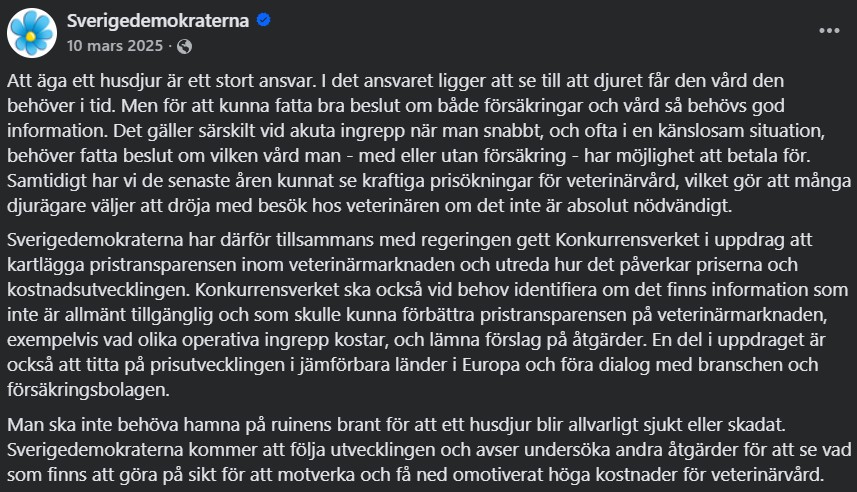
High veterinary costs are an issue that the Sweden Democrats have taken to heart: