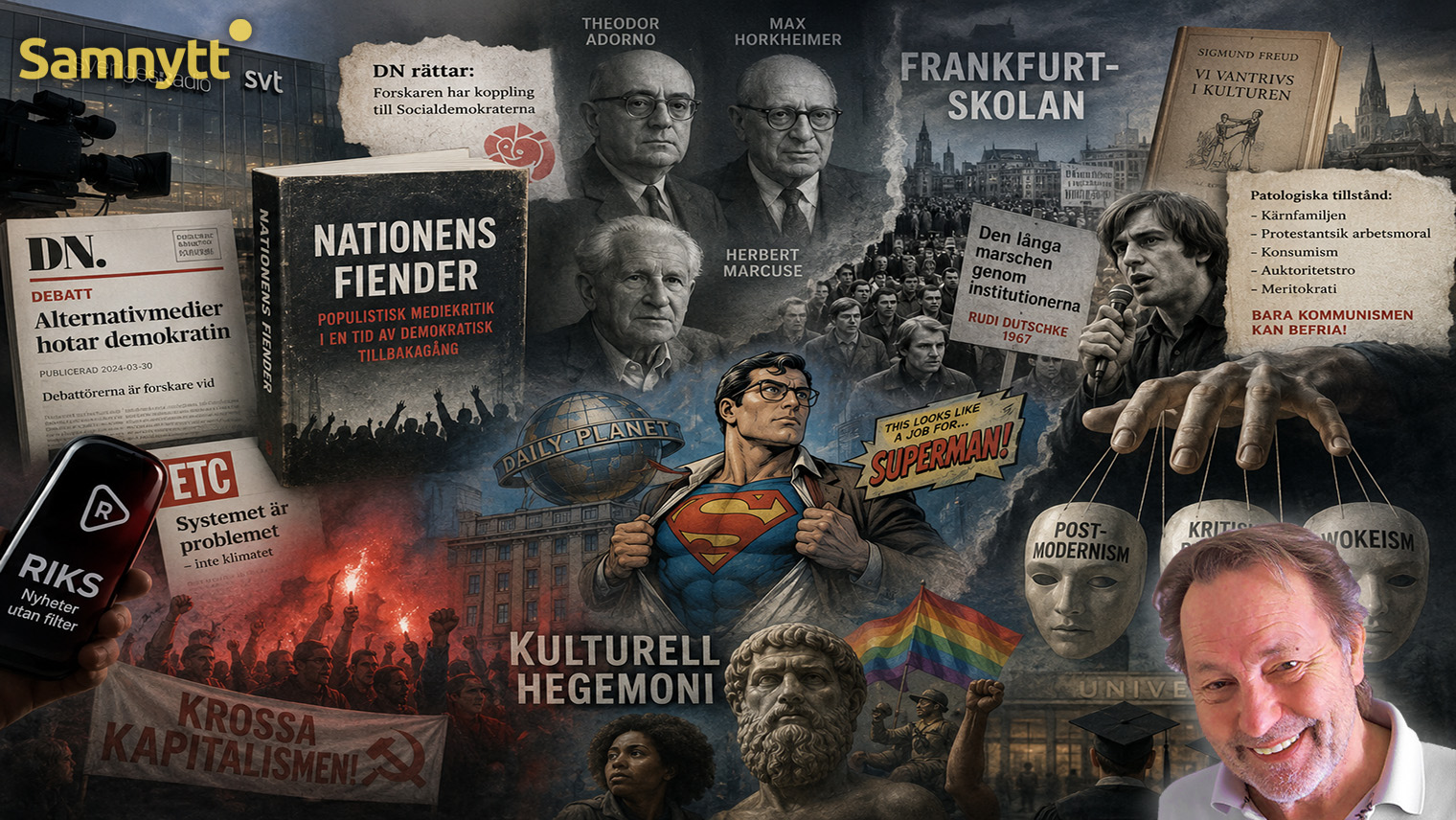
DEBATE • All too often in the news flow, one hears that alternative media pose a growing threat to democracy. On Dagens Nyheter’s debate page, two ‘researchers’ get to promote their new book ‘Nationens fiender (Populist Media Criticism in a Time of Democratic Decline)’ in which alternative media is accused of spreading lies and contempt for knowledge, especially in questions of immigration and environmental policy. Only so-called ‘right-wing media,’ however, are criticized. Openly communist-supporting newspapers such as ETC, Flamman and Proletären fly under the radar, despite the fact that the ideology of Marxism in practice has always led to dictatorship.
However, it turned out that one of the researchers was affiliated with the Social Democrats, which, ironically enough, was revealed by the alternative media channel Riks, after which DN had to issue a correction. In the book, they cite a research report claiming that the criticism that Swedish news media would be unreliable or politically biased is completely unfounded, and that Public Service is entirely impartial. This is despite DN openly stating its pursuit of political agenda journalism and the fact that 75 percent of those employed at SR and SVT are left-wing sympathizers.
Furthermore, these two (partisan?) media researchers argue that criticism of MSM undermines trust in facts, knowledge, and expertise, and that people are misled into thinking facts are merely one of many opinions. Here we approach the real ironic core, since the later offshoots of Marxism, such as postmodernism, critical race theory and wokeism, are leftist movements that, through rhetorical tricks and demagogy, precisely claim that objective truths do not exist because everything is subjective, thereby reducing facts to merely opinions. In psychology, this behavior exhibited by the above researchers is called projection—accusing others of their own faults and shortcomings.
Infiltration instead of revolution—struggle instead of unity
When Marxism’s ideology was to be practiced in industrialized Western countries, most of the working class that was supposed to revolt were not interested in revolting. They were too well off and thus had been ‘bought’ by the capital, thought many hardcore Marxists, and so they began sketching out another strategy to crush capitalism.
The bourgeois cultural hegemony needed to be broken and a working-class culture created to clear the way for a socialist society by infiltrating culture-spreading media, or as the later revolutionary Rudi Dutschke put it in 1967: ‘The long march through the institutions.’ Inspired as he was by Antonio Gramsci, who coined the term ‘cultural hegemony,’ and by the Chinese Communists’ long struggle. Half of the ’68 left heeded Dutschke’s call and went to teacher, journalist, or social worker schools in order to get jobs in media, education, or at the National Board of Health and Welfare.
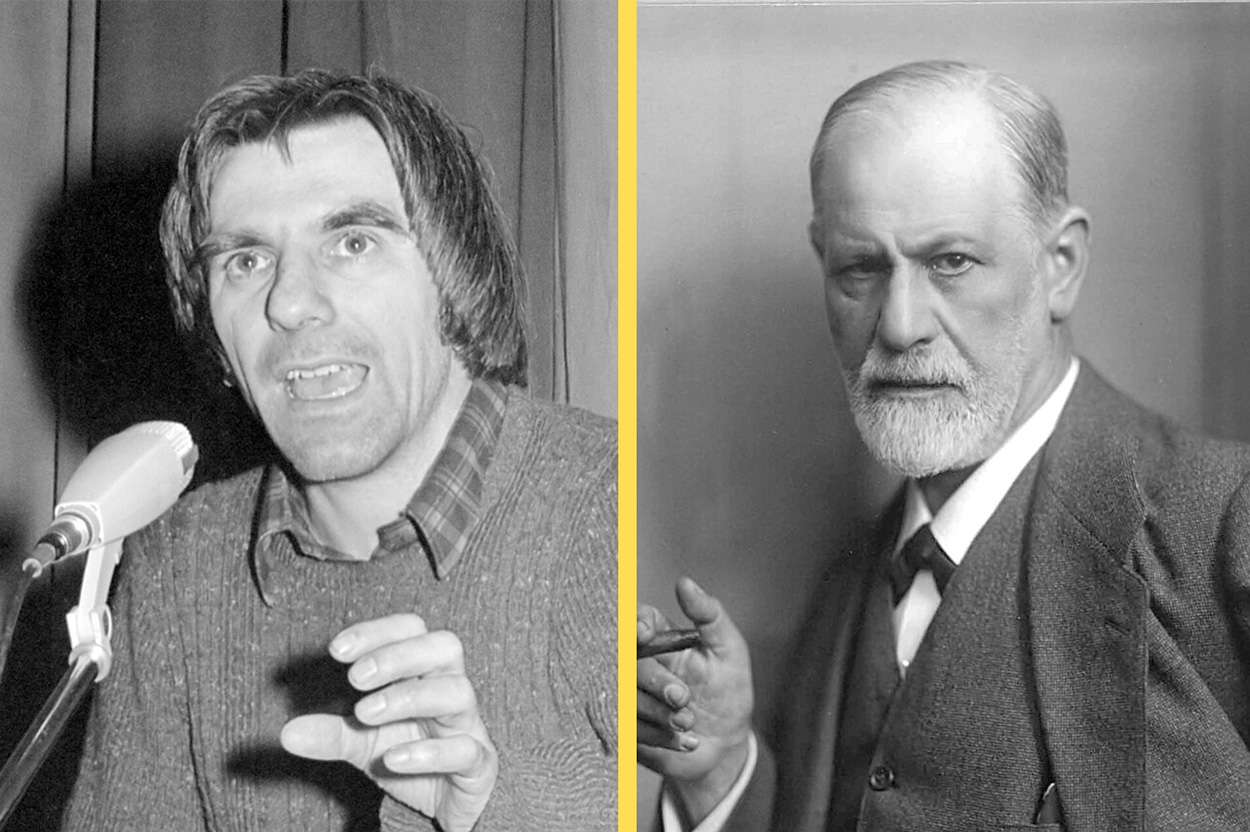
The First World War became a disappointment for the Marxists. The call: ‘Workers of the World, Unite’ received little response because patriotism and national feeling led the proletarians to fight each other rather than unite and revolt. Many theoretical Marxists were perplexed that Marx’s prophecies had not come true. The newly founded (1923) ‘Institute for Social Research’ in Frankfurt concluded that the western ‘bourgeois’ culture had seduced the working class, which did not realize it was being exploited and oppressed. The Frankfurt School was influenced by Freud’s book ‘Civilization and Its Discontents’ and merged psychiatry with Marxism, thereby being able to declare the bourgeois society as mentally ill.
The nuclear family, Protestant work ethic, consumerism, respect for authority, and meritocracy were all pathological states that could only be cured with the liberation of communism. After Hitler’s rise to power, the men of the Frankfurt School had to hastily leave for the USA, since the majority of members were Jews, and they were welcomed at Columbia University in New York. Once there, they became even more radicalized as they experienced America’s popular culture and mass consumption as vulgar and depraved.
Anti-Semitism, name changes, and superheroes
The anti-Semitism from which they had fled was ever-present even in the United States, where Jews were not welcome at certain private schools, resort hotels, exclusive clubs, golf courses, and more, and were also discriminated against in the job market. To assimilate more easily, many Jews Americanized or changed their names: Israel Beilin became Irving Berlin, Issur Danielovitch became Kirk Douglas, Allan Königsberg became Woody Allen, Bernard Schwartz became Tony Curtis, etc.
This is ironically illustrated (pun intended) in comic book form—one of the Frankfurt School’s hated objects—when the creators of the first modern superhero have their central figure get a job in the media (The Daily Planet) using an alias. We are of course talking about Superman, who debuted in Action Comics in 1938, created by two young Jewish guys, Jerry Siegel and Joe Shuster. Clark Kent’s real name is Kal-El and he is an alien from the planet Krypton, sent here as an ‘anchor child’ when his home planet faced destruction.

When Abraham’s people (the Israelites?) migrated to the ‘Promised Land,’ it was inhabited by Phoenicians and Canaanites whose chief god was named El. The migrants adopted this deity and called him Elohim. Traces of the god El can be seen in many Jewish names such as Michael, Daniel, and Gabriel, and of course also in the nation name Israel.
This is probably the reason why Kal-El and his father Jor-El are named as they are, and perhaps the reason—considering the anti-Semitism from white Protestants (WASPs) in the USA—that Superman’s arch enemy is named Lex Luthor, which after all becomes Luther’s Law. Who knows?
Marxism becomes postmodern
In any case, the Frankfurt School’s ideas had a great impact among Western intellectuals, including at universities. The French, who hold the world record for bad ideas, came up with postmodernism, which is a continuation of the Marxist thoughts propounded by Lukács and Gramsci. Derrida, Lyotard, and Foucault are almost deliberately intellectually dense in their critique of the Enlightenment and science in general, these linguistic gymnasts questioning all so-called objective truths, arguing that all is just subjective experience, which ultimately means there is no objectivity. Everything, according to them, is about power—with oppressors and oppressed.
Most of the Frankfurt School’s members, such as Adorno and Horkheimer, returned to Germany after the war, but some remained in the USA, e.g. Herbert Marcuse and Erich Fromm. The former became the ‘new left’s’ figurehead during the sixties, and one could say that his ideas of free love and condemnation of capitalist consumerism paved the way for the hippie movement, which started out promisingly with the creative potential of drug romanticism, including lots of groundbreaking music and lyrics, but for many ended in addiction and untimely death.
It could be said that the ‘critical theory’ that was the Frankfurt School’s core has today, as I mentioned above, gained new life precisely through the questioning of all general truths as a recurring theme. Gender and race are said to be nothing but social constructs. White people as a ‘race’ (which supposedly does not exist?) are all congenital racists. Mathematics is also said to be racist for not taking into account that not all ethnicities believe that 2 plus 2 is 4—we must accept that the sum can also be 5, and so forth. But when the right questions something, it is, paradoxically enough, ‘fact-resistant.’
The destructive sophistry
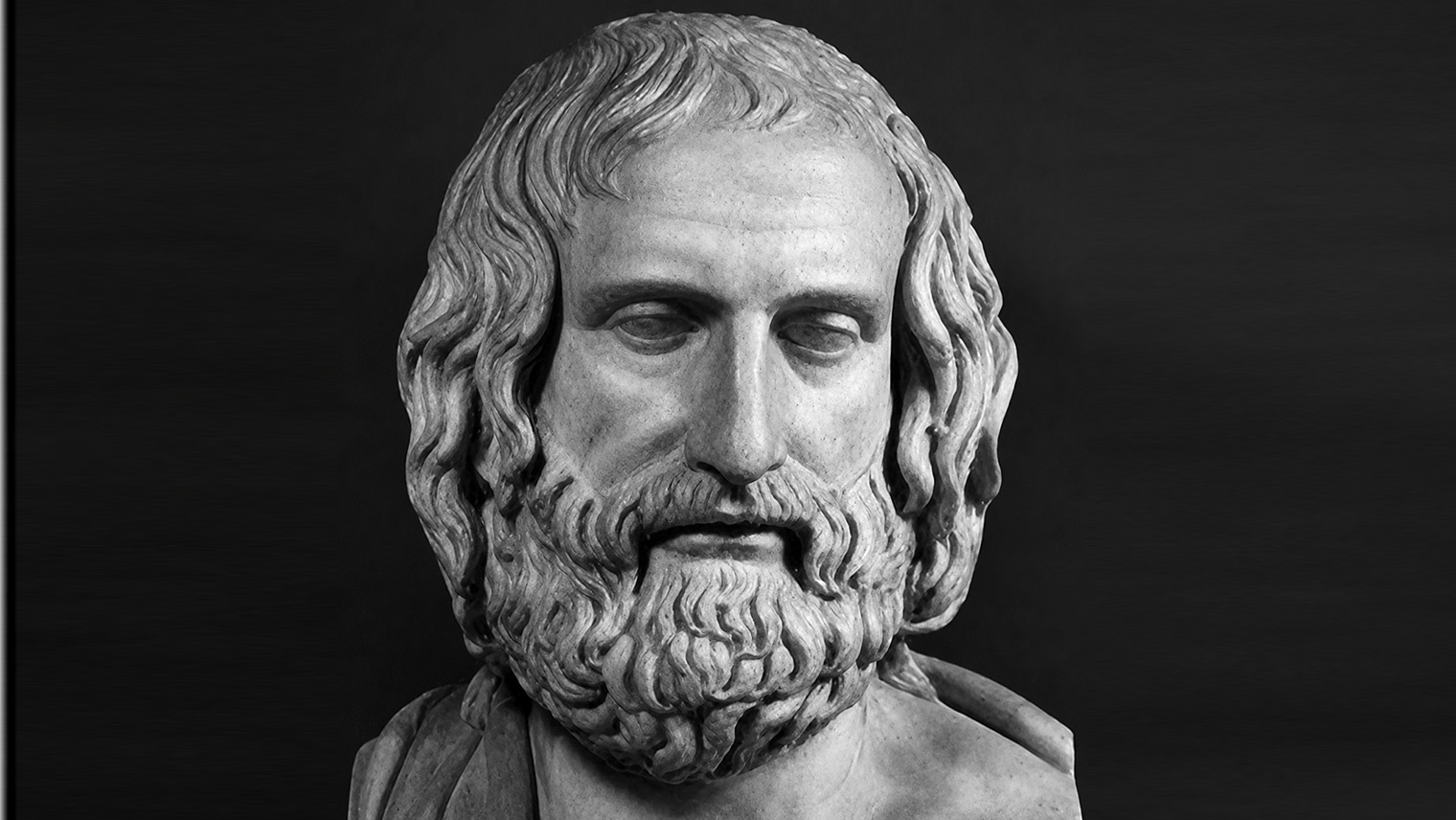
There is an English word for what the linguistic jugglers of postmodernism are up to. The word sophistry quite well describes reasoning that on the surface sounds reasonable and plausible, yet in practice is poorly grounded in reality but easy to be seduced by theoretically. The word comes from Greek and describes a movement that arose around 500 BC, where the intellectual sophists used rhetoric to show that even obviously false statements could be proven. The goal was to win the debate at all costs, including seeking truth or the best outcome.
This is said to have affected democracy in Athens, causing poor decisions on, for example, certain acts of war that proved catastrophic, such as the attack on Syracuse in Sicily, where 200 ships and thousands of soldiers were lost. Protagoras was the sophist who maintained that there were no objective truths—all is relative; you decide for yourself what is true. The sophists were such skilled rhetoricians that they undermined the basic principles of democratic rule, which often led to irrational decisions being voted through. This was one reason for the eventual end of Athenian democracy.
Are we in the same situation now, one might ask. Do democratically elected politicians make poorly thought-out decisions that tick all the boxes for the politically correct manual’s doctrine: Diversity, equity, and inclusion (DEI)? Marxism’s dream of a classless society nowadays mainly means diversity as the coexistence of various ethnic and cultural groups, not a diversity of different ideas. The corridor of opinion is very narrow. Justice in principle now means the abolition of meritocracy—all are of equal worth, which means that everyone must be included, regardless of suitability, knowledge, or intelligence.
Social engineering at odds with human nature
Failing to take human nature into account, and instead believing that social engineering will magically remake humanity, inevitably leads one’s thoughts to Stalin’s favorite biologist Trofim Lysenko, who, contrary to evolution, believed that acquired traits could be inherited and that, over generations, the perfected communist citizen could be bred. Needless to say, this did not happen; Russians remained Russians, proving that you cannot plan and build a society where the goal is a totally unrealistic utopia, à la The Truman Show.
Today in Sweden, it looks as if non-European votes in upcoming parliamentary elections will be decisive for a red-green rule with the Social Democrats, Green Party, Centre Party, and even the Left Party (?). Securing takeover of power in this way through so-called ‘voting cattle’ is democratically questionable, and also in the long run, a financial disaster, as many of these ethnic groups largely live on benefits and of course vote for parties that promise guaranteed future support.
Trust, which is the basis for democracy and the social contract to be maintained, is weakened or nonexistent in multicultural and multi-ethnic countries. Even trust among ethnic Swedes is said to decline in a multicultural society according to Harvard professor and political scientist Robert Putnam, who in his two books on ‘social capital’: ‘Making democracy work’ and ‘Bowling alone’ concludes that the trust between people—which took a long time to build and also nourishes social and political engagement—can quickly be destroyed in the wake of destructive multiculturalism.
Islam and neo-Marxism: the real threat to democracy
The biggest threat to democracy mainly comes from neither MSM nor alternative media. It comes from groups who are opponents of democracy such as the rapidly growing mass of Muslims in Sweden as well as domestic neo-Marxists, whose goal is, and always has been, to crush capitalism and establish the dictatorship of the proletariat.
An additional, and perhaps even greater, threat against democracy is that the average IQ tends to decrease with too much immigration from countries with considerably lower general cognitive capacity. Should Sweden in the not too distant future end up with an average intelligence level around 90 IQ points, there is a high risk that democracy will fail, since no country with such a low average appears capable of democratic rule.